Where is the Lord?

Where is the Lord? Has He forsaken us? Why isn’t He acting? I know these are questions each of you have asked at one point or another because they are questions I have asked too. You might even be asking these questions now, especially given the difficult days in which we find ourselves.

At the core of these questions is the idea that God is distant because He has not immediately delivered you from the difficulty you are experiencing at the moment. But does a lack of immediate deliverance mean God is not there? That He is distant and doesn’t care?

The Exodus

The Exodus serves as the primary motif of deliverance in God’s Word. The Exodus is a powerful deliverance motif because God delivers His people out of the hands of the powerful Egyptians, releasing them from bondage and slavery so that they might serve and worship Him as His own people.

What, however, is remarkable about the Exodus is that God did not act instantaneously nor did He act unilaterally. Look at the text with me:

Then the Lord said, “I have surely seen the affliction of my people who are in Egypt and have heard their cry because of their taskmasters. I know their sufferings, and I have come down to deliver them out of the hand of the Egyptians and to bring them up out of that land to a good and broad land, a land flowing with milk and honey, to the place of the Canaanites, the Hittites, the Amorites, the Perizzites, the Hivites, and the Jebusites. And now, behold, the cry of the people of Israel has come to me, and I have also seen the oppression with which the Egyptians oppress them. Come, I will send you to Pharaoh that you may bring my people, the children of Israel, out of Egypt.” But Moses said to God, “Who am I that I should go to Pharaoh and bring the children of Israel out of Egypt?” He said, “But I will be with you, and this shall be the sign for you, that I have sent you: when you have brought the people out of Egypt, you shall serve God on this mountain.

(Exodus 3:7–12)

Notice, God tells Moses He has seen the affliction of the people in Egypt. He has heard their cries for help (vs 7). Seeing and hearing God has come down to deliver His people and to bring them to a favorable land (vs 8). But notice in verse 10 how He is going to deliver the Israelites:

Come, I will send you to Pharaoh that you may bring my people, the children of Israel, out of Egypt.”

(Exodus 3:10)

I will send “you”

Who is the “you”? It is Moses. God is going to send Moses to Egypt to deliver “my people”. Certainly, God is not sending Moses alone. Instead, God promises in verse 12 that He will be with him as he seeks to deliver Israel. What follows in the narrative is exactly that — God rescues the Israelites from Egyptian bondage through the work of Moses.

God could have act miraculously and unilaterally, rescuing the Israelites in a matter of seconds from the Egyptians. He could have transported them to the wilderness to worship Him. He could have killed all the Egyptians right then and there allowing the Israelites to walk out of Egypt at a leisurely pace. He could have intervened in a number of ways to rescue Israel, but He chose to send Moses to rescue His people.

To be sure, Moses did not deliver Israel by his hand alone. If you have read the Exodus story in full, you know Moses was not alone. God was there and He worked in miraculous ways. But God worked through Moses’ interactions with Pharaoh and the people.

God’s primary means of rescue

At times, God does perform miracles and He does instantaneously rescue those who are suffering, but what we see in the Exodus event and in other events throughout redemptive history is that God primarily works over a period of time and through those He has commissioned on His behalf.

Our God is a commissioning God

He commissioned Adam, Noah, Abraham, Moses, Joseph, David, etc to work and speak on His behalf. He has even commissioned us, Christians, in the Great Commission (Matt. 28). We are to tell others the good news in order to rescue mankind from slavery and bondage.

Our God is a commissioning God who primarily works through His people to rescue, discipline, encourage, bless, mend, uphold, etc.

The next time you are tempted to ask: Where is God in all this? Why is He silent? Why isn’t He working? Look around at the people God has recently brought into your life. Think about the conversations you have had with others.

God is present, He is not silent, and He is at work. Even though it might feel like it at times, God has not abandoned you. He is just not working in the way in which you think He should. Instead of working miraculously and unilaterally, God primarily works through the community of people with whom you are associated.
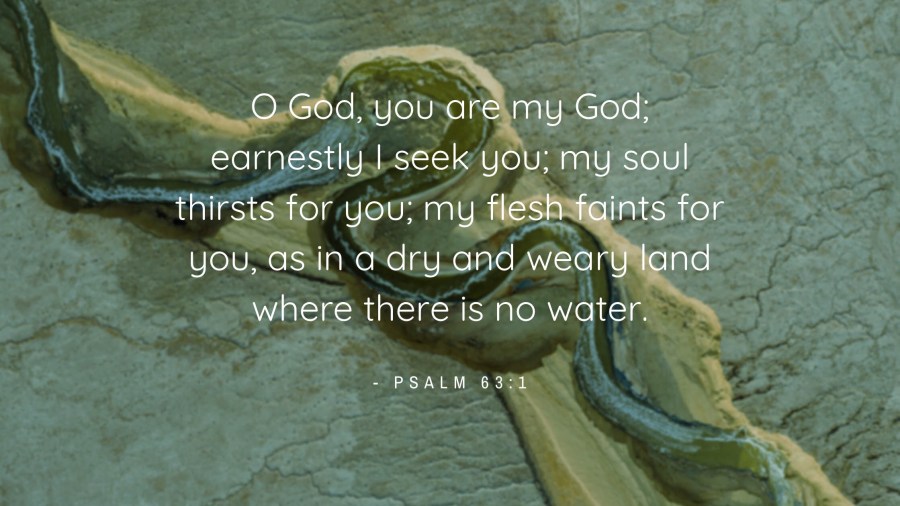
The praiseworthy steadfast love of the Lord

Running from Absalom, David finds himself in the wilderness thirsty and in fear for his life. Even though David knows God has the ability to immediately change the situation, he turns to the Lord, seeking Him in earnest. His soul thirsts for him as he thirsts for water.

Why does David thirst for the Lord is such difficult times, especially knowing God’s sovereign hand can change his situation in a moments notice?

Later in the Psalm, David reflects on the Lord’s steadfast love. He says,

“because your steadfast love is better than life, my lips will praise you.”

Psalm 63:3

God’s steadfast love “refers to [his] special commitment to the people with whom he has gladly bound himself in an unbreakable covenant bond” (Ortland, Gently and Lowly, 149). It is God’s steadfast love that causes David to seek the Lord and trust that He will rescue him from his situation. He knows the Lord will not forsake or withdraw His love from him no matter the situation he faces or the sins he commits against the Lord.

Prior to this episode with Absalom (2 Samuel 16), David sins against Bathsheba and ultimately the Lord (see Psalm 51). But God doesn’t reject him. He doesn’t cast him out. He doesn’t annul his covenant with David due his sin and rebellion against Him. Instead, He sends Nathan the prophet to call David back to Himself (2 Samuel 12).

God’s steadfast love draws David in, it captivates him. Reflecting on God’s steadfast love causes David to thirsts for the Lord, his “soul clings to [Him]” (vs 8a). He is satisfied by the Lord alone (vs 5).

In the same way that David is drawn to the Lord, we should be drawn to the Lord. His steadfast love should captivate us and draw us in too.

Despite our consistent rebellion, God remains faithful. He doesn’t cast us off, instead He seeks us out. He sends people into our life to call us back to Himself when we sin. He provides encouraging voices so that we keep pressing on. He reminds us, through the work of the Spirit, of His steadfast love. A love that is greater than riches, status, comfort, power, and even life itself (vs 3).

God is there both when we are running from Him and towards Him. His steadfast love never ceases.

What an amazing God we serve! A God worthy of worship and praise for His steadfast love endures forever!

What can God do through you?

I’ve been reading the book of Ephesians devotionally for the last few weeks, slowly working my way through the text in study and prayer. The practice of intentional meditation has fostered a deeper level of praise and worship for what God has done for us in Christ.

This morning I finished reading Ephesians chapter 3, specifically verses 20 and 21,

Now to him who is able to do far more abundantly than all that we ask or think, according to the power at work within us, to him be glory in the church and in Christ Jesus throughout all generations, forever and ever. Amen.” (Eph 3:20–21)

Context

Contextually, Paul has in mind the power of the Holy Spirit to unify both Gentile and Jew in Christ, so that they become one new humanity (Eph 2:15-16). Imagine that, a people who are completely and utterly opposed to and different from one another brought together in harmony and unity, so that they are loving and serving one another. Only God can unify in that way. Only God can break down those barriers.

One new humanity at the foot of the cross

God creates one new humanity at the foot of the cross. We are all sinners who are in need of salvation from God’s wrath (Eph 1 and 2). Those who are Christian (followers of Jesus) have been saved in exactly the same way, through the spilled blood of Jesus and the work of the Holy Spirit in our life who causes us to recognize our need for a Savior and to believe that Jesus is our Savior (Eph 2).

Seeing God work in and through opposing humanity to create one unified group that loves and cares for one another in ways unimaginable causes Paul to break out in praise as he closes chapter 3 with a doxology.

God can and will do far more than we can imagine

Just as God is able to reconcile two opposing groups to Himself and one another, God is also able to do in and through us far more than we could ever imagine. He reconciles us with people who are different, creating a new bond between us and others of different cultures, races, and nationalities, so we will work together for His glory.

Not only will God create bonds where there were divisions, but God will also do in and through us far more than we could ever ask or think. Our God is a powerful God and He will use us in powerful and mighty ways. Ways that will ultimately bring Him glory.

What can God do through you?

He can do the imaginable. Not for your glory, but for His.

Question for Reflection

  1. How has God used you for His glory?

What should we think of God’s command to destroy an entire nation?

In The God Delusion Richard Dawkins says,

“The God of the Old Testament is arguably the most unpleasant character in all fiction: jealous and proud of it; a petty, unjust, unforgiving control-freak; a vindictive, bloodthirsty ethnic cleanser; a misogynistic, homophobic, racist, infanticidal, genocidal, filicidal, pestilential, megalomaniacal, sadomasochistic, capriciously malevolent bully.”

But is this true? Is God who Dawkins makes Him out to be? In order to understand where Dawkins is coming from, we need to look at what the Bible says. One of the events to which he might be referring is God’s command to destroy the Amalekites.

Destroy the Amalekites

The nation of Israel first encountered the Amalekites when they were wandering around in the desert. They were at a place called Rephidim and the Amalekites attacked them. This was the battle where God had Moses hold his hands up. When his hands were up, the Israelites would prevail, but when they went down, the Amalekites would prevail. Ultimately, with the help of Aaron and Hur holding up his hands, the Amalekites were defeated (Ex 17:8-13).

After the battle was over, God promised that one day He would destroy the Amalekites. In Exodus 17:14 God said to Moses,

““Write this as a memorial in a book and recite it in the ears of Joshua, that I will utterly blot out the memory of Amalek from under heaven.”” (Ex 17:14)

By the time we get to 1 Samuel 15, God was ready to make good on that promise.

“…“The Lord sent me to anoint you king over his people Israel; now therefore listen to the words of the Lord. Thus says the Lord of hosts, ‘I have noted what Amalek did to Israel in opposing them on the way when they came up out of Egypt. Now go and strike Amalek and devote to destruction all that they have. Do not spare them, but kill both man and woman, child and infant, ox and sheep, camel and donkey.’ ”” (1 Sa 15:1–3)

When we read this, we might think that is a bit extreme. Some, like Dawkins, may even go so far as to call God an unjust Tyrant for not only destroying the military, but the whole nation — women, children, and cattle. Every last thing was to be destroyed.

What should we think of God’s command to destroy the entire nation?

As we think through God’s command, we need to keep several things in mind.

(1) We don’t deserve God’s mercy.

You see, we are all sinners. Paul confirms this when he says in Romans 3:23,

“for all have sinned and fall short of the glory of God,” (Ro 3:23)

When we talk about sin, what we are actually talking about is us living in rebellion to God. Rebellion means that we reject God’s way of doing things for our own way of doing things.

All those who live in rebellion against God are sinners who deserve God’s punishment. Paul makes this clear in Romans 6:23 when he says…

“…the wages of sin is death…” (Ro 6:23)

In other words, the payment we deserve for our sin is eternal punishment.

What these verses tell us, then, is that we don’t deserve salvation. Instead, we deserve condemnation. But, and this is a very big beneficial but, because our God is merciful, He doesn’t always give us what we deserve. Instead, God gives us what we don’t deserve. He gives us salvation from sin, death, and ultimately His punishment. Everyone who calls themselves a Christian has experienced God’s mercy and grace because we are all getting what we don’t deserve.

(2) God is a patient with us 

One of the reasons we experience God’s mercy is because He is patient with us. If God wanted, He could have destroyed us the moment we took our first breath. That’s because we are born sinners. No one is innocent. Honestly, God could destroy us the moment our life begins and still be just. God’s holy and His holiness requires Him to deal with sin. In destroying us, we would be dealing with our sin. Thankfully, God doesn’t destroy us the moment we are born, and He doesn’t because He’s patient.

God’s patience explains why those in Israel’s day were allowed to live. While God was determined to destroy the Amalekites and the other nations Israel encountered in the land of Canaan — the Promised Land — he didn’t destroy them right away. For hundreds of years, He allowed them to chase after other gods, commit injustices, and live by their own wisdom. It wasn’t until the cup of God’s wrath was full that He used Israel as His instrument to destroy them.

(3) God uses others to execute His punishment

That’s what we see in 1 Samuel 15. God uses Israel as His instrument to not only punish the Amalekites, but also the Canaanites, and all the other nations in the Promised Land who deserved His wrath.

The Patient Daming of God’s Wrath

John MacArthur, in his sermon The Wrath of God, uses an illustration from Barnhouse to explain God’s patience, His wrath, and ultimately His offer of salvation in Christ. He says,

In His eternal foreknowledge, God the Father foresaw all of the sin that would be committed after the time of Christ, your sin and my sin, and He stored His wrath against it behind the dam of His patience.  And the wrath of God against sin that even today has not yet been committed is also stored up waiting for the day when His patience shall burst into its holy end.  “For thousands of years, that dam has held and God has held back His wrath.  Occasionally throughout human history He stooped to dip His hand into the pent up flood and pour a few drops of wrath on some especially vicious outbreak of rebellion.  But for the most part, God seemed to overlook the sins of man in the centuries before the cross.  It looked maybe as if sin was tolerated, but it was just piling up.”

You know, the dam broke one day, and it broke at Calvary.  And it broke on Christ and drowned Him in all the sea of sin.  And it will break again, and it will drown all those men who are not in Christ.  Christ took the judgment for those who believe.  For those who do not believe, they will take their own judgment.  And the wrath of God awaits them.  Because they hold the truth, no matter what they claim, but they hold it, and suppress it because of their sin.

So we see that God isn’t an unjust Tyrant. Instead, He’s a patient, merciful, and gracious God, who eventually gives us what we deserve, if we don’t repent and turn to Christ.

Question for Reflection

  1. Do you believe God is an unjust Tyrant or a patient and merciful heavenly Father who gives us what we don’t deserve?

Resources

Post adapted from my sermon Portraits of Israel – Saul

Image

3 Things Those Created in God’s Image Should be Doing Daily

In Genesis 1:26, we are let in on a conversation that took place between the members of the Trinity.

Then God said, ‘Let us make man in our image, after our likeness.” (Gen. 1:26a)

If you think about it, this is an amazing text because it tells us that we were actually designed and created by God. He actually thought about us, planned out what we would be like, and then He created us. When He created us, He didn’t create us like the other animals. No, we are distinct from all other living things because we are created in God’s image, in His likeness.

As creatures created in His likeness, there are several things we should be doing.

3 Things Those Created in God’s Image Should be Doing

(1) We are to reflect His image and likeness to the world. 

In other words, we are to shine forth God’s characteristics to the world. Love, faithfulness, justice, wisdom, and more should characterize our lives, just as it characterizes God’s.

(2) We are to act as His representatives. 

If you have ever traveled to another country, you know that the American Embassy can come in handy, especially if you lose your passport or get into trouble in another country.

While embassies and the ambassadors posted there can come in handy for travelers, they aren’t just there to assist travelers to the region. They have a much more important job of representing the US and its interests, while at the same time working to gain and maintain diplomatic relationships with the foreign government.

Just as the US and other countries appoint ambassadors, God has appointed us as His ambassadors or representatives on this earth. To that end, Paul in 2 Corinthians 5:20 says,

“Therefore, we are ambassadors for Christ, God making his appeal through us. We implore you on behalf of Christ, be reconciled to God.” (2 Co 5:20)

As His ambassadors, we are to carry His message of redemption and reconciliation to the world.

(3) We are to exercise dominion, working to bring order and beauty to God’s creation.

Along with carrying His message of redemption and reconciliation to the world, as His representatives, we are also to exercise dominion over the earth (Gen. 1:28-30).  He gives us that right so that we might bring order and beauty out of chaos.

We can bring order and beauty out of chaos in many different ways.

  • By keeping our yards, tending the garden, or working the farm, we are bringing order and beauty out of chaos.
  • By creating technologies such as airplanes, cars, and computers, we are bringing order and beauty out of chaos.
  • By planning and developing neighborhoods and cities, we bring order and beauty out of chaos.
  • By loving our neighbor, caring for the sick and poor, and leading our families in a godly way, we are bringing order and beauty out of chaos.
  • By evangelizing, along with preaching and teaching God’s Word, we are bringing order and beauty out of chaos.
  • We also bring order and beauty out of chaos when we work for the shalom of the city (Jeremiah 29:7).

In all these ways and more we can push back the chaos and bring order and beauty to this world.

While there are other things that we are to as those created in God’s image, these are three that we can do each and every day.

Question for Reflection

  1. Do you find yourself working to do these three things?

Resources

Post developed from my sermon: Creation and Kingdom

11 Characteristics of the Self-Righteous

Self-righteousness is rampant in our churches. Pews are packed every week with Pharisees, who think they are doing everything right. Scripture, however, paints a woefully different picture. Far from thinking, we have arrived or that we are superior to others, we should see a need for and dependence on the righteousness of Christ.

Instead of raising our spiritual noses at those struggling with sin, we should humbly bow before the Savior knowing we too are sinners saved by God’s grace. Instead of thinking of ourselves as self-righteous, we should thank and praise God for sending His Son to die for our sin.

Even though we should humble ourselves before our Savior, we often don’t. We have a tendency to act like we are the ones who make ourselves righteous by our own efforts, instead of relying on Christ’s work. When we rely on our own efforts we acting self-righteous. We can fall into self-righteousness without even knowing it.

In an effort to keep us out of the trap and create self-awareness here are 11 characteristics of the self-righteous adapted from Paul Tripp’s book, Dangerous Calling.

11 Characteristics of The Self-Righteous

1. They do not see their walk with God as a community project.

2. They do not work well with others.

3. They consistently believe they are right and know best.

4. They are resistant to change.

5. They do not respond well when reminded they need to change.

6. They do not desire others exhortation or admonition, even getting angry at times.

7. They are not patient with those who mess up, struggle with sin or have lost their way.

8. They do not deal well with opposition or accusations.

9. They will consistently wonder why God has singled them out for difficulty.

10. They do not see a need to admit or confess their sin.

11. They consistently point out the sin of others with an air of superiority.

Question for Reflection

  1. Do your actions or attitudes reflect any of these characteristics?

Resources

Characteristics in post adapted from Paul Tripp, Dangerous Calling, 73-74.

Image