Leadership Through Daily Scripture Reading

Have you ever wondered why reading through the Bible every year is important? Have you ever wondered why leaders in churches consistently talk about reading your Bible everyday? Have you ever thought about how your Bible comes to bear on the leadership of your family, small group, or even church?

Leadership Through Personal Scripture Reading

Bible reading plans are a dime a dozen, with each one offering you a different way to read through the Bible. However, before we throw our latest plan off to the side, I want us to think through the importance of our daily Bible reading for our leadership. I am not just talking about leadership at a vocational pastor level, but at all levels because we are all called to be leaders/shepherds, whether that be in our homes, our small groups, or over a local congregation.

Personal Confession

I often find myself reading Scripture in order to gain knowledge. I want to know who the kings were at the time of Isaiah’s prophesy, how many times Jesus told His disciples He was going to die without them understanding what He was telling them, or what churches Paul started on his 1st missionary journey. In doing so, I often fail to see how the text comes to bear on my life in particular.

Reading Scripture for Personal Growth, not Just Knowledge

In saying that, I am not saying we should not understand the facts and broad movements of Scripture. Those things are necessary and very important if we are to understand what God is communicating to us, but we must not stop there. We must dig deeper into each text we are reading in order to understand how the text comes to bear on our lives. In other words, our reading of the text is not complete if we just have the facts, we need to understand what the particular text is teaching us about God (His character or what He has done for us) and about mankind.

Once we understand what the text is saying about God and about mankind, we need to probe our own lives to see if we are dealing with the same sins mentioned in the text. As we make that a daily practice, we will begin to understand what Scriptures speak to different issues we are dealing with, as well as we will begin to root sin out of our lives. When we understand what Scriptures speak to particular issues/sins in our lives, we can then determine what others around us are struggling with. But not only will we know what they are struggling with, we will know what Scriptures will help them in their struggles because we have personally sought to apply them to our own lives during our daily Scripture reading.

Importance of a Daily Reading Plan

Notice, I said, “as we make that a daily practice.” Here is where the daily Scripture reading plans come in. They serve several functions:

(1) To keep us on track
(2) To provide us with accountability
(3) To expose us to a wide range of Scripture, which then causes us to probe our lives in different ways.

So, before you throw your daily reading plan aside, think about its function and what it is helping you to achieve.

Conclusion: Tying It To Leadership

If we want to lead/shepherd others, and we all are called to lead/shepherd others, then we must first understand how the Scripture comes to bear on our own lives. As we understand how the Scripture comes to bear on our lives through the daily reading of it, we are then better positioned to understand how Scripture comes to bear on others lives, as well as we are able to provide them with places to go in God’s Word when discussing with them the particular issues/sins they are dealing with.

So if we want to be a good leader/shepherd, we must first shepherd ourselves with God’s Word by reading it daily and reading it widely, as well as by asking ourselves more about the text than simple who did what and where did they do it. We must ask ourselves: What is God telling us about Himself and about mankind? After which we have to be willing to probe our own lives to see if we view God the way the text presents Him or if we are dealing with the sins the text presents.

I hope that you now see the importance the daily reading of Scripture plays in our lives. It is not for the sheer facts or to check another box off of a list as we go through the day. It is so we can, first, personally grow to be more like Christ through understanding and subsequently rooting sins in our own lives out, and, second, so we can help others deal with sins in their lives in a biblical manner.

Some Additional Things to Keep in Mind

As we read the text, we should also seek to understand how we can use it to counsel others through difficult seasons in their lives. In other words, we should not solely ask, what attitude toward God does this address or what sin is illumined in my life, we have to also ask how could/would I use this Scripture to counsel others who are hurting.

Most importantly, we have to understand that when we discover a particular sin we are dealing with through our daily reading of Scripture, we do not root that sin out solely in our own power. It is by preaching the gospel to ourselves that we deal with sin in our lives, as well as by taking certain measures to remove the temptation for that particular sin. This means that we have not truly dealt with a sin if we do not deal with it at the root level.

May I recommend several resources to help you with this. First, I recently wrote about preaching the gospel to ourselves. You can read it by clicking here. I would also recommend two other posts I wrote: Understanding Your Idols and The Functional Centrality of the Gospel. Second, I would recommend you pick up: Counterfeit God’s by Timothy Keller, as well as How People Change by Lane and Tripp.

If you are interested in different reading plan, my friend Dustin Bruce highlighted some in a recent post on his blog Gospel Spirituality. You can check it out by clicking here.

The Lord Directs Our Paths

Psalm 139:13-16

For you formed my inward parts;
you knitted me together in my
mother’s womb.
I praise you, for I am fearfully and
wonderfully made.
Wonderful are your works;
my soul knows it very well.
My frame was not hidden from you,
when I was being made in secret,
intricately woven in the depths
of the earth.
Your eyes saw my unformed substance;
in your book were written, every
one of them,
the days that were formed for
me,
when as yet there was none of
them. 

Personal Reflection

As graduation from seminary approaches, I have been reminded that the Lord has a plan for each and every one of us, and that His plan was forged before I was even formed.  In the hustle and bustle of the business world, or the endless assignments, papers, and tests of school, we often become so consumed with what is due next, we forget that God is the one directing our steps. However, when we are in between jobs, finishing school, or starting a new phase of our lives we are quickly reminded that the Lord is the Sovereign ruler of the universe, which includes the jobs we take. He is the one who has sustained us through the countless hours of projects, papers, and tests. He is the one who has placed those difficult circumstances in our lives, shaping and molding us into the men and women He would have us to be, so He can use us how He sees fit. He is the one who will direct our steps into the next phase of life.

As I near the end of my studies, I am thankful for the sustaining power of the Lord, but more importantly I have learned that wherever the Lord places me, He has truly called me to be there. The same is true for you as well. This means, when the Lord provides us with a job, career, or ministry opportunity, we should recognize it for what it is, a calling from the Lord to a particular place, people, and responsibilities. As a result, we should serve Him diligently in the role He has placed us.

A Few Questions to Ask Yourself

In order to serve the Lord in our positions and community best, we should ask a few questions of ourselves:

  1. Why would God place me in this position at this time?
  2. What is it about this city, state, or region that God would see fit to place me there? In other words, do I know a lot of people in this area, or does my skill set suit these people particularly well?
  3. What do I believe God would have me accomplish for His kingdom in this particular place or position?
  4. What skills has He been developing in me that could be used to meet the particular needs of those He has called me to serve, or could be used in the surrounding community?

Conclusion

The Lord directs our steps and sustains us, as well as He uses us to accomplish His will. This means every place we live and every position we are given is from the Lord. As a result, we should seek to understand how we can best serve Him there, and then work that out until He calls us somewhere else. May we all remember this week that the Lord will provide a position for us, as well as that our future position and the position we currently hold, or community in which we currently live, was designed by God, and serves as an opportunity for ministry.

Continue In The Faith

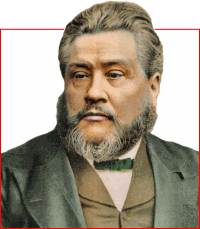
Perseverance is the badge of true saints. The Christian life is more than a beginning in the ways of God. It is also a continuance in the faith as long as life lasts. It is the same with a Christian as it was with the great Napoleon who said, “Conquest has made me what I am, and conquest must maintain me.” The only true conqueror who will be crowned is the one that continues until war’s trumpet is blown no more.

The Target of Our Spiritual Enemies

Perseverance is, therefore, the target of all our Spiritual enemies.

The world does not object to you being a Christian for a time if she can tempt you to give up your journey and settle down in her Vanity Fair.

The flesh will seek to entangle you and prevent you from pressing on to glory. “It is weary work being a Christian. Come, give it up. Must I always be humbled? Am I never to be indulged? Give me at least a vacation from this constant warfare.”

Satan will make many fierce attacks on your perseverance. It will be the target of all his arrows. He will strive to hinder you in service. He will insinuate that you are doing no good. He will endeavor to make you wary of suffering. He will whisper, “Curse God, and die” (Job 2:9). He will attack your steadfastness: “What is the good of being so zealous? Be quiet like the rest.” He will assail your doctrinal beliefs: “Why do you hold to these denominational creeds? Sensible men are getting more liberal. They are removing the old landmarks. Blend in with the times.”

Conclusion

Wear your shield, Christian, close to your armor. Pray to God that, by His Spirit, you may endure to the end.

Resource

Spurgeon, Morning and Evening: May 26, Evening

Interestingness

It is once again time for a few interesting posts from around the web. Here is what I have been reading and watching lately.

Medieval Help Desk

Kevin De Young highlighted this video on his blog recently. I thought it was funny, so I want to share it with you.

5 Necessary Shifts for Missional College Ministry

Stephen Lutz highlights what he believes to be five shifts that need to take place in order for college ministry to be more missional. You can read his article by clicking here.

Steve Jobs

Here are two great articles on Steve Jobs, Technology, and Christianity. You can read John Dyer’s article by clicking here. And you can read Al Mohler’s article by clicking here.

Mohler’s Commentary on Joel Osteen’s Interview with Piers

This article includes a video of Joel Osteen’s recent interview where he discusses gay marriage, and Mohler’s commentary on that interview. It is an interesting interview to watch as well as commentary to read. You can read it by clicking here.

Ministry to the Partially Evangelized

Who are the partially evangelized and how can we reach them? Chris Castaldo answers those questions in his recent article. You can read it by clicking here.

iPhone 4S

Apple recently released the iPhone 4S. Check it out by clicking here. I would be curious if you are going to get one. Let me know your thoughts in the comments below.

Reading Encouragement

In my last post, I provided you with a list of books that have influenced me over the years. Today I want to provide you with encouragement to read more.

Justin Taylor Interviews Tony Reinke about his new book “Lit!” from Crossway on Vimeo.

Learn how to better read, what to read, when to read, and why you should read with this helpful guide from accomplished reader Tony Reinke. Offered here is a theology for reading and practical suggestions for reading widely, reading well, and for making it all worthwhile.

On his blog, Taylor provided this break down of the video:

0:14 – Tony’s desire for the book
1:22 – What kind of books should I be reading? (6 Priorities for determining what to read)
3:17 – Creating time to read
5:10 – Tips for growing as a reader
7:21 – The value of fiction
9:08 – The theological importance of reading

A Technique for Remembering What You Are Reading

(1) After you read a chapter or article, stop and allow yourself to absorb the content.

(2) Identify the main point of the chapter or article.

(3) Do not let the details bog you down. Your goal is to remember the main point.

(4) After you understand the main point, now rehearse to yourself the important parts of the chapter or article you just read. This could be anything from important facts or statistics the author uses, to the major points that support the main point. The point is that you want to be able to tell a friend the main point of the article, as well as how the author supports the main point.

New Book Recommendation Page

This week I have been working on a new Book Recommendation page. You can view it by clicking here. For the most part it is completed, even though it will always be a work in progress. I will be adding new books as I read them, so check back often.

The books I recommend on this page are ones that have influenced and taught me many things about the Christian faith, so I want to recommend them to you in hopes that they will teach you as much as they have taught me throughout the years. I have read almost every book on this page, so be assured it is not a page I put together off of a list somewhere. And I want to assure you the ones I have not read come highly recommended from friends whose lives have been touched as they have read these books. As a result, I felt comfortable recommending them, as well as placing them on my personal reading list. I just need to find the time to get to them.

When you go to the Book Recommendation page, you will be greeted by a bunch of book covers, which are broken down into categories. If you would like to learn more about a book, or purchase it, just click on it. When you do, you will be redirected to Amazon.com’s page for the book. There you can read reviews or add the book to your cart.

In order to get you started, I want to provide you with a quick list of my personal favorites. Of course, all the books on the Book Recommendation page are excellent and are highly recommended, but there are some that have resonated with me more than others. Here are those books:

Christian Living

  • Counterfeit God’s
  • Hard to Believe
  • Respectable Sins
  • Christ Formed in You

Marriage & Family

  • The Exemplary Husband
  • When Sinners Say I Do
  • What Did You Expect?
  • God, Marriage and Family

Evangelism & Missions

  • The Mission of God
  • Evangelism and the Sovereignty of God
  • Questioning Evangelism

Reading & Writing

  • How to Read a Book
  • A Classic Guide to Better Writing
  • The Craft of Research
  • How to Read the Bible as Literature

Culture & Society

  • Amusing Ourselves To Death

Theology

  • The Existence and Attributes of God
  • Theology of the Reformers
  • The Potter’s Freedom
  • Putting Amazing Back Into Grace
  • Systematic Theology

Biblical Theology

  • God’s Glory In Salvation Through Judgment
  • Biblical Theology in the Life of the Church
  • According to Plan

Preaching

  • Preparing Expository Sermons
  • Preaching the Whole Bible as Christian Scripture
  • Using Illustrations to Preach with Power
  • Preaching with Variety

The Church

  • Ashamed of the Gospel
  • Nine Marks of a Healthy Church
  • The Shepherd Leader
  • The Deliberate Church

Hermeneutics

  • Gospel Centered Hermeneutics
  • The Meaning of the Pentateuch
  • 40 Questions About Interpreting the Bible

Philosophy & Apologetics

  • Love God with All Your Mind
  • The Francis Schaeffer Collection
  • The Reason for God
  • Does God Believe in Atheists?
  • Defeating Darwinism

Biography

  • Spurgeon: A New Biography

Image: Paul / FreeDigitalPhotos.net