Run the Race of the Christian Life to Win the Prize

Dan Jansen was always close with his sister – in fact it was she who suggested he become a speed skater. In 1988 his dream came true when he made it to the Winter Olympics in Calgary, Canada. With just hours to go to his first race he informed his sister had died.

Of course, the news of his sister’s death stunned and devastated Jansen, but he decided to compete anyways. His sister had encouraged him to be a speed skater and supported him along the way to his Olympic dreams. It is what she would have wanted.

As he raced across the ice that day, grief proved to be too much. He feel in both races, dashing his hopes of winning the gold.

Although he was grieved and defeated, Jansen decided he couldn’t quit. He continued to chase the gold. In 1992, he came back to the Winter Olympics hoping to win, but the gold eluded him once again. Still undeterred he set to train for the next Olympic games.  Finally, in 1994, all his effort paid off. He not only won the gold in the 1,000 meter but he also set a new world record.

Jansen succeeded because he didn’t give up. Despite all the set backs he kept pressing forward toward the prize.

Likewise, as Christians we must not give up. We must keep pressing forward. Despite set backs, road blocks, and distractions, we must, as Paul tells us, run the race of the Christian life to win the prize (1 Cor 9:24).

Run the Race of the Christian Life to Win the Prize

Paul, using an image from the Isthmian Games held in Corinth, says in 1 Corinthians 9:24

“Do you not know that in a race all the runners run, but only one received the prize? So run that you may obtain it.”(1 Cor. 9:24)

Now when Paul says this, he doesn’t mean to imply only one of us will win the prize, that is pressing Paul’s image too far. Instead what Paul wants us to do is run the race of the Christian life in such a way that we will win the prize.

When I was in elementary school, I was one of the fastest kids in the school — it was a small school. I remember one year I was cocky. I knew I was faster than everyone else, so on the first race of the heat I held back; I didn’t give it my all. I still came in first, but when I went to brag to my teacher about how I had just won he said, “You didn’t win by much. You better step it up, or you won’t make it to the finals.”

My teacher taught me something in that moment. He taught me that I didn’t have it in the bag and that I had to give it my all, I had to run so as to obtain the prize.

Christians must do the same. We have to run so as to win the prize. We can’t give a half effort. We can’t be lackadaisical about our Christian walk. If we are, we may not cross the finish line and win the prize.

Not Works Based

In saying we have to run in such a way so as to obtain the prize, Paul is not advocating a works based salvation. Paul is holding a tension between Christ’s work and our work. Yes, those who are Christ’s will finish the race, but that doesn’t mean we don’t have to work to finish it.

The encouraging part of running the Christian race is that we don’t have to run it in our own power. At salvation, not only is our heart created anew, which causes us to desire to run for Christ, but we are also empowered by God to run. In Philippians 2:12b-13, Paul tells us to:

“Work out your own salvation with fear and trembling, for it is God who works in you, both to will and to work for His good pleasure.” (Phil. 2:12b-13)

Do you see what Paul is saying? We are to work out our own salvation – run with all our might, striving for the finish line – but we don’t run in our own power or alone. God runs with us, empowering us by changing our will, causing us to want to work to please Him, and giving us the strength to press on. What a glorious truth!

What is the Prize?

“Every athlete exercises self-control in all things. They do it to receive a perishable wreath, but we an imperishable.” (1 Cor 9:25)

Once again using an image from the Isthmian Games, Paul tells us our prize is greater than any earthly prize because: It is not perishable, but imperishable. It’s not temporary, but eternal. It’s not a laurel wreath, but a crown. Our prize, the prize we run the race to receive, is eternal life.

Since our prize is so great, we should give it our all. We shouldn’t run the race at half-speed, but full steam ahead until we cross the finish line.

Question for Reflection

  1. Are you running the race to win the prize?

Resources

Post adapted from the sermon Run the Race to Win the Prize which you can listen to in its entirety here.


Image

How & Why We Need to Live Out the Golden Rule

Broken Glasses

We all know the Golden Rule. It is found in Matthew 7:12. There Jesus says,

So whatever you wish that others would do to you, do also to them, for this is the Law and the Prophets.”

While we have all recited this rule throughout our life, do we know what it really means?

For this is the Law and Prophets

In order to answer the question, we have to start with the last phrase, “For this is the Law and Prophets.” Later on in Matthew we come across a conversation Jesus has with a Lawyer who asks Him what is the greatest commandment.

In response to the question, Jesus says,

You shall love the Lord your God with all your heart and with all your soul and with all your mind. This is the great and first commandment. And a second is like it: You shall love your neighbor as yourself. On these two commandments depend all the Law and the Prophets.(Matt. 22:37-40)

It is important we start with this phrase because Jesus’ commandment in verse 12 is another way to summarize the command. We can’t do unto others as we would have them do unto us without first loving God and then loving others.

The reason we need to love God before we can love others has to do with our heart. Before our heart is penetrated by the gospel we are enemies of God. We don’t love Him, we hate Him.

After our heart is pierced by the gospel, a change takes place. We no longer see God as our enemy. Instead we love Him, which is crucially important because only after we love God, will we obey His command to love others and practice the Golden Rule.

Positive, Not Negative

The second thing we need to look at in order to understand the Golden Rule is the nature of Jesus’ command. His command is given in the positive, not the negative.

Instead of not doing what we don’t want done to us. Jesus tells us we are to do to others what we would want them to do to us.

In other words, if you want others to…

  • Serve you
  • Love you
  • Care for you
  • Give to you
  • Be nice to you
  • Respect you
  • Honor you
  • Listen to you
  • Learn from you
  • Hold you accountable
  • Comfort you
  • Counsel you
  • etc

…then you do these things to them. In the way we want to be treated, we are to treat others, which is the Golden Rule.

Easier Said Than Done

I know it is easier said than done. It is easy to not do what we don’t want done to us. For instance:

  • If we don’t want others to steal from us, we don’t steal from them.
  • If we don’t want others to hurt our families, we don’t hurt theirs.
  • If we don’t want others to aggravate us, we don’t aggravate them.

It is much easier for us not to do what we don’t want done to us because of the benefit we receive.

It is much harder, however, to do what we want others to do for us because we don’t always benefit. We may do and do, but never see any return. Here is why love is necessary.

True Love

True love is not built around our emotions, getting what we want, or what makes us happy. The culture defines love in that way. The Bible, however, defines love as self-sacrifice, which means we don’t always get what we want. When we are not getting what we want, it is harder to live by the Golden Rule.

The golden rule, however, isn’t about us getting what we want. Jesus doesn’t give it so we can be selfish. He gives it because He wants us to understand what it looks like to truly love one another.

Salt and Light

When we live out the golden rule, truly love others, we live as salt and light to the world. We are a witness for the gospel because we live in a way the world doesn’t because the world doesn’t give without getting.

Not only are we a witness to the power of the gospel when we live out the Golden Rule, but we also promote peace and societal flourishing. In other words, we make the world a better place, and give others a glimpse of what the world to come will look like simple by doing unto others what we would have them do to us.

Questions for Reflection

  1. Do you truly live by the Golden Rule?
  2. What would you add to the discussion here about the Golden Rule?
  3. Do you agree or disagree with my explanation and application?

The Soul Shaping Reality of the Gospel

We need a little perspective here. Our situation in the U.S.A., relative to Christians elsewhere, is not unusually difficult. It is true that we are now moving away from a time when Christianity has had some cultural acceptance. After all, consider how popular it has been to be “born again.”

But let us remember that outside the U.S.A., there are Christians who live under tyrannies, such as from Islam, or in extreme poverty, or surrounded by horrible political corruption, or are subject to rampant crime. Our situation is really not that bad!

What the Message Isn’t

What it requires is that we have some conviction about biblical truth, some savvy about the culture in which we are living, and the spine to preserve our identity as believers.

It is a temptation to think that by being nice and accommodating we can make the Christian gospel seem like a great little addition to everyone’s life.

But the gospel is not a great little addition. It is a soul-shaking, costly demanding reality. The church cannot hide this fact!

The gospel is not about self-therapy. Despite our pressured, taut, nerve jangling age, the Christian message is not there just to make us feel better about ourselves or more able to cope.

What the Message Is

It is about coming before our great God and Savior, confessing our sins, entrusting ourselves to Him, and surrendering our claim upon ourselves to Him.

What is Needed

What is most needed, and what is most lacking in the church, is a little character in differentiating its message from self-help therapies and marketing strategies. Our deficiency is not that we lack the right technique. It is that we often don’t have a real alternative.

Questions for Reflection

  1. Do you see the church as an alternative faith community to the culture?
  2. How can we live as an alternative faith community?

Resources

Image

David F. Wells, The Soul-Shaping Reality of the Gospel, an interview in Table Talk Magazine, January 2011.

Does God Help Those Who Help Themselves?

America is a hard working nation. The average workweek is no longer 40 hours a week, but 50, 60, or even 70 hours a week. Why do we work so hard and for so long? We have been told no one is going to do it for us and so we operate under the mentality that we have to go out there and earn it ourselves. While that is partly true in the secular world, it is not true when it comes to salvation found in Christ.

Sadly, many have applied this concept of ‘earning it yourself’ to Christian life. They live by the motto ‘God helps those who help themselves.’ If we do our part, then God will do his part. Even though that may sound right to our ears and in our culture, it is not true.

What Does Living By This Motto Mean?

Look: I, Paul, say to you that if you accept circumcision, Christ will be of no advantage to you. I testify again to every man who accepts circumcision that he is obligated to keep the whole law. You are severed from Christ, you who would be justified by the law; you have fallen away from grace. (Galatians 5:2-4)

Paul is saying that if we believe we need to do something other than have faith in Christ for salvation, we do not understand the gospel. Instead of understanding Christ we have rejected him and are obligated to keep the whole law, which cannot be done.

So then, by thinking we can add works or merit to the gospel we will earn acceptance with God, we, in fact, do the opposite. We do not gain the acceptance from God for which we were hoping. God doesn’t help those who help themselves.  God helps those who can’t help themselves. That may come as a shock, but that is what Scripture tells us.

By thinking we have to do our part, we prove we don’t believe Christ’s sacrifice is sufficient; we believe we have to make up for something that it lacks.

Christ’s sacrifice, however, lacks nothing. His work on the cross sufficiently paid the price for our sins – past, present, and future. We do not need to do anything to earn or pay God back for our salvation. Christ paid it all and earned it all for us.

How Do We Try To Earn God’s Acceptance?

Even though the Bible tells us that we are accepted and made righteous because of Christ’s work–not because of our works–we still have a tendency to try and earn God’s acceptance. Why do we do this knowing it doesn’t work? The temptation of moralism is powerful. It fits within the framework of our society.

Moralism is the idea that we can earn righteousness, or acceptance through our works, and it is inherent in our DNA; it is natural to us.

For example, if you do well in school, you will be rewarded with recognition or accepted into an elite program. If you do well at work, you will be acknowledged and promoted. This is how our society works, but it isn’t how the gospel works.

In order to combat something so natural to us, we must know what things we typically add to the gospel. If we know some of the things we add to the gospel, we can watch out for them and seek to rid them from our lives.

What Are The Things We Add To The Gospel?

Before we get into it, let me first say, we should do all of the following, but for different reasons. The reason we do them is because Christ has made us righteous, not in order to gain acceptance or righteousness.

What are the things we may add to the gospel, thinking we become more righteous by doing them?

A Quiet Time – Some believe that if they miss their quiet time they will loose God’s acceptance and things will go bad for them. It is almost as if they treat their quiet time like Karma. However, the reason we do a quiet time is to commune with God, learn more about him, and how he would have us live in his kingdom, not so that things will go well for us.

Church Attendance – There are those in the Church who think themselves superior to others and more accepted by God because they come to church every time the doors are open. Yes, we should attend church services. The reason we attend should be to fellowship with, encourage, and serve other believers; worship the Lord; and learn more about our Savior, not to make ourselves more righteous or acceptable to God.

Holding to a Certain Political View – In the South, I think we have this false notion that being a Republican is the same as being a Christian. Well, not necessarily. There are some who genuinely follow Christ who politically identify with Democrats or Independents. In order to come to Christ, you don’t have to change your political affiliation; you only have to believe in Jesus as your savior. That doesn’t mean; however, all believers should not hold to their party affiliations without biblical discernment.

Social Justice – It is right and good to fight and provide for the needs of others. Scripture calls us to love our neighbor, take care of widows and orphans, and provide for the poor and needy. All these things, however, are the result of the gospel melting our heart of stone into hearts of flesh. In other words, we do them because we have been made righteous, not to gain righteousness.

Being on Mission – Our God is a God of mission. He both calls us and uses us to accomplish His mission. While it is true a large number of Christians avoid, or half-heartedly accept God’s call to mission, those who actively take it up are not more righteous than those who do not. I need to be careful here because I do not want to discount the necessity to be on God’s mission. I do, however, want to make sure those who label themselves as missional do not create a false sense of superiority, or believe they are more accepted for their labors. We are on God’s mission because He has called us to it, not to puff ourselves up or gain greater acceptance from God.

Community – Since we are made in the image of God, community is in our DNA. The Trinity has existed in community for all eternity, serving, loving, and glorifying one another. We are called to reflect or image that community here on earth as those redeemed by Christ. By God’s grace some reflect that relationship better than others. Where I believe some go wrong is to believe better community equals greater acceptance from God. The only reason, however, we can exist in community with one another is because the gospel has changed our heart. Better community then does not equal greater acceptance from God. Better community is the result of God’s work in the gospel.

Other things we may have a tendency to add to the gospel are:

  • Prayer
  • Community service
  • Adoption
  • Home schooling
  • Baptism
  • Giving
  • Eating organic

Again, all these things are right and good, but none of these things make us more acceptable to God. We are justified by faith alone. You see, in Christ, we are as accepted as we will ever be. We can do nothing to make ourselves more acceptable. Nor do we need to do anything. Christ’s sacrifice on the cross is sufficient.

Attempting to gain acceptance outside of Christ, will merit us nothing but exhaustion, because our work will never be done. Exhaustion will turn into anxiety because we never know if God accepts us or not. Exhaustion and anxiety will turn into distress, and finally disappointment as we realize we cannot be made righteous through our own work.

In addition, by adding these things to the gospel message we functionally prove we don’t believe Christ’s sacrifice is sufficient. Rather, we prove we actually believe we have to make up for something that it lacks. But what Paul is telling us, and why this message is so important, is that if we think we must add to the gospel in order to be saved, or to maintain our righteousness, even though we say we believe in Christ as our Savior, we may not be saved.

So as Christians, we have to examine our hearts. We have to ask ourselves why we do the things we do. Is it because Christ has saved us and the Holy Spirit is working in us to produce the fruits of righteousness through the means of grace? Or is it because we think we have to do these things in order to either gain or maintain our acceptance with God? Your answer will be telling of your understanding of the gospel.

God Helps Those Who Humble Themselves

God does not help those who help themselves; God helps those who humble themselves. He helps those who completely and utterly depend on Him for salvation. He helps those who see Christ’s sacrifice as sufficient and who do not attempt to earn his acceptance through their work.

God wants us to depend on him completely and to trust that Jesus’ sacrifice is all we need for salvation. If we are trying to help ourselves, then we do not really understand the gospel. We do not really know what it means to accept God’s free grace for our sins. We do not understand that all our works are like filthy rags and they are not able to merit us even one ounce of God’s acceptance.

We are saved by God’s grace through Jesus Christ’s death on the cross, which means we must stop laboring for God’s acceptance. We must stop laboring for our salvation. We must trust in Jesus Christ for our salvation! Once we realize our salvation doesn’t come through our labors but Christ’s, we can then labor for the right reason. We can labor because we have been accepted, not for acceptance.

Questions for Reflection

  1. Have you thought in the past that you need to earn your acceptance with God?
  2. Do you believe you need to pay God back for your salvation?
  3. How freeing was it for you when you realized that salvation was by faith alone?
  4. If we do not earn salvation from God through our works, why do we work?
  5. What or whom empowers us to work?

Resources

Image

This post was also posted at Gospel Centered Discipleship. Click here to view my post there. You can also download a PDF copy if you are interested. While you are at it, check out some of their other work.

All Things to All People to Win Some

What does it look like for us to be all things to all people? Paul models that for us in 1 Corinthians 9. He says when he was with the Jews, he became like a Jew; when with the Gentiles, he became like a Gentile; when with the weak, he became like the weak (1 Cor. 9:21-22).

What, however, does it look like in practice for us to be all things to all people? I believe it works out differently for each of us because we all run in different circles. Let me, however, give you some general principles to operate under.

(1) We must present the gospel in a way people can understand.

Presenting the gospel in a way people can understand doesn’t mean we water down the gospel. Paul sure didn’t. Even though he knew the cross was a stumbling block to the Jews and folly to the Gentiles, he boldly preached the cross. We must do the same.

Knowing we can’t eliminate the offense of the cross doesn’t mean we can’t present the gospel in a way that makes sense to those we are trying to win to Christ.

In the mid 1800’s Hudson Taylor went to China as a Christian missionary. While he was there he also founded the China Inland Mission.

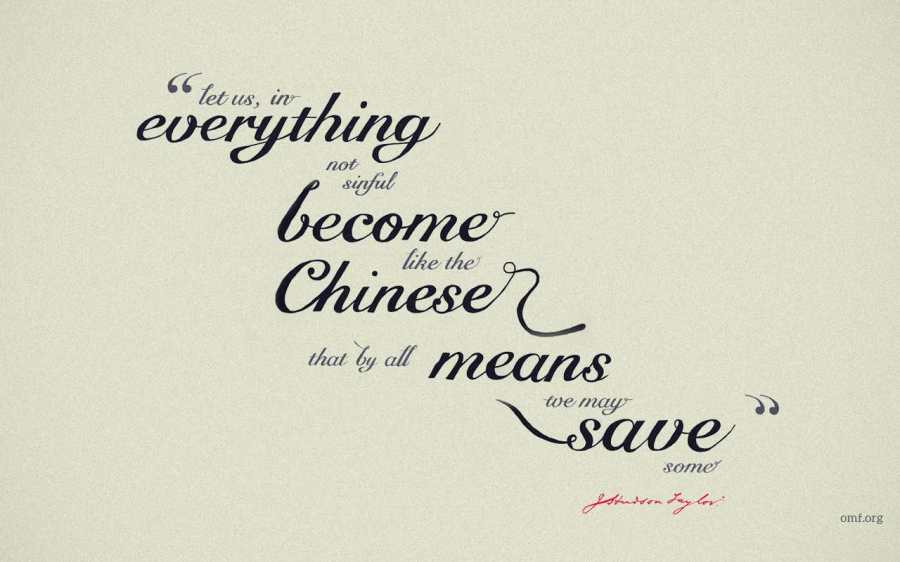
Taylor argued, from the example of the Apostle Paul, “Let us in everything not sinful become like the Chinese, that by all means we may save some [1].

In saying that Taylor was taking a different line than most of the missionaries at the time. Instead of expecting the Chinese to adopt western christendom, he adopted Chinese culture. He grew his hair out, ate Chinese food, wore traditional Chinese clothing, and learned their language and stories.

Taylor recognized forcing his culture on the Chinese wouldn’t work, so he became like the Chinese as much as he could without sinning, just like Paul became like the Gentiles as much as he could without sinning. Taylor’s unusual move allowed him to do something different than those who had come before him. He was able to use language, stories, and metaphors that resonated with the Chinese people.

That is what we have to do. We have to work to understand the culture of those we are trying to reach, so that we can present the gospel in an understandable way.

Not only do cultural difference exist abroad, but in the States as well.

City and Country

I experienced this personally when I moved to Decatur, TX. While Decatur is not too far from the Dallas Fort Worth Metroplex, it is still a rural town. I didn’t grow up in the country. I grew up in the city, and I have always lived in the city.

When I moved to Decatur, I had to start working, and I still am working, to understand the culture, so I can present the gospel in an understandable way to those who live here.

Generational Differences

Cultural divides, however, don’t just exist between the country and city. There are also cultural differences between generations.

There are certain stories, metaphors, and environments that resonate with the older generation that just doesn’t resonate with the younger. If you are in the older generation and you want to reach those in the younger generation — say you grandkids or even your kids — you have to learn their culture. Vice versa for those who are younger.

Now parents this doesn’t mean that you have to start dressing in skinny jeans and cool graphic tee’s. That is probably taking it a little too far. Just understand where they are coming from.

Church and Unchurched

There is also a cultural divide between the churched and unchurched. I believe those of us who were raised in the church either forget this or don’t know it exists. I say that because we often expect those outside the church to understand our churchy language, stories, and metaphors.

We don’t give second thought to using phrases and terms like:

  • Jesus lives in my heart.
  • That was a God thing.
  • That is what sanctification is for.
  • Jesus has justified you.

While there is nothing theologically wrong with those phrases and terms, to those outside the church, they often don’t make any sense. Since they don’t make sense, they don’t get what we are trying to say.

Which means when we are talking with the unchurched we have to use language, stories, and metaphors that resonate with them, as well as we have to define our terms, in order to help them understand the good news of the gospel better.

Again that doesn’t mean we water down the gospel, it just means we speak in a way that makes the most sense to those who haven’t had the opportunity to grow up in the church like most of us.

(2) We must be a living incarnation of gospel values.

Paul was a living incarnation of the gospel. We must be the same. We must incarnate or live as an example of the gospel. People should be able to look at our lives and say,

If I were to become a Christian, that is what my life would look like.

The way we give them that picture is by living out the gospel’s values of grace, mercy, love, justice, compassion, and mission, just to name a few.

Our neighbors should be able to see the gospel’s values worked out in a:

  • A stay at home mom as she cares for her children, husband, and house.
  • A business man as he deals with his clients, employees, and finances.
  • A farmer as he cares for his animals, his workers, and business.
  • A teacher as she interacts with the kids, the parents, and the administration.

The examples could go on and on, but I think you get the idea. The gospel should permeate our lives so that we are a living incarnation of gospel values.

It is one thing to preach the gospel, it is another to live it.

Living out the gospel’s values, along with preaching, has to happen. If we don’t, the message we preach will fall on deaf ears.

(3) We must discipline ourselves to live as Christ has called us to live

We all know Tiger Woods is a great golfer. You can’t deny it. The man has won 105 tournaments, 4 Masters, and 4 PGA Championships. He has won 132 billion dollars in total prizes [2].

While he has real talent, he doesn’t just walk out on the course the day of the tournament and win. He trains almost everyday for 12 hours a day – working out, playing golf, and eating well [3].

Tiger’s talent takes him a long way, but what makes him a great golfer is his discipline and self-control.

Like Tiger, Paul tells us we must exercise self-control, we must be disciplined, if we want to be all things to all people, while remaining faithful to the gospel.

In chapter 9 of 1 Corinthians he uses an athletic metaphor derived from those who participated in the games held in Corinth — the Isthmian games. He says,

Do you not know that in a race all the runners run, but only one receives the prize? So run that you may obtain it.

Then he starts to tell us how we are to run:

Every athlete exercises self-control in all things. They do it, Paul tells us, to receive a perishable wreath, but look what we are striving for – an imperishable wreath; an eternal reward. Because our reward is so great Paul says,

So I do not run aimlessly; I do not box as one beating the air. But I discipline my body and keep it under control, lest after preaching to others I myself should be disqualified. (1 Cor. 9:25-27)

With that Paul gives us the secret to remaining faithful to the life God has called us to live; the secret to being all things to all people is self-discipline, self-control.

Those are needed in order for us to be all things to all people, because we have to have walk a fine line between giving up our rights and adhering to Christ’s law.

As Christians we have rights, but we have to be willing to give those up at times. As Christians we have freedom to live as others do, but we can’t take that too far.

The only way for us to find the sweet spot, so that we can be all things to all people, while remaining faithful to the Law of Christ is to be disciplined, is to exercise self-control.

Question for Reflection

  1. How has God used you as you have been all things to all people?

Resources

Post adapted from my sermon All Things to All People to Win Some, which you can listen to by clicking here.

Image

[1] James Hudson Taylor’s reflection on 1 Corinthians 9v19-23
[2] http://www.tigerwoods.com/about-tiger#biography
[3] http://www.youmotivation.com/motivational-articles/tiger-woods-daily-schedule-12-hour-routine-7129

How and Why Should We Prepare to Take the Lord’s Supper?

The Lord’s Supper is one of the two ordinances of the church. It is something we do regularly, but how and why should we prepare to take the Supper?

How Should We Prepare to Take the Lord’s Supper?

Paul tells us in 1 Corinthians 11 that before we take the Supper we must examine and judge ourselves.

Let a person examine himself, then, and so eat of the bread and drink of the cup.” (1 Cor. 11:28)

Skipping down to verse 31 Paul says,

But if we judged ourselves truly, we would not be judged” (1 Cor. 11:31)

Then in verse 33 Paul says,

So then, my brothers, when you come together to eat, wait for one another — if anyone is hungry, let him eat at home — so that when you come together it will not be for judgment.” (1 Cor. 11:33-34)

So before we come to the table we must examine ourselves to:

  • (1) Make sure that we are a believer, that we believe Jesus to be our Lord and Savior, that we have committed to following Him.

Going even further, we not only need to make sure we are believers, but we also need to:

  • (2) Make sure there is no known unrepentant sin in our lives.

After examining ourselves, if we find sin in our hearts we have been unwilling to repent of, we must repent before partaking of the Supper.

Lastly, we must:

  • (3) Make sure we are united with others.

Recently, I was watching a show, and in it one of the main characters reluctantly goes home for a Christmas meal. While around the table with her family, they break out into a huge argument. The scene ends with her telling her father she regrets coming, then storming out.

Now, I think it is safe to say unity didn’t exist before that meal began — that is why she was reluctant to go home in the first place. Since there was no unity, when they all sat around the table together it ended in a fight.

That, however, should not be so in the church. We are supposed to come to the table together united with one another as brothers and sisters in Christ. We can’t do that if we are at odds with another in the body. So we must examine and repair our relationships before we take the Supper.

What Happens if We Don’t Examine Ourselves and Take the Supper Anyways?

We could be eating and drinking judgment on ourselves. In verse 27 Paul says,

Whoever, therefore, eats the bread or drinks the cup of the Lord in an unworthy manner will be guilty concerning the body and blood of the Lord.” (1 Cor. 11:27)

When Paul tells us that we are guilty of the body and blood of the Lord, he means that we are liable and will face the same punishment as those who crucified Jesus. In other words, we are treated as unbelievers because we show we don’t understand the point of the Supper.

We show we don’t believe what the Supper proclaims — that Jesus died in our place for our sins so that we might have a relationship with the Father and experience eternal life. For if we did, we would show reverence and honor for the Supper being observed.

Also, starting in verse 28, Paul says,

Let a person examine himself, then, and so eat of the bread and drink of the cup. For anyone who eats and drinks without discerning the body eats and drink judgment on himself. That is why many of you are weak and ill, and some have died. But if we judge ourselves truly, we would not be judged.” (1 Cor. 11:28-31)

Apparently, there were some in the Corinthian church who were weak, ill, and some who have even died. Paul tells the Corinthians this happened and is happening because they do not observe the Supper rightly.

The same will happen today. If we take the Supper in an unworthy manner. If we misuse it and treat others poorly at it, we too will face the same fate. We too will be treated as an unbelievers. We too will grow weak, ill, and some of us may even die.

So if we don’t examine ourselves and take the Supper anyways, we could be eating and drinking judgment on ourselves.

Conclusion

So before we take the Supper we need to examine ourselves: make sure we are believers, repent of the sins we are holding onto, and repair any relationship that needs to be repaired. If we do those things, we will not only avoid the Lord’s judgment, but the Supper will be what Jesus designed it to be:

A time for Jesus’ family to come together in unity to celebrate and proclaim to each other and the world what He has done and will do for us.

Question for Reflection

  1. Do you prepare for the taking of the Lord’s Supper?

Resources

Post developed from the sermon: The Lord’s Supper: A Family Meal of Unity, Celebration, and Proclamation which you can listen to in its entirety by clicking here.

Image