Are You On the Broad or Narrow Road?

Road Less Traveled

When I was in elementary school, I looked forward to that time in the day when we left our class room and went to the gym for P.E. Most days we would play a team sport. Basketball, whiffle ball, or something like that.

Our teacher would have us all line up behind a line. Two captains would pick who they wanted on their team. As your name was called, you would cross the line and join your captain.

Inevitable there was always an odd number, so one person wouldn’t get picked, which meant they couldn’t cross the line and join a team. You didn’t want to be that kid because you had to sit out and wait until the next game.

At the close of the Sermon on the Mount Jesus too is drawing a line in the sand. His line doesn’t determine whether you get to play a game or not. It determines whether you are in the Kingdom or not.

While that line has been there all throughout Jesus’ teachings in the Sermon on the Mount, it becomes even more pronounced at the end as Jesus draws a clear distinction between two ways of living.

The reason He ends in this way is to force us to examine our own lives to determine whether we can cross the line and join Him in eternity or not.

What is required for us to cross that line and join Jesus in eternity?

Jesus begins by drawing a distinction between two roads. He says in Matthew 7:13-14:

Enter by the narrow gate. For the gate is wide and the way is easy that leads to destruction, and those who enter by it are many. For the gate is narrow and the way is hard that leads to life, and those who find it are few.

Jesus’ command is for us to enter by the narrow gate, not the broad gate. To travel the narrow road, not the broad road. Jesus gives this command because one road leads to eternal life, while One road leads to destruction.

Only Two Roads

Notice Jesus only provides two roads. He tells us we are either on one or the other. No one is neutral. You can’t hangout between the two roads. Everyone travels either the narrow or broad road.

These two roads head to one of two destinations, which means not all roads lead to the top.

The Difference in the Two Roads

These two roads differ from one another. The narrow road is hard, while the broad road is easy.

Why is the broad road easy? 

It is easy because it is what comes natural to us. It doesn’t require we make any sacrifices. It doesn’t require we change our will.

Why is the narrow road hard?

The narrow road, on the other hand, is hard because it is unnatural. It requires we focus. We work at it. We change our will.

I was listening to a sermon this last week and the preacher said “When it comes to learning a second language, it is difficult for us, almost unnatural, whereas our first language is easy, almost natural.”

I can attest to that. In High School and College I learned Spanish. In seminary, I had to learn Greek and Hebrew. When it came to learning these languages, it was tough. Hours of focused work was necessary. I constantly flipped through vocabulary cards. As I studied diligently, there were times when I thought I would never get it.

When I spoke Spanish, or translated the Bible from Greek or Hebrew, conscious effort and focus was required. English, on the other hand, comes easy. Sure, I have to think about what I am saying, but not nearly as hard as with the others. It comes natural to me.

The same with broad road living. It is what comes natural to us. It requires no effort or focus on our part. Not so with narrow road living. It is unnatural and hard. It requires we exert effort.

How do we know which road we are on?

We can determine what road we are traveling by thinking about the distinctions we just drew.

If how we live on a daily basis comes easy to us, it’s natural to us, it requires we expend no effort, or we don’t have to change our will, we are probably on the broad road. If what we believe and the way we act is inline with society, we are probably on the broad road.

Take for instance the following topics.

  • The sanctity of marriage.
  • Sex before marriage
  • Lust
  • Exclusivity of Christianity

Each requires we pick one side or the other. Each has a popular opinion and a more restricted opinion.

Those on the broad road:

  • Reject the sanctity of marriage.
  • They reject the idea we must wait until we get married to have sex.
  • They reject the idea that lust is wrong.
  • They reject the idea that Christianity is the only way to God.

While those on the narrow road, take the opposing opinion, which is not always easy or popular. Nor is it what comes natural. Holding the narrow road opinion requires we consistently work at it. Above all, it requires our heart be changed by the gospel.

So we can tell what road we are on by looking at what we are doing. If we are doing what comes easy to us, and is natural to us, and if we are always inline with society, then we are probably on the broad road. However, if we are doing what is hard, if we have to change our will, if we are counter cultural, then we are probably on the narrow road.

Question for Reflection

  1. What gate have you entered through? What road are you on?

Resources

Images

Post adapted from my most recent sermon

Do You Desire to Appease or Worship God?

Church Worship

How do you view God? Is He someone you worship? Or is He someone you seek to appease?

Background

In 1 Samuel 6, the Philistines prepare to return the ark of the Lord to Israel. They captured the ark seven months earlier and it has been ravishing their people and their gods ever since.

Originally, they placed it in the house of Dagon. He ended up face down in front of the ark with his head and hands cut off. The ark then went to Gath where the people broke out in tumors. Ekron was the next city on the circuit. They experience the same thing as Gath. Since God’s hand was heavy against the Philistines they decide to send the ark back to Israel.

Appeasement Not Worship

As they prepare to send the ark back, they forge five golden tumors and mice. These were placed in the cart with the ark to appease the Lord. The Philistine Priests say in verse 5:

So you must make images of your tumors and images of your mice that ravage the land, and give glory to the God of Israel. Perhaps He will lighten His hand from off you and your gods and your land.

The Philistine Priests did not counsel the people to turn from their idolatry and worship the Lord. Instead they counseled them to appease the Lord. Their reason was simple. They wanted to freely worship their own idols and do as they pleased. Israel’s God was getting in the way, so they sought to appease Him with offerings of gold.

Application

The Philistines acted in a pagan way. Offering gold to God in order to appease Him so they could do as they wanted.

Americans often act the same. No, we don’t offer gold to God, but we offer acts to Him. We go to church on Easter and Christmas, or even every Sunday with the intent of appeasing God. We do this thinking He will allow us to do what we want the rest of the year or week. We serve and give for our own benefit, so that we can pursue our own way of life and our idols.

These actions show we don’t understand who God is. We don’t understand He is the Creator of heaven and earth, the one true God. He is the Redeemer, sending His Son to die in our place so that we might be release from the bondage of sin, Satan, and death. When we offer acts of appeasement to God, we show we don’t understand these things about God. We show we don’t understand Christ’s work. We show we don’t understand the gospel.

Instead of appeasing God so we can continue to worship our idols, we should bow to Him in worship. Freedom from the slavery of idolatry is possible with God. Quit thinking like the Philistines. You don’t have to appease God. Jesus does that for you on the cross.

His work on the cross, however, doesn’t free us so we can live as we please and worship what we desire. Instead, His cross work frees us to worship the one true God. So then, worship God!

Question for Reflection

  1. Do you appease God or worship God?

Trust the Lord Daily

Sunrise

Trusting God is something we have to exercise daily, not just once in our life at our conversion.

The Story

In Genesis 12:10-20, a famine forces Abraham and his family down to Egypt. As they approached Egypt, Abraham comes up with a plan. He tells Sarai to tell the Egyptians he is her brother, not her husband. Abraham formulates this plan so he will not be killed by the Egyptians for his beautiful wife Sarai.

After Abraham and Sarai enter Egypt, the princes of Pharaoh praised Sarai to Pharaoh. She was taken into Pharaoh’s house to be one of his wives. Instead of killing Abraham, he was given riches. Sheep, oxen, donkeys, male and female servants, and camels were all given to Abraham for Sarai because it was thought he was her brother.

Shortly after Sarai moves in with Pharaoh, plagues begin. The Lord afflicted Pharaoh and his house for Abraham and Sarai. Sarai was eventually allowed to return to Abraham and they were ordered to leave the city.

The Analysis

Abraham failed to trust God. Just a few verses before, God made a promise to Abraham. A promise Abraham trusted. His trust was strong enough in God that he left his family and inheritance behind to go to a place the Lord would show him.

Certainly, time had passed between Abraham’s departure and the famine that drove them into Egypt. In that time, Abraham forgot the Lord’s promises. Faced with the uncertainty of death he forgot the Lord’s promise to make him into a great nation. He forgot the Lord’s promise to bless him. He forgot the Lord’s promise to take care of and provide for him.

Instead of leaning on God in this difficult time, he leaned on his own understanding and allowed his emotions to direct him instead of the Lord. After all, it was only logical Pharaoh would kill him for his beautiful wife.

Application

How often has your emotions or logic directed you to do something in your own strength instead of trusting God to provide? How often have you leaned on your own understanding instead of trusting God to provide?

As Christians, we are called to trust God everyday of our lives, not just at our conversion.

Questions for Reflection

  1. Do you trust God daily?
  2. Do you allow your emotions or logic to direct you instead of God?
  3. How does Abraham help you to see the futility of trusting your own plan instead of in God’s promises?

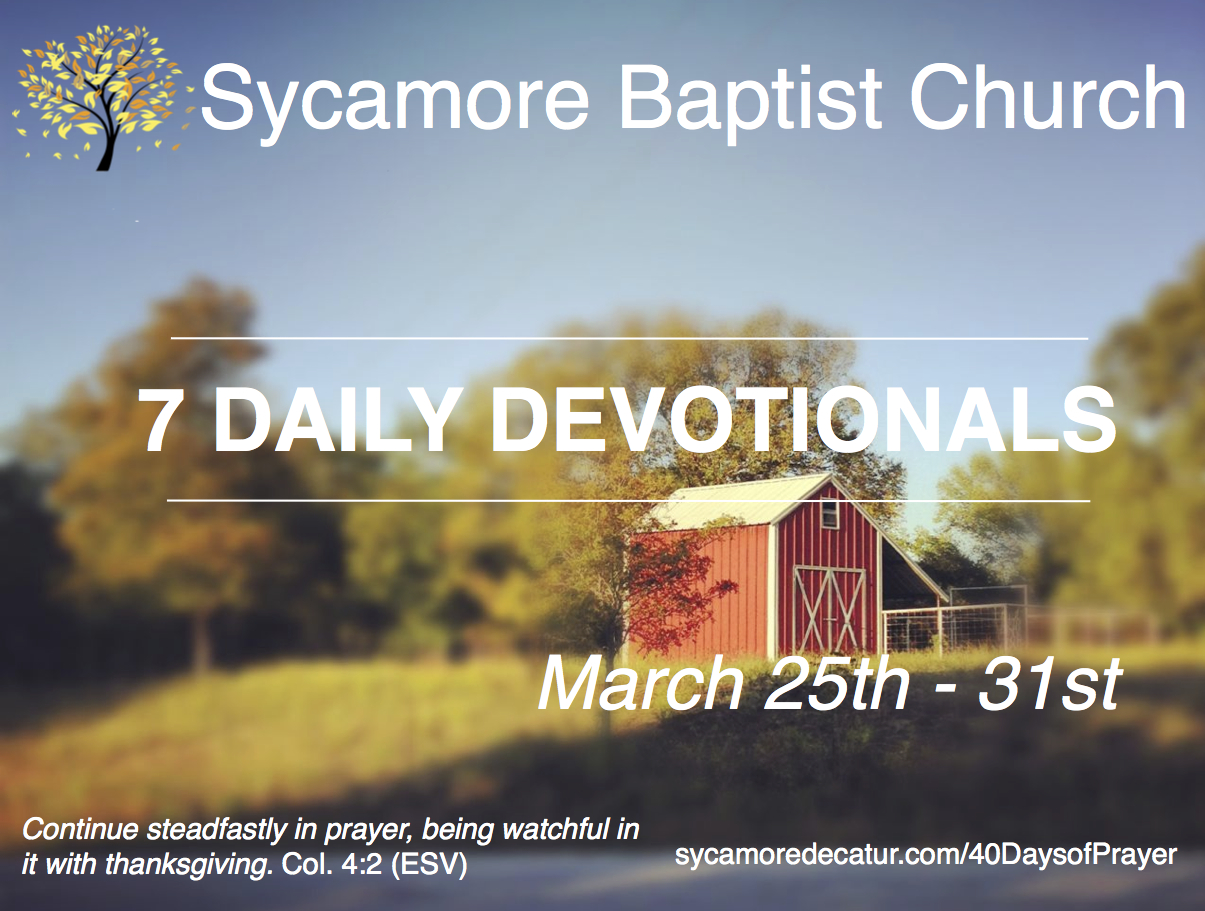
40 Days of Prayer Begins Today

40 Days of Prayer Graphic

40 Days of Prayer begins today. We would love for you to pray alongside us during this time, as we lift up our nation, city, community, and church.

Here is the information for 40 Days of Prayer: sycamoredecatur.com/40DaysofPrayer

The Valley of Vision: Resurrection

Jesus is Risen from the Grave

O GOD OF MY EXODUS,

Great was the joy of Israel’s sons
    when Egypt died upon the shore,

Far greater the joy
    when the Redeemer’s foe lay crushed in the dust.

Jesus strides forth as the victor,
    conqueror of death, hell, and all opposing might;

He bursts the bands of death,
    tramples the powers of darkness down,
    and lives for ever.

He, my gracious surety,
    apprehended for payment of my debt,
    comes forth from the prison house of the grave
    free, and triumphant over sin, Satan, and death.

Show me herein the proof that his vicarious offering is accepted,
    that the claims of justice are satisfied,
    that the devil’s sceptre is shivered,
    that his wrongful throne is levelled.

Give me the assurance that in Christ I died, in Him I rose,
    in His life I live, in His victory I triumph,
    in His ascension I shall be glorified.

Adorable Redeemer,
    Thou who wast lifted up upon a cross
    art ascended to highest heaven.

Thou, who as man of sorrows wast crowned with thorns,
    art now as Lord of life wreathed with glory.

Once, no shame more deep than Thine,
    no agony more bitter, no death more cruel.

Now, no exaltation more high,
    no life more glorious, no advocate more effective.

Thou art in the triumph car leading captive Thine enemies behind Thee.

What more could be done than Thou hast done!
    Thy death is my life, 
    Thy resurrection my peace,
    Thy ascension my hope, 
    Thy prayers my comfort.

Resource

The Valley of Vision, Resurrection, 86-87 (leather edition edition)

Image

40 Days of Prayer Devotionals – Day 7

Devotional Day 7

Day 7 – The Challenge Before Us

As we end this week of preparation, we hope you have benefited from the daily devotionals. It is our prayer that you share our desire for national healing, revival in the church and salvation for the lost in our community.

Tomorrow starts our 40 day event of focused prayer. We anticipate struggles with maintaining this schedule. It is easy to be excited and motivated during the planning and early days but our schedules are full. Work, family and even church commitments can drain our energy and distract us from obedient service to God.

For many of you, today, Easter Sunday, will be filled with activities celebrating the resurrection of our Lord and Savior, Jesus Christ. Let the gospel truth of His redemptive work motivate and strengthen you. As part of your worship today, meditate on the things God has shown you this week. Be encouraged with the knowledge that you have a High Priest who can sympathize with our weakness and in all points has faced the temptations, which beset us.

Let us then with confidence draw near to the throne of grace, that we may receive mercy and find grace to help in time of need.” (Hebrews 4:16)

 Resource

If you would like more information about 40 Days of Prayer, including how you can download a PDF copy of the information and link with us on social media, visit our website: sycamoredecatur.com/40DaysofPrayer