Sermons, Cultural Studies, and the Heart

Heart and the City

Studying culture is necessary when preparing a sermon. Pastors, including myself, read and devour everything in culture to ready themselves for their sermon. While it is profitable for pastors to know what is going on around them, I think we have to be careful what we take in. Consuming everything is not profitable, and it may even be a subtle way for us to make way for our sin.

Martyn Lloyd-Jones in his Studies in the Sermon on the Mount tackles these subtle sins of the heart. Here is what he has to say:

You have never been guilty of adultery? All right. Would you then answer me this simple question. Why do you read all the details of divorce cases in the newspaper? Why do you do it? Why is it essential that you should read right through these reports? What is your interest? It is not a legal interest, is it? or a social one? What is it? There is only one answer: you are enjoying it. You would not dream of doing these things yourself, but you are doing them by proxy.

You are sinning in your heart and mind and in your imagination, and you are therefore guilty of adultery. That is what Christ says. How subtle this awful, terrible thing is! How often do men sin by reading novels and biographies. You read the reviews of a book and find that it contains something about a man’s misconduct or behavior, and you buy it. We pretend we have a general philosophical interest in life, and that we are sociologists reading out of pure interest. No, no; it is because we love the thing; we like it. It is sin in the heart; sin in the mind!

Could we actually be making way for sin in our sermon preparation? Could we be disguising our cultural studies as a way to make room for our heart to fulfill it’s lusts and desires? I don’t believe that is always the reason we study our culture, but these paragraphs gave me reason to pause and consider the reasons behind the cultural studies I do. It gave me reason to check my heart and see what sin I may be feeding. I hope it gives you reason to do the same.

Questions for Reflection

  1. Why do you study culture?
  2. Have you ever stopped and considered that some of your studies might be done to make way for sin?

Resource

Martyn-Lloyd Jones, Studies in the Sermon on the Mount, 239.
Image

How Do You Know You are a Christian?

Fish Symbol

How do you know you are a Christian? If you call yourself a Christian, Christ follower, Believer, or whatever other label that is out there, you must answer the question.

Searching the internet I find that some believe they are a Christian because they were born into a Christian family, attend church every Sunday, have been baptized, or walked the aisle. While others believe they are a Christian because they live in the United States, or because they are a good person. Are these adequate answers? I don’t think so. If these answers will not do, then what makes you a Christian?

The book of 1 John answers the question for us. Let’s see what it says.

How Do You Know You are a Christian?

  • You know you are a Christian if you walk as He walks (1 John 1:5-7).
  • You know you are a Christian if you confess your sins (1 John 1:8-10).
  • You know you are a Christian if you keep His commandments (1 John 2:3-6; 3:19; 22-24; 5:2-4).
  • You know you are a Christian if you love one another. We cannot be a Christian if we hate others (1 John 2:9; 3:10-15; 4:7-12; 4:16-21; 5:1).
  • You know you are a Christian if you do not love the world (1 John 2:15-17).
  • You know you are a Christian if you remain steadfast in your faith until the end (1 John 2:19).
  • You know you are a Christian if you confess that Jesus is the Son of God (1 John 2:22-23; 4:3; 14-16; 5:5; 10; 13).
  • You know you are a Christian if you continue in the doctrine you have heard from the beginning (1 John 2:24-25).
  • You know you are a Christian if you confess that Jesus is the Christ (1 John 2:28; 5:1).
  • You know you are a Christian if your life is not characterized by continual sinfulness (1 John 3:1-9; 5:18).
  • You know you are a Christian if you confess that Jesus Christ has come in the flesh (1 John 4:2).
  • You know you are a Christian if other Christians agree with you rather than the world (1 John 4:5-6).
  • You know you are a Christian if you believe that Jesus is the Savior of the world (1 John 4:13).
  • You know you are a Christian if you believe that God has given you eternal life through His Son (1 John 5:11-12).

 Questions for Reflection

  1. Can you answer these questions yes?
  2. Do you believe you have to answer all these questions yes in order to be a Christian?

Resource

Image

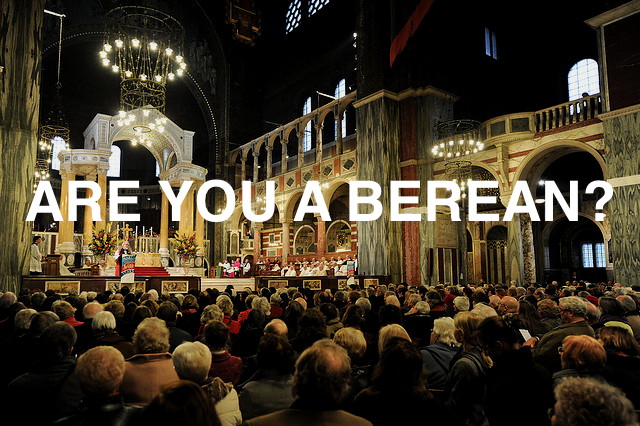
Are You a Berean?

Berean Congregation

Week in and week out church members listen to sermons, sit in on Bible studies, and attend Sunday School. They receive teaching, but what do they do with that teaching afterward? I am afraid most members do nothing more than casually mention to their family over lunch that the sermon was good this week.

Scripture tells us that is an inadequate response. It calls us to do more than listen to the sermon on Sunday, even though that is a good start. What else should we do? Let’s look to the book of Acts and see what our friends the Berean’s did.

The Bereans as Our Example

After leaving Thessalonica, Paul and Silas came to Berea. Luke tells us after arriving Paul and Silas…

… went into the Jewish synagogue. Now these Jews were more noble than those in Thessalonica; they received the word with all eagerness, examining the Scriptures daily to see if these things were so (Acts 17:10-11).

The Bereans model for us what we should do on Sunday morning. What is that?

Here are the three things they did that we should be doing:  

(1) They Eagerly Received God’s Word – They came to the synagogue hungry for the preached Word. Preaching wasn’t the part of the service they endured. It was a part of the service they eagerly anticipated.

(2) They Listened Attentively – Not only did they desire to hear God’s Word taught, but they listened attentively. Limited edition Berean Moleskine’s sat in every listener’s lap being filled with notes from the sermon. Daydreaming, counting the pews for the 100th time, or catching up on their beauty sleep was far from their mind. They listened to the exposition of God’s Word attentively.

(3) They Examined the Teaching they Heard – Not only did the Bereans receive the Word with all eagerness, listening attentively, but they went home, opened their Bibles, and examined Paul and Silas’ teaching. Was it accurate? Did it coincide with the rest of Scripture? Was it applied rightly? These are the questions they probably asked and more.

Questions for Reflection

  1. Do you hunger to hear God’s Word proclaimed?
  2. Do you listen attentively during the preaching of God’s Word?
  3. When was the last time you went home and examined the sermons content for accuracy?
  4. Are you a Berean?

Resource

Image

God as Our Creator | Part 2

Leaves Changing

Chances are if you started a Bible reading program this New Year, the first verse you read was Genesis 1:1. Even if you have not, it is a familiar passage to us all.

In the beginning, God created the heavens and the earth.

This succinct statement is packed with application both for us individually and our worldview. In my last post in this series, I looked at how God as Our Creator applies to our worldview. You can read that post here. In this post, I will reflect on how God as Our Creator applies to us individually.

What are the individual implications of God being our Creator?

(1) If God is our Creator, we should listen to what He says to us and keep His commandments.

As our Creator God has authority over our lives. The writer of Ecclesiastes comes to this conclusion in the final chapter of his book. There the writer tells us if we want to find meaning in life, we are to fear God and keep His commandments. The reason that can be his conclusion is because God is our Creator. He is the one who made us, and He is the One we are to submit to as Lord.

(2) If God is our Creator, He is also our Sustainer.

God is the One who upholds all things. The reason the earth spins, the laws of science do not change, why we have a never ending supply of oxygen, why our crops grow, why anything happens the way it does, is because God sustains the universe. Without God holding all things together, everything would fall apart. Hebrews 1:3-4 says,

He is the radiance of the glory of God and the exact imprint of his nature, and he upholds the universe by the word of his power. After making purification for sins, he sat down at the right hand of the Majesty on high, having become as much superior to angels as the name he has inherited is more excellent than theirs.

The writer of Hebrews makes is clear God upholds the world by the word of His power. Nothing more but His Word is needed to Sustain His own creation, which He also created by the Word of His mouth.

God as Sustainer means we fully depend on Him for everything in our life. To forget that means we will try to do things our own way. When we strike out on our own, leaving behind what we know about God, we act like a fool and repay God with sin instead of worship (Deut 32:4-7).

God as Sustainer also means that all creation depends on something outside of themselves. Self-help books and religious teaching that tells us to look inside ourselves to fix the problem has it wrong. Instead of looking inside ourselves, we must look outside ourselves to God. He is the only one who can provide an answer for the problems we face.

(3) If God is our Creator, True Worship begins when we see that we are but creatures and owe our Creator thanksgiving, praise, and obedience.

Worship is not solely what we do when we gather together on Sunday Morning. Rather True Worship is given with our entire lives every minute of every day. By living with the idea that God is our Creator who has authority over our lives and who is our Sustainer we set ourselves up to worship God because this understanding will lead to thankfulness, praise, and obedience. When these things characterize our daily lives, then we are truly worshipping God.

(4) If God is our Creator, He leaves us without excuse because He places His fingerprints all over creation.

Romans 1:18-32 tell us that God made Himself plain in Creation, but man did not submit to Him as God. Instead we worshipped the creation. As a result, God gave man over to the lusts of their heart, and because of our rejection of God we deserve to die.

The main thread that runs through these verses is that God has made Himself known to His creation. He has placed His fingerprint everywhere for man to see. Intelligent Design is evident in all creation, so man has no excuse for not searching out and worshipping God.

Questions for Reflection

  1. Can you think of any other ways God as our Creator applies to us individually?
  2. If God is our Creator and King, when we sin against Him, we are doing more than just breaking the rules. What are we doing?

What Faith Does | Hebrews 11

What Faith Does

Every Friday a group of men from our church meet at IHOP to discuss a chapter in God’s Word. For the last few months we have been working through Hebrews. Today, we met to discuss chapter 11, which is commonly known as the Hall of Faith.

What Faith Does

During our study, one of the men shared a list he jotted down about the things faith does. Here is the list he shared:

  • Faith is Evidence of things hoped for | God’s promises.
  • Faith gives us Understanding | Knowledge of creation.
  • Faith results in Action | Abel’s righteous sacrifice; Noah built an ark.
  • Faith is Obedient | Abraham left his home; he placed Isaac on an altar.
  • Faith gives Strength | Moses overcame his fear.
  • Faith changes our Desires | We now seek a heavenly home.
  • Faith results in Miracles | The crossing of the Red Sea; the defeat of Jericho.
  • Faith obtains Promises.
  • Faith obtains Victory.
  • Faith Raises the dead.
  • Faith allows us to both Receive and Endure torture and persecution.
  • Faith allows us to Persevere through poverty and hardship.
  • Faith is required to Please God.

As you can see, our faith does many things, which is the key. It is an active faith; a faith that works. It is not a faith that sits by idle. It changes our heart and causes us to act, which is why James tell us faith without works is dead (James 2:14-26).

Question for Reflection

  1. How do you see your faith working in your life?

Resource

Co-Author Mike BlankenshipMike is a member of Sycamore Baptist Church, where he serves as a Deacon, as well as a teacher of our Adult II Sunday School Class. 

My Top 10

Top 10

We are closing in fast on the New Year. Soon it will be 2013 and 2012 will be a thing of the past. Before we venture into the New Year, a time of reflection is in order. With that in mind, today I want to highlight my top 10 posts from this last year. These are not my favorite posts, but yours.

How did I determine your favorite posts? Not through complicated metrics or surveys. I simple looked at the stats to see which ones were viewed the most by my readers. Some of these you may remember, others you may not. Either way, these were the ones you clicked on the most last year. Without further ado, here are my top 10.

#10 A Christian View of Social Justice

#9 The Sanctifying Work of the Holy Spirit (part 1)

#8 Thoughts on Seminary from a Graduating Seminarian

#7 Faith + Nothing = Salvation

#6 For He has Risen, as He Said!

#5 What Does it Mean to be Godly?

#4 Colored Eggs, Scavenger Hunts, or the Resurrection

#3 Christian Meditation: What is it and What does it Involve?

#2 Celebrate the Savior for He has Risen

#1 The Keys to Unity

Resources

Image