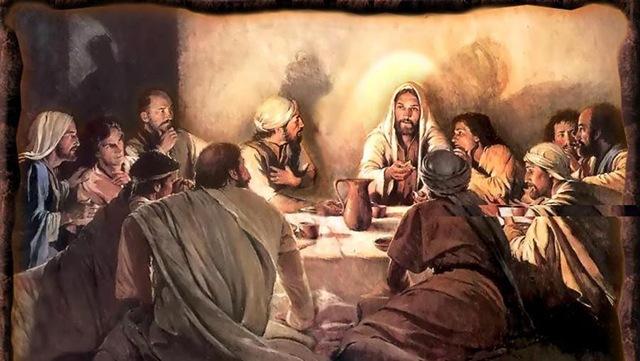
Maundy Thursday

Today is Maundy Thursday. Have you ever wondered what that means? Or what is significant about this day?

What is Maundy Thursday?

Maundy Thursday occurs the Thursday before Easter and commemorates the Last Supper of our Lord. On the day before Jesus’ crucifixion, Jesus and the Disciples met in the upper room to take the Last Supper, which occurred on the day of Unleavened Bread (Luke 22:7). The day when the Passover lamb had to be sacrificed (Luke 22:7).

The Passover

If you remember, the Passover was instituted during the Exodus event (Ex 12:14). Before God brought Israel out of Egypt, a final plague was delivered on the Egyptians. God declared that every firstborn in the land would be killed unless the blood of a lamb was smeared on the doorposts and lintel of their homes. As the Lord passed through the land, He would Passover the houses with the blood, while executing judgment on those who did not have the blood on the doorposts and lintel.

That night, at twilight, a lamb was to be slain and its blood spread on the doorposts and lintels, while its body was roasted to eat. As the Israelites waited, they were to eat the roasted lamb, with bitter herbs and unleavened bread with their belt fastened, sandals on their feet, and their staff in hand. In other words, they were to be ready to leave as they watched and waited on the deliverance of the Lord.

That night, the Lord passed through the land killing the firstborn of all who did not have the blood smeared on their doorposts and lintel. After which, the Exodus of Israel from Egypt occurred. At that time, the Israelites were delivered from the bondage and slavery of Egypt and set free to worship their God.

Jesus Re-institutes the Passover

In order to commemorate the Exodus, the feast of Unleavened Bread was instituted. It was this feast that the disciples and Jesus were celebrating. But something new was happening during the celebration. Jesus takes the wine and says that it represents His blood (Luke 22:20). He takes the bread and says it represents His body (Luke 22:19). At this time, Jesus was re-instituting the Passover Meal around Himself. In other words, He was telling the disciples that He would be the one to deliver His people from the slavery and bondage of sin, through a New Exodus (Eze 20:32-38; 37:15-28; Jer 16:14-15; Isa 40:1-13; 62:10-12). Thus, instituting a new covenant with His blood that would provide all who believed in Him with a new heart (Jer 31:31).

Taking the Lord’s Supper

When we take the Lord’s Supper tonight, in celebration of Maundy Thursday, we should take it in a state of celebration for Jesus’ work on the cross because it is His sacrifice that delivers us from the bondage of sin.

We also should take the Lord’s Supper with the same expectation and hope as the Israelites in Egypt. They were in a state of expectation, waiting and watching for the Lord’s deliverance as they ate their meal. We too, as we take the Supper, must wait in a state of expectation for our Lord’s return. We too must watch and be ready for Him to lead us in a final Exodus.

X-Ray Questions: Evaluating our pursuits

In an effort to help us root the idols out of our lives, I am doing a series entitled X-Ray Questions. You can view the other two posts by clicking here and here. In this post, we will focus on our aims and pursuits.

X-Ray Question

(3) What do you seek, aim for, and pursue? What are your goals and expectations?

This particularly captures that your life is active and moves in a direction. We are purposeful. Human motivation is not passive, as if hardwired needs, instincts, or drives were controlled from outside us by being “unmet,” “frustrated,” or “conditioned.” People are active verbs.

Understand

The things that we seek, aim for, and pursue, as well as the goals and expectations we set for ourselves reveal the true nature of our hearts. As humans, we are not controlled by external conditions or instincts. We are not animals. We have the ability to make decisions. Decisions that reveal the true nature of our heart.

For instance, if our life goal is to acquire a particular job or success in our career, then we will do everything and anything to make it happen. We may neglect our families, compromise our convictions, or defame a co-worker, in order to achieve the level of success we are seeking.

Our desire should be to glorify Christ, not ourselves. In glorifying Christ, we may miss a particular promotion at work, but our families will be better for it because we are able to spend more time teaching them and building them up in the Word of God. Our witness to others about Christ will be greater because our convictions are not compromised. Our relationships with our co-workers will not suffer, resulting in deeper more meaningful relationships that will hopefully allow us to either share the gospel, or build another believer up in the faith.

Repent

We repent by redirecting our pursuits towards Christ. We must value Him and His glory more than our glory. We must see Him as our provider, comforter, and from whom we gain affirmation. We must see His mission, to reach the world with gospel, as more important than our success.

As you reflect on your aims, pursuits, goals, and expectations, remember that climbing the corporate ladder is only one example. You may not struggle with that particular goal or you may be pursuing your career from a godly perspective, but that does not mean you do not struggle with something else. Other idols may include: acceptance, comfort, a new car, a perfect looking spouse, or a finely kept home. Since we cannot cover every idol, my prayer is that you will honestly reflect on your life this week to determine if any of your goals, expectations, or pursuits are taking the place of Christ.

Scripture

Reflect on these Scriptures as you seek to root this idol out of your life: Matt 6:32-33; 2 Tim 2:22

All X-Ray questions taken from David Powlison’s book Seeing with New Eyes.

Training Your Child In Righteousness

Recently, I did a photo shoot for my brother and sister-n-law’s new baby girl, Taylor. She is a newborn right now, but will soon grow up like her big brother. I remember when their son, Taylor’s brother, was born two years ago. As we looked back over his baby pictures it was hard to believe he has grown so much in the last two years. He has progressed from being fully dependent on mom and dad for everything to being able to walk, talk, and play. It is during these formable years that parents need to start actively teaching their children about their sinful hearts and need of a Savior. In order to help parents in the shepherding process, I am recommending a book. It is Shepherding a Child’s Heart by Tedd Tripp.

Here is a brief summary of Tripp’s book:

Ted Tripp’s book is focused on the heart of the child, not just his behavior. He begins by explaining that children’s behavior stems from the condition of their heart. Using techniques only designed to modify behavior does not tackle the real problem (4). Non-believers will act like non-believers, and believers will act like believers, so simply modifying behavior does not turn an unbeliever into a believer (3). Since behavior modification does not change a child’s heart, Tripp explains that parents must not be satisfied to only get their children to obey; they must also “help [their] child ask the questions that will expose that attitude of the heart that has resulted in the wrong behavior” (5). By helping children see that their heart is the real problem, parents are able to show their children their need for a Savior (6), which is the main goal of parenting, not parental convenience (27). Parents must “not try to shape the lives of [their] children as pleases [them], but as please [H]im (28)

In order to help parents shape their child’s life in a way that pleases God, Tripp offers a plethora of advice. He begins by helping parents understand the outside influences that shape their child’s life (10-16), while at the same time explaining to parents that changing these influences alone will not produce a more godly child (16-25). Before continuing with the child’s heart, Tripp turns toward the parent, helping them better understand their task by informing them of their God given authority (26-38), and by calling them to examine and rework their parenting goals (39-57). Tripp also takes the time to point out unbiblical parenting methods, such as pop psychology and emotionalism to name a few, and help parents evaluate the use of these methods from a biblical standpoint (58-69). Tripp then walks parents through biblical methods of parenting, explaining the importance and how to of communication, discipline, and appealing to the conscience (70-121). He shows parents how to shepherd through each stage of childhood by alternating between training objectives and procedures (127-210).

Conclusion

If you are looking for a book that seeks to address the condition of your child’s heart, then Tripp’s book is for you. His reasoning and methods are thoroughly grounded in Scripture. And he does a fantastic job teaching parents that behavior modification is not the ultimate goal. Rather, a changed heart through the saving and sanctifying power of the Gospel is the main goal parents should be working to achieve. I would recommend Tripp’s book to any parent seeking to learn how to shepherd their child from a biblical standpoint, which should be each and every parent.

Go Up The Mountain of the Lord

20110404-114252.jpg

Come ye, and let us go up to the mountain of the Lord.” — Isaiah 2:3

It is exceedingly beneficial to our souls to mount above this present evil world to something nobler and better.

The cares of this world and the deceitfulness of riches are apt to choke everything good within us, and we grow fretful, desponding, perhaps proud and carnal.

It is well for us to cut down these thorns and briers, for heavenly seed sown among them is not likely to yield a harvest; and where shall we find a better sickle with which to cut them down than communion with God and the things of the kingdom?

In the valleys of Switzerland many of the inhabitants are deformed, and all wear a sickly appearance, for the atmosphere is charged with miasma, and is close and stagnant; but up yonder, on the mountain, you find a hardy race, who breathe the clear fresh air as it blows from the virgin snows of the Alpine summits. It would be well if the dwellers in the valley could frequently leave their abodes among the marshes and the fever mists, and inhale the bracing element upon the hills.

It is to such an exploit of climbing that I invite you this evening.

May the Spirit of God assist us to leave the mists of fear and the fevers of anxiety, and all the ills which gather in this valley of earth, and to ascend the mountains of anticipated joy and blessedness.

May God the Holy Spirit cut the cords that keep us here below, and assist us to mount!

We sit too often like chained eagles fastened to the rock, only that, unlike the eagle, we begin to love our chain, and would, perhaps, if it came really to the test, be loath to have it snapped.

Spurgeon’s Prayer

May God now grant us grace, if we cannot escape from the chain as to our flesh, yet to do so as to our spirits; and leaving the body, like a servant, at the foot of the hill, may our soul, like Abraham, attain the top of the mountain, there to indulge in communion with the Most High.

Charles H. Spurgeon, Morning and Evening : Daily Readings, Complete and unabridged; New modern edition. (Peabody, MA: Hendrickson Publishers, 2006), Evening, April 4.

Defeating Materialism


I want, I want, I want!! This is the mantra of our consumeristic society. We all want a shiny new car, celebrity status, designer clothes, and a brand new house. We disregard our families and sell our souls to attain these worldly possessions. But for what reason?  This life will end one day, and we will not be able to take these possessions with us.

If this is true, then how do we defeat the power of materialism?

Yesterday, I led a discussion over Luke 20:27-40, during which we talked about how to rid ourself of the power of materialism, while still having possessions.

Four ways were given, which I would like to share with you.

  1. View your material possessions as provisions God has given you, in order to complete your journey in this life.
  2. Find your significance in your relationship with Jesus, rather than in material possessions.
  3. Find your satisfaction in Jesus, rather than in your possessions.
  4. Be willing to give sacrificially because you don’t find your security in your wealth, but in Christ.

The trend in all four is to stay focused on God, not man. Find your significance, security, and satisfaction in Him alone. All your material possessions will disappoint you, but Christ will not.

Shouldn’t we be training leaders?

Friday night I had the opportunity to help out at Southwestern Seminaries annual Youth Ministry Lab (YML 2011). I was highly encouraged by the turn out of youth who have answered God’s call of leadership on their lives. Over 400 youth showed up on Friday night to kick the weekend off. They started with a time of praise and worship with the Ross King Band, and preaching from Tony Merida. They then participated in a lion’s den session, where they could ask Southwestern Faculty any question they wanted, followed up by leadership training. Watching these students desire to learn and serve Christ was encouraging. Not only was it encouraging to see these youth’s love for the Lord, but it further cemented for me the importance of training the next generation of leaders.

Leaders must be training leaders. We should be discipling others who are answering God’s call on their life for ministry. However, all to often churches fail in this area. They do not spend the time equipping men for leadership.

“The result is devastating to both our personal ministry and the future of the church.”

Personal Ministry

It is devastating to our personal ministry because we are not enlisting other leaders to help us in the task of shepherding the flock. Not having enough leaders to spread ministry responsibilities results in burn out. One man cannot be expected to shepherd a large group of people over a prolonged period of time without help.

The Example of Moses

Moses is a prime example. His father-in-law, Jethro, realized that Moses was going to kill himself if he tried to shepherd all of Israel without any help, which is the reason he counseled Moses to appoint capable men over smaller groups of Israelites (Exod. 18).

Likewise, our ministries will not flourish, and we will not survive, if we are not equipping others to minister alongside us.

The Future of the Church

Not only did Moses appoint other elders to look after Israel, but he also trained Joshua to take his place upon his death (Joshua 1:7). Pastors today need to follow Moses’ example by training others to take their place when their time of ministry ends. If they do not, then the result will be devastating for the future of the church.

The Example of Joshua

Take for instance, the story of Joshua. He was trained throughout Moses’ ministry and was prepared to take over when Moses died. However, Joshua failed to follow Moses’ example and teach the people the necessity of training their youth. After his death and the death of the elders, a generation arose that did not know the Lord, nor the work the Lord had done in Israel (Joshua 2:10). The result was devastating for the nation of Israel. They fell into idolatry, and everyone did what was right in their own eyes (Joshua 2:11-15).

Likewise, the result will be devastating for the future of our church if we are not preparing leaders to take our place when our ministry comes to an end. Without capable leadership to take over, disunity and power struggles will ensue.

The Solution

The solution is simple. We must be committed to training our future leaders. It was obvious tonight that the youth pastor’s who took the time and money to bring their youth to YML are committed to training future leaders. Their dedication to this task was highly encouraging to me, and it should be encouraging to you.

The Charge

My charge to you is to invest in your people. Find a future leader in your church, spend time with them, teach them Scripture, and train them to lead the people. Both your personal ministry and the future of your church will be all the better for it.