Judge Not – What does it really mean?

Court Room

It is not uncommon to hear people to say:

Aren’t we all sinners? What gives you the right to make moral judgments about someone else? Isn’t that God’s job?” “Do not judge, or you to will be judged.”

Some who make these claims know where this verse is found, and others do not, but the common theme is that it is used out of context. Incase you did not know, the verse is found in Matthew 7:1.

Why is this verse commonly used, or might I say, misused?

People desire to shield their sin. They want to keep others at bay. They desire to have “unrestrained moral freedom, autonomy, and independence [1].” They don’t want anyone to question their behavior, thoughts, or ideals.

That is a secular way of thinking. It is not a biblical way of thinking. Jesus is not giving this command so others can hide behind it. He is not giving this command as a license to sin. The Bible is clear about that.

  • The Bible gives us commands we are to live by.
  • The Bible tells us we are to hold others accountable.
  • Jesus provides us with the steps to church discipline.
  • Jesus provides us with a church so that we can stir one another up and encourage one another in the faith.
  • Jesus provides us with people in our life to point out our sin so that we will grow to be more like Him.

So then, Jesus’ command is not to be used to shield ourselves from moral scrutiny. To think and act in that way is to think and act in a secular way. It is to allow the world to influence us, and our interpretation of the Bible.

Instead of looking at the Bible through the world’s lens, we have to look at the Bible through its own lens. We have to allow it to interpret itself.

What Does This Verse Really Mean?

Even though people use this verse to dissuade others from judging their behavior, the verse actually does not mean we cannot ever judge another person. Let’s look at this verse in context, and you will see what I mean.

Judge not, that you be not judged. For with the judgment you pronounce you will be judged, and with the measure you use it will be measured to you. Why do you see the speck that is in your brother’s eye, but do not notice the log that is in your own eye? Or how can you say to your brother, ‘Let me take the speck out of your eye,’ when there is the log in your own eye? You hypocrite, first take the log out of your own eye, and then you will see clearly to take the speck out of your brother’s eye.”

After reading this verse in context, it should be apparent that Jesus is addressing judgmentalism and hypocrisy. He was after those who were critical of others and those who operated under a double standard. As well as He was after those who judged others without first dealing with their own sin.

Essentially, Jesus is giving two commandments:

  1. Stop judging others in a hypocritical fashion.
  2. Get the sin out of your own life [2].

So then, Jesus is not telling us we cannot speak about the sin in others lives. Rather, He is telling us that we are not to be hypocritical. We are not to operate under a double standard. We are not to be critical of others.

Can We Judge?

The answer is yes. In fact, it is our duty to judge others, so that they will grow in the Christian life. We are to spur one another on to growth and godliness, and we are to keep each other accountability. Hebrews 10:24-25 says,

And let us consider how to stir up one another to love and good works, not neglecting to meet together, as is the habit of some, but encouraging one another, and all the more as you see the Day drawing near.

In order to stir one another up and hold them accountable, we have to look into people’s lives and make judgments about how they are living.

However, if we are not humbly submitting our own lives to the Word of God for review, and if we are not willing to allow others to help us in that task, then we are not to judge others. If we are examining our own lives, and we are dealing with our own sins, living a life of genuine repentance, then we can judge others.

It is important that we are dealing with our own sin because those who are working on their own sin will approach others in a vastly different way than those who are not.

Those who don’t think they have any sin to work on will approach others in a judgmental way. Those who do work on their sin first will approach others with love, mercy, grace, and patience.

The reason for that is because they realize that God has had mercy on them; He has come to them in love; He has patience with them; He has shown them grace. Those who have experienced these things, will be in a better place to point out others sins than those who haven’t.

So then we can judge others, but not before we deal with the sin in our own lives.

The Proper Way to Judge

When we judge others, we must do it in a loving way. We are not judging them in order to make ourselves look better. We don’t come at them from a morally superior position. No, we approach them in love, humbly recognizing we are all sinners, we have all fallen short of God’s glory, and we all need Jesus Christ as our Lord and Savior. If we approach people from that position, then we have a right, neigh a duty, to speak into their lives, so that we may wage war on the flesh together.

Conclusion

Jesus did not say these words, in order to keep us from making moral judgments. Nor did He give us this verse so we can shield our own sin from review. Rather, He is attacking those who are hypocrites; those who operate under a double standard; those who are critical.

So then, when we look at this verse in context, we see that we can judge others, as long as we are first judging ourselves, and as long as we are approaching them in a loving manner.

Question for Reflection

  1. Do you agree or disagree? Why or why not?

Resource

[1] Eric Bargerhuff, The Most Misused Verses in the Bible, 26.
[2] Ibid., 27

Image

Judge Not – What does it really mean? (Sermon I preached on this topic)

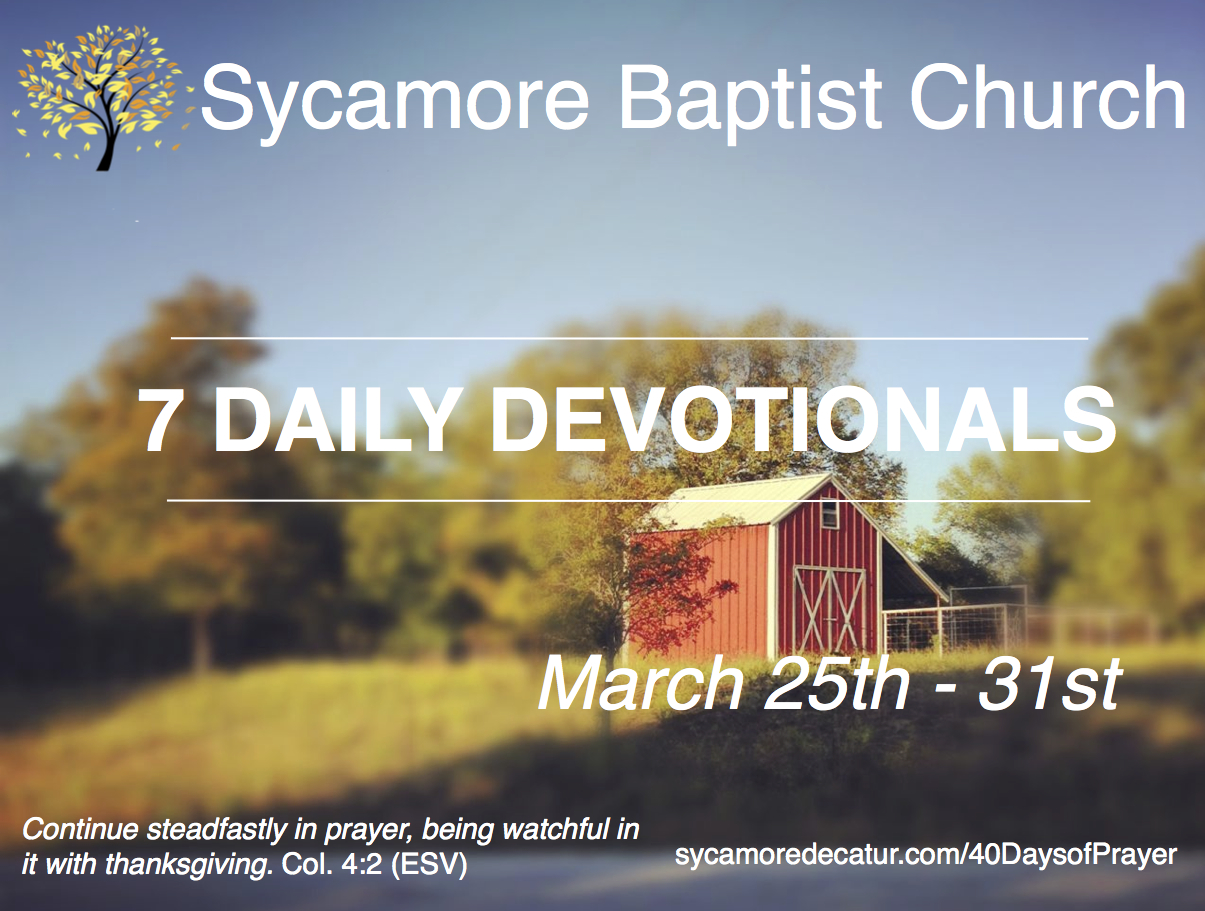
40 Days of Prayer Begins Today

40 Days of Prayer Graphic

40 Days of Prayer begins today. We would love for you to pray alongside us during this time, as we lift up our nation, city, community, and church.

Here is the information for 40 Days of Prayer: sycamoredecatur.com/40DaysofPrayer

How Can We Celebrate the Resurrection All Year?

Resurrection

Yesterday was Easter. If you went to church, you celebrated the resurrection of Jesus Christ. Today, you can still celebrate the resurrection.

In my sermon yesterday, I challenged the congregation to celebrate the resurrection all year long. The way we do that is by living as resurrected Christians.

What do I mean by resurrected Christian?

In Romans 6:1-14, Paul tells us, when we profess Jesus as Lord and Savior, we are united to Him. His death becomes our death. His burial becomes our burial. His resurrection becomes our resurrection.

When God looks at believers, He sees a people who have already suffered His punishment, already died, and already been resurrected, which means He no longer see us as sinners who deserve punishment. He sees us as He sees His Son. He sees us as those who have been resurrected.

For those who have been united to Christ in His death, burial, and resurrection, the penalty for sin is paid. The power of death is broken. They are resurrected to live in newness of life.

When we obey God’s commandments, live as if our old man has been crucified, the power of sin broken, as those free to serve and worship God, we live as resurrected Christians. When we live as resurrected Christians, we celebrate the resurrection everyday of our lives.

Three Ways Our Union with Christ Applies to Resurrected Christians

(1) Resurrected Christians know why they can obey God.

Christians don’t obey God because somehow they try harder than non-Christians. They obey God because:

(1) Sin is no longer their master.

They have been set free from sin.

(2) As well as their heart has been changed.

They have new desires. One’s that direct them to know God’s commandments and obey them.

So then resurrected Christians know why they obey God. It is not because they have pulled up their bootstraps and manned up. It is because of their union with the resurrected Savior.

Practically, this is important because if we believe the only way we can obey God is by our own efforts, we have setup a system that causes us to forget that our union with the resurrected Savior is what empowers us to obey God. That is going to cause us to be frustrated because we can’t obey God in our own power. To try to do so is futile. We must be united with the resurrected Savior.

So you may ask yourself:

  1. Why do I obey God?
  2. Is it because I try hard?
  3. Or is it because I know the bonds of sin have been broken and my heart has been changed?

If we are resurrected Christians, the second will be true for us.

(2) Resurrected Christians do not continue to live a life of sin.

This doesn’t mean we will not sin; we will. Instead it means our lives will not be characterized by sin. We will do all we can to follow God’s commandments.

  • We will read and know God’s Word.
  • We will gather with other Christians to discuss and learn His Word.
  • We will ask others to hold us accountable.
  • We will flee from sin.
  • We will know our struggles.

That is not to say that we will not be disobedient to God from time to time as Christians. Rather, it is to say that the continual pattern of a resurrected Christian is obedience to God.

So you may ask yourself:

  1. Is my life marked by continual obedience to God’s Word?
  2. Have I been faithful to live for God since I professed Christ?

If you are a resurrected Christian, then you will continually obey God.

(3) Resurrected Christians are motivated to obey God by the gospel

This means they do not obey in order to pay God back or earn their salvation. They understand they have been made a new creation. They know that the old man has been laid aside. They understand they are now freed from the bondage of sin and Satan. They know this has occurred because of God’s grace.

So instead of obeying to pay God back or earn salvation, resurrected Christians obey because they are free and thankful. They are overwhelmed with the thought that Christ would die for them. They are overwhelmed with the knowledge that they have been freed from the bondage of sin, Satan, and death. Their gratitude and freedom then motivates them to obedience.

So you may ask yourself:

  1. Am I thankful for Christ’s death and resurrection?
  2. Am I thankful I have been freed from the bondage of Satan, sin, and death?
  3. Does my gratitude and freedom motivate me to serve God and obey His commandments?

If it doesn’t, then you might want to consider whether or not you are a resurrected Christian.

Question for Reflection

  1. Do you live as a Resurrected Christian?

Resource

Image

The Valley of Vision: Resurrection

Jesus is Risen from the Grave

O GOD OF MY EXODUS,

Great was the joy of Israel’s sons
    when Egypt died upon the shore,

Far greater the joy
    when the Redeemer’s foe lay crushed in the dust.

Jesus strides forth as the victor,
    conqueror of death, hell, and all opposing might;

He bursts the bands of death,
    tramples the powers of darkness down,
    and lives for ever.

He, my gracious surety,
    apprehended for payment of my debt,
    comes forth from the prison house of the grave
    free, and triumphant over sin, Satan, and death.

Show me herein the proof that his vicarious offering is accepted,
    that the claims of justice are satisfied,
    that the devil’s sceptre is shivered,
    that his wrongful throne is levelled.

Give me the assurance that in Christ I died, in Him I rose,
    in His life I live, in His victory I triumph,
    in His ascension I shall be glorified.

Adorable Redeemer,
    Thou who wast lifted up upon a cross
    art ascended to highest heaven.

Thou, who as man of sorrows wast crowned with thorns,
    art now as Lord of life wreathed with glory.

Once, no shame more deep than Thine,
    no agony more bitter, no death more cruel.

Now, no exaltation more high,
    no life more glorious, no advocate more effective.

Thou art in the triumph car leading captive Thine enemies behind Thee.

What more could be done than Thou hast done!
    Thy death is my life, 
    Thy resurrection my peace,
    Thy ascension my hope, 
    Thy prayers my comfort.

Resource

The Valley of Vision, Resurrection, 86-87 (leather edition edition)

Image

40 Days of Prayer Devotionals – Day 7

Devotional Day 7

Day 7 – The Challenge Before Us

As we end this week of preparation, we hope you have benefited from the daily devotionals. It is our prayer that you share our desire for national healing, revival in the church and salvation for the lost in our community.

Tomorrow starts our 40 day event of focused prayer. We anticipate struggles with maintaining this schedule. It is easy to be excited and motivated during the planning and early days but our schedules are full. Work, family and even church commitments can drain our energy and distract us from obedient service to God.

For many of you, today, Easter Sunday, will be filled with activities celebrating the resurrection of our Lord and Savior, Jesus Christ. Let the gospel truth of His redemptive work motivate and strengthen you. As part of your worship today, meditate on the things God has shown you this week. Be encouraged with the knowledge that you have a High Priest who can sympathize with our weakness and in all points has faced the temptations, which beset us.

Let us then with confidence draw near to the throne of grace, that we may receive mercy and find grace to help in time of need.” (Hebrews 4:16)

 Resource

If you would like more information about 40 Days of Prayer, including how you can download a PDF copy of the information and link with us on social media, visit our website: sycamoredecatur.com/40DaysofPrayer

Colored Eggs, Scavenger Hunts, or the Resurrection

Resurrection Empty Tomb Jesus

What comes to mind when Easter is mentioned? For many it might be the thoughts of family gatherings, colored eggs, and scavenger hunts. Easter, however, is about more than our family, our fun, and ourselves. Easter is about the Resurrection of Jesus from the dead.

Why is the Resurrection Important?

(1) It proves all Jesus’ claims during His earthly ministry were true.

As the climax of the biblical story, it proves that Jesus is the Messiah, the Chosen One, the Son of God, the Savior of the World.

(2) It provides salvation for the believer.

Jesus’ resurrection brings all those, who believe by faith that He is their Savior, into a right relationship with God (Rom. 4:25). In Jesus’ resurrection we are vindicated and made sons of the Living God (Gal. 3:26). As well as, we are freed from the bondage of sin, which means we should not let sin reign in our bodies any longer. We must put all unrighteousness to death by the power of Jesus’ resurrection (Rom. 6:11-13).

(3) It provides eternal life for the believer.

Death no longer has dominion over the Christian. All those who believe in Jesus as their Savior, will be resurrected to a new and eternal life, and given a perfect body that is not subject to aging, weakness, or death (1 Cor. 15:50-57). Whereas, all who reject Jesus as their Savior will experience eternal punishment (Matt. 25:46; 2 Thess. 1:5-10).

The Proper Response to the Resurrection

In Matthew 28, Mary Magdalene and the other Mary go to the tomb of Jesus where they meet an angel. The angel shows them the empty tomb and tells them to go and tell the disciples that Jesus has risen from the dead. On their way to tell the disciples, they meet Jesus on the road and fall down and worship Him.

The two Mary’s provide us with the proper response to the resurrection.

  1. We are to go and tell others of Jesus’ resurrection and what that means for those who believe.
  2. We are to worship Jesus as Savior and Lord.

Conclusion

Jesus’ resurrection proves all that He said is true. It vindicates us from our sin. It mends our relationship with God. It frees us from the bondage of sin. It allows us to live in accordance with God’s commandments. As well as Jesus’ resurrection provides us with a new body that will never die, age, or experience decay for all of eternity.

As a result, our proper response is to tell others about Jesus’ resurrection, and to worship Him as Lord and Savior.

I pray that we will contemplate more fully the resurrection of Jesus this Easter Sunday.

Resource

Image