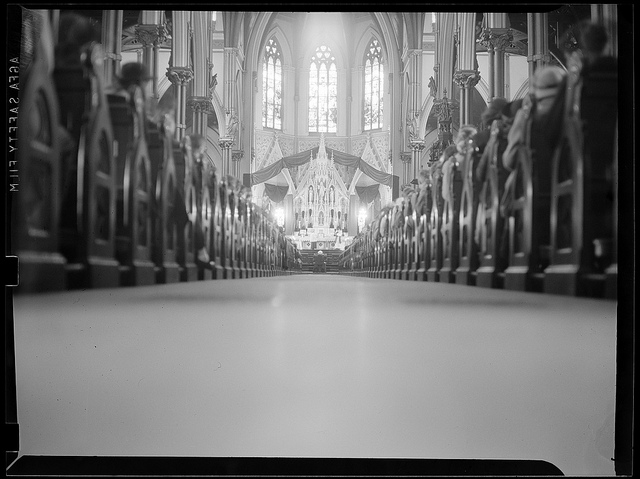
Why Don’t People Participate in Christian Community?

IMG_6096-1

Robert Putnam in his book Bowling Alone says,

“Over the last three to four decades Americans have become about 10 percent less likely to claim church membership, while our actual attendance and involvement in religious activities has fallen by roughly 25 to 50 percent. Virtually all the postwar boom in religious participation – and perhaps more – has been erased.”

Why is involvement in Christian community decreasing? There are several reasons.

Reasons People Don’t Participate in the Church’s Community

(1) Individualism – A lot of church members are individualistic believing they can change by themselves.

(2) Compartmentalism – Most people tend to compartmentalize their lives. There is church life, work life, and family life.

(3) Busyness – Almost all Americans are busy. But we all know we make time for what is important. So when we say, “I am too busy”, what we really mean is that living in community with other Christians is not important to us.

(4) Consumerism – Most Americans are consumerists. They come to church in order to get, but are not willing to give. They are content sitting in the pew week after week because they have been conditioned by society to consume and shop around instead of plugging in and getting involved.

Questions for Reflection

  1. Do you resonate with any of these points?
  2. Are there others reason you would offer for why people don’t participate in the Christian community?

Resources

Want to learn more? You should check out:

On True Church Growth

The growth of the gospel happens in the lives of people, not in the structures of my church.

Or to put it in terms of our opening metaphor, the growth of the trellis is not the growth of the vine.

We may multiply the number of programs, events, committees and other activities that our church is engaged in; we may enlarge and modernize our buildings; we may re-cast our regular meetings to be attractive and effective in communicating to our culture; we may congratulate ourselves that numbers are up. And all of these are good things!

But if people are not growing in their knowledge of God’s will so that they walk ever more worthily of the Lord, seeking to please him in all things and bearing fruit in every good work, then there is no growth to speak of happening at all.

Questions for Reflection

  1. How do you measure growth at your church?
  2. Do you seek to fill the pews, or to fill people’s hearts with the truth of the gospel?

Resources

Colin Marshall and Tony Payne, The Trellis and the Vine, 82.

Image

On Felt Needs

The newscaster gives us the awful truth, which is reality; the Bible gives us the revealed truth, which is revelation; psychology has given us the hidden truth, which is a rip-off.

America is the psychological society, and the language and philosophy of need have seduced the church.

Therefore the people in the pew ask all the wrongs questions, based on cultural programming:

  • What can the church do for me?
  • Can I get my needs met here?
  • Do I feel good when I leave here?
  • Does the pastor make me feel guilty?
  • Will I have to do what I don’t feel like doing?

These questions and more reflect the corruption of self-idolatry primarily fostered in our society by the secular psychological community.

This has led to the development of a “need theology” that finds its roots in gratifying the desires of the flesh. Therefore, the most popular theologies of today are directed toward immediate need gratification.

Questions for Reflection

  1. Can the church meet the needs of its congregants without being a felt needs church?
  2. How would you suggest a pastor meet the needs of his congregation without being a felt needs pastor?

Resources

Bill Hull, The Disciple Making Pastor42.

Image

On the Disappearance of Theology

The Stats

What does it mean, for example, when 91 percent of evangelicals say that their beliefs are “very important” to them, when 93 percent say that they believe in divine judgment, when 96 percent say that they believe in miracles? It does not mean all that much.

Theology is Peripheral and Irrelevant

Even in churches that are active and among believers who are religiously observant, it is possible that theology (i.e., a set of beliefs that refers beyond the experiencing subject to the world “out there, “natural and supernatural) has become peripheral and remote.

Even “those who count themselves as believers, who subscribe to the tenets of a Church, and who attend services regularly, ” Bryan Wilson has observed, “nevertheless operate in a social space in which their beliefs about the supernatural are rendered in large part irrelevant.”

Wherever modernity has intruded upon the Church, there the social space even of believers who give assent to the full range of credal elements will be emptied of theology.

Even the beliefs of such individuals will have been pushed to the margins of life, the central and integrating role they once had commandeered by other interests.

Theology on the Periphery Can’t Define Evangelical Life

It is in this sense that it is proper to speak of the disappearance of theology. It is not that the elements of the evangelical credo have vanished; they have not. The fact that they are professed, however, does not necessarily mean that the structure of the historic Protestant faith is still intact.

The reason, quite simply, is that while these items of belief are professed, they are increasingly being removed from the center of evangelical life where they defined what that life was, and they are now being relegated to the periphery where their power to define what evangelical life should be is lost.

Practice Reveals What Polling Can’t

This is not the sort of shift that typical polling will discover, for these items of belief are seldom denied or qualified, but that does not mean that the shift has not occurred. It is evangelical practice rather than evangelical profession that reveals the change.

Questions for Reflection

  1. What do you think of the state of the church? Has care for theology been moved to the periphery?
  2. If theology is moved to the periphery, what affects will that have on the church?

Resources

David Wells, No Place for Truth Or Whatever Happened to Evangelical Theology?, 107-108. (NOTE: Paragraphs are Wells; headings are mine)

Image

On Salvation

The mark of someone who is saved is that they maintain their confession of faith until the end of their lives.

Salvation is not a prayer you pray in a one-time ceremony and then move on from…

…salvation is a posture of repentance and faith that you begin in a moment and maintain for the rest of your life.

Question for Reflection

  1. Are you assured of your salvation because you prayed a prayer or because you are actively following Jesus?

Resources

J.D. Greear, Stop Asking Jesus Into Your Heart, 5.

Image

How Do You Know You Are Apart of Jesus’ Family

Church Family

Who is apart of your family? That’s easy, it’s either those born into the family, those adopted, or those who married in. If they weren’t born or married in, or if they weren’t adopted, they aren’t apart of your family.

Jesus’ criteria for being apart of His family is different. You can’t be born in and you can’t marry in. But you can be adopted. The only way to be adopted is to believe in Jesus as your Lord and Savior.

How do we know who are apart of Jesus’ family? Anyone can say they are apart of the family. How can we know for sure they, or we, are in?

Who Are Apart of Jesus’ Family?

In Matthew 12, Jesus tells us who are apart of His family. Starting in verse 46 Jesus says,

While he was still speaking to the people, behold, his mother and his brothers stood outside, asking to speak to him. But he replied to the man who told him, “Who is my mother, and who are my brothers?” And stretching out his hand toward his disciples, he said, “Here are my mother and my brothers! For whoever does the will of my Father in heaven is my brother and sister and mother.” (Matthew 12:46-50, ESV)

Jesus is explicit. Those who do the will of the Father are apart of His family. In other words, those who desire to live according to God’s Word are apart of His family, and those who don’t, aren’t apart of the family.

Jesus’ family members desire and live according to the Father’s will.

An Important Point

Jesus’ criteria is an important concept to grasp. There are many who claim to be Christians. Who claim to know God. Who claim that Jesus is their Savior. These same people, however, don’t desire, or do, the will of the Father. They don’t live according to God’s Word, which means they are not apart of Jesus’ family.

Jesus is explicit. If you don’t do the Father’s will, you aren’t apart of His family. If you don’t submit to God and allow Him to call the shots in your life, you aren’t apart of His family. If you don’t live according to God’s Word, you aren’t apart of His family.

You might be religious. You might be spiritual. You might be a good person. You might come to church every week. You might rub elbows with Christians. You might help everyone in your neighborhood. But if you don’t do the Father’s will, you aren’t apart of Jesus’ family.

Questions for Reflection

  1. Do you search God’s Word to determine His will?
  2. Do you desire to live in obedience to God’s Word?
  3. Do you allow God to be number one in your life?
  4. Do you allow God to direct your life?
  5. Do you seek to follow Jesus on a daily basis?

Resources

Image

Post adapted from my most recent sermon: Jesus’ Family Doesn’t Need A Sign