Respectable Sins: 4 Manifestations of Pride | Part 2

In my last post in this series, I discussed the pride of moral self-righteousness. Today, I continue my discussion by focusing on the pride of correct doctrine.

The Pride of Correct Doctrine

This sin manifests itself when we think our belief system is superior to others. It often occurs in those who are theologically minded, or even in someone who believes doctrinal distinctions are erroneous or unnecessary. Personally, being theologically minded and having attended seminary, I struggle most with this form of pride.

What does Scripture have to say?

Scripture is not silent when it comes to the pride of correct doctrine. In 1 Corinthians 8:1 Paul addresses this form of pride, when he writes,

 “Now concerning food offered to idols: we know that “all of us possess knowledge.” This “knowledge” puffs up, but love builds up.

In this verse, Paul does not disagree with their knowledge. He too believes that idols are nothing and that eating meat offered to idols is permissible. What he disagrees with is the pride associated with their knowledge.

Apparently, some in the church in Corinth had become puffed up because they thought themselves doctrinally superior to the other church members, since they realized food offered to idols was not wrong to eat.

Paul tells them that their knowledge is not to puff them up, but it is to cause them to act in love. Knowing that others will stumble when they eat meat offered to idols, should result in them limiting their eating of it to certain times and places; times and places when and where their weaker brothers are absent. In doing so, they would be acting out of love and not pride.

However, if they chose to partake when their weaker brother was present, they would not only cause them to stumble, but they would be acting out of pride. Since they would be touting their knowledge of correct doctrine.

How do we guard against this form of pride?

First, by treating others with respect. Realizing that many godly men and capable scholars hold differing beliefs than we do for good reasons. We should not down them, as if they are stupid, ignorant, or less intelligent. Rather, we should disagree with the system to which they hold, while still respecting them and their abilities.

Second, by being humble about our beliefs. So what if we have it right? Being doctrinally correct does not make us better than someone else.

Looking Forward

In my next installment in this series, I will focus on the pride of achievements. Until then, reflect on this post through the questions below.

Questions for Reflection

  1. Are you susceptible to this form of pride?
  2. What belief systems might we believe are better than others?
  3. Has God convicted you of this sin in the past? If so, how did you deal with it?
  4. How might it affect our church if we rid the pride of correct doctrine from our church?

Resource

Post Adapted from Respectable Sins by Jerry Bridges, 89-100

Respectable Sins: 4 Manifestations of Pride | Part 1

This week we are going to discuss pride. To be more specific, I are going to dig a little deeper and look at certain expressions of pride that believers are easily susceptible to committing.

The expressions of pride I will focus on will be:

  1. The pride of moral self-righteousness
  2. The pride of correct doctrine
  3. The pride of achievement
  4. The pride of an independent spirit

In what follows, I will discuss how each of these manifests itself in our lives, what Scripture has to say, and how we can rid this sin from our lives.

Let’s start today by looking at the pride of moral self-righteousness.

The Pride of Moral Self-Righteousness

In Luke 18:11-12 Jesus tells a parable of a Pharisee who went down to the temple to pray. A tax collector went down at the same time he did. As the Pharisee stood before God, and next to the tax collecter, he prayed like this:

‘God, I thank you that I am not like other men, extortioners, unjust, adulterers, or even like this tax collector. I fast twice a week; I give tithes of all that I get.’” (Luke 18:11–12, ESV)

The Pharisees’ prayer shows he thought himself to be morally superior to the tax collector. When reflecting on this prayer and Jesus’ teaching afterwards, we learn that anyone who believes they hold a moral high ground, whether that be in their spiritual life, or in politics, economics, or environmental policy are committing the sin of moral self-righteousness.

Why is Moral Self-Righteousness a common form of pride?

Amongst Bible believing evangelicals moral self-righteousness is a common form of pride. That is because it is easy to indulge in this sin when reflecting on the moral climate in our society. When we look around and see others either “committing or condoning such flagrant sins as immorality, easy divorce, a homosexual lifestyle, abortion, drunkenness, drug use, avarice, and other flagrant and scandalous sins,” which are sins we don’t commit, we tend to feel morally superior to them [1].

How do we guard against this form of pride?

First, by realizing none of us are naturally morally upright (Ps. 51:5). If it were not for God working in our lives, then we very well likely could be in the same or even worse place as the drug dealer on the other side of the tracks. Knowing that should lead us to have the attitude that:

There but for the grace of God go I.”

Second, we can guard against this sin by identifying ourselves before God with the sinful society in which we live. Ezra did just this and so should we. In Ezra 9:6 we read,

saying: “O my God, I am ashamed and blush to lift my face to you, my God, for our iniquities have risen higher than our heads, and our guilt has mounted up to the heavens.” (Ezra 9:6, ESV)

Did you notice that Ezra said, “our iniquities” and “our guilt”? Even though he was one who feared the Lord and sought to please Him with his actions, he still identified with his societies sins. He identified with their sins because he believed himself to be apart of his society. As a member of the nation of Israel, he felt he was just as guilty.

So then, instead of setting ourselves apart from our society, if we include ourselves in it, we will be hesitant to think ourselves morally superior to everyone else.

Looking Forward

In my next installment in this series, I will focus on the pride of correct doctrine. Until then, reflect on this post through the questions below.

Questions for Reflection

  1. What principle can we learn from the Pharisee? Are there other areas of life besides spiritual life that we can become morally self-righteous about?
  2. Why do you believe Moral Self-righteousness is a common sin amongst Bible believing evangelicals?
  3. Has God convicted you of this sin in the past? If so, how did you deal with it?

Resource

[1] Jerry Bridges, Respectable Sins, 90.

Post Adapted from Respectable Sins by Jerry Bridges, 89-100.

Respectable Sins: Unthankfulness | Part 2

In my last post in this series, I defined unthankfulness, discussed why it was a sin, and look at what it would lead to. In this post, I am going to discuss when we are to give thanks.

When are we to give thanks?

(1) ALWAYS & IN EVERYTHING – Ephesians 5:20 tells us that we are to give thanks always and in everything. For all the blessings God gives us, we are to give thanks to Him.

(2) IN ALL CIRCUMSTANCES – We are not only to give thanks to God for the blessings He pours out on our lives, but we are to give thanks to Him in all circumstances. In Paul’s final benediction and instruction to the Thessalonians, he tells them to:

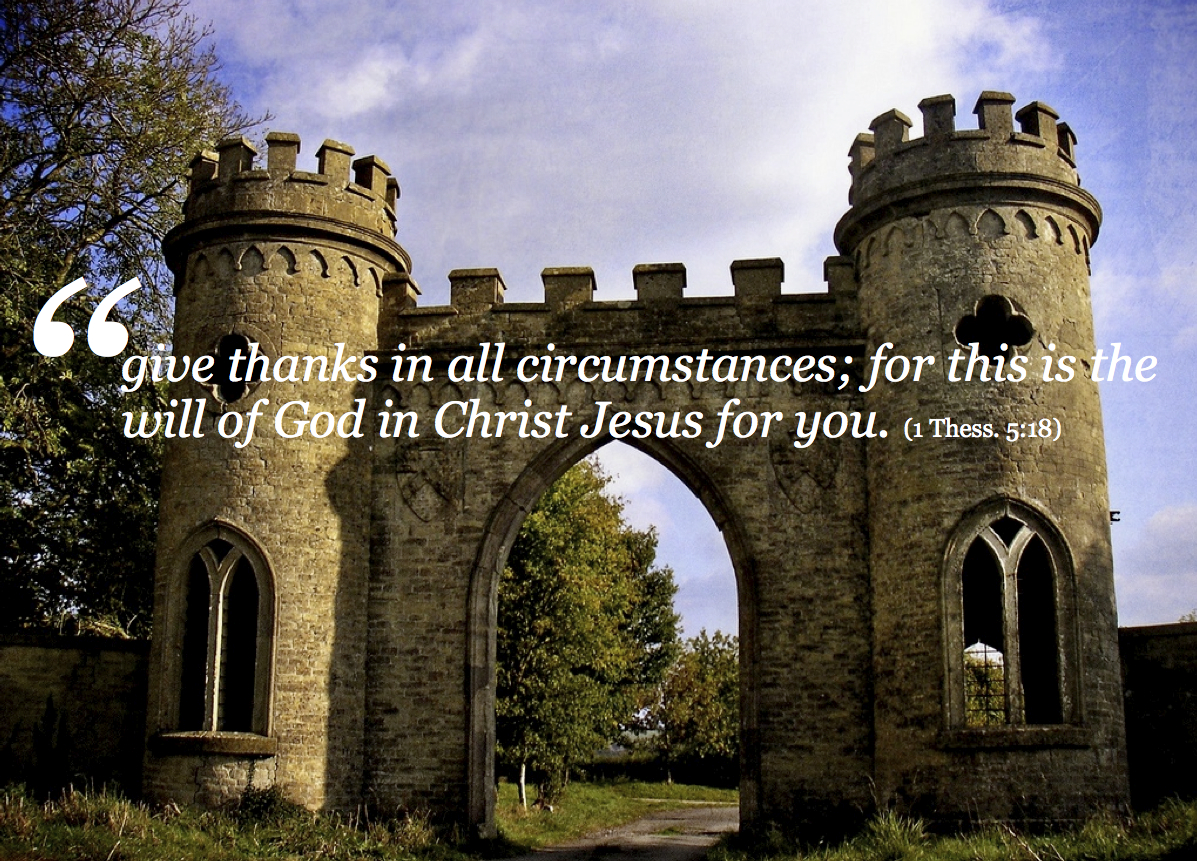
give thanks in all circumstances; for this is the will of God in Christ Jesus for you (1 Thess. 5:18).

This means no matter what is taking place in your life, whether it be good or bad, you are to give thanks to God. We can give thanks to God in these difficult circumstances because of Romans 8:28-29; 38-39.

In vs 28-29 Paul writes,

And we know that for those who love God all things work together for good, for those who are called according to his purpose. For those whom he foreknew he also predestined to be conformed to the image of his Son, in order that he might be the firstborn among many brothers.

When we look at Paul’s command in 1 Thessalonians 5:18 in light of these verses in Romans 8, we see that we can give thanks in all situations because God works all things together for good.

The good Paul refers to here is found in vs 29, and it refers to conforming us to the image of God’s Son, Jesus Christ. Since all circumstances are used by God to conform, or grow, us into the image of His Son, we can give thanks in all circumstances.

Commenting on this verse, Jerry Bridges says, 

“So in situations that do not turn out the way we hoped, we are to give God thanks that He will use the situation in some way to develop our Christian character. We don’t need to speculate as to how He might use it, for His ways are often mysterious and beyond our understanding. So by faith in the promise of God in Romans 8:28-29, we obey the command of 1 Thessalonians 5:18 to give thanks in [all] circumstances”[1].

We not only can give thanks because of Romans 28-29, but we can give thanks because of Romans 8:38-39, knowing that nothing can separate us from the love of God.

For I am sure that neither death nor life, nor angels nor rulers, nor things present nor things to come, nor powers, nor height nor depth, nor anything else in all creation, will be able to separate us from the love of God in Christ Jesus our Lord.

So then, no matter what we face in this life, if we are truly God’s children, nothing can separate us from Him, which means we can look forward to spending eternity with Him free from whatever terrible circumstances we have faced here on this earth.

Conclusion

As we have seen in these verses, we should develop the habit of continually giving thanks to God for everything we have and in all situations we find ourselves. For it is ultimately God who has given us everything we possess. This includes both tangible (possessions, job, family, etc) and intangible (intellectual and athletic ability, place we were born, etc) things.

Since God works all things together for good for all those who are in Christ Jesus, and since no circumstance can separate a true Christian from God, we should continually give thanks, knowing that even the worst circumstances we face are being worked together for our growth in Christlikeness. As well as no circumstance we face will pull us away from our Lord and Savior, whom we will spend all eternity worshipping and praising.

So may we always give thanks, never forgetting our all gracious and merciful Lord.

Questions for Reflection

  1. What are some circumstances that you would not think to give thank to give God thanks in?
  2. When you give thanks to God, is it heartfelt or nominal?
  3. Do you believe everything you have has come from the hand of God or do you believe you have earned some or most of what you have by hard work?

Scripture to Memorize 

Ephesians 5:20; 1 Thessalonians 5:18; Romans 8:28-29; 38-39.

Resources

[1] Jerry Bridges, Respectable Sins, 85.

Image

Respectable Sins: Unthankfulness | Part 1

Do you thank God on a regular basis? When you do is it nominal or heartfelt? Do you see every circumstance as a reason to give thanks? Unthankfulness is common. So common we don’t really pay it much attention, which is why it is considered a respectable sin, and one we must deal with.

Unthankfulness Defined

When I say someone is unthankful, I mean that they do not show appreciation for the things they have been given.

Why is it a sin?

Unthankfulness is a sin because by not thanking God for all we have, we show we do not recognize everything we have is from God. Our lack of recognition and thankfulness means that we believe all we have is from our own hand. When we believe we have obtained in our own strength everything we have, then we are living ungodly lives, forgetting He is the One who has given us everything.

This is the attitude that Moses counseled against in Deuteronomy 8:11-14, 17-20. There he writes,

Take care lest you forget the LORD your God by not keeping his commandments and his rules and his statutes, which I command you today, lest, when you have eaten and are full and have built good houses and live in them, and when your herds and flocks multiply and your silver and gold is multiplied and all that you have is multiplied, then your heart be lifted up, and you forget the LORD your God, who brought you out of the land of Egypt, out of the house of slavery…Beware lest you say in your heart, ‘My power and the might of my hand have gotten me this wealth.’ You shall remember the LORD your God, for it is he who gives you power to get wealth, that he may confirm his covenant that he swore to your fathers, as it is this day. And if you forget the LORD your God and go after other gods and serve them and worship them, I solemnly warn you today that you shall surely perish. Like the nations that the LORD makes to perish before you, so shall you perish, because you would not obey the voice of the LORD your God.

Moses explicitly tells the Israelites that they should not forget the Lord, who has given them everything. They were to remember:

  • The works of the Lord, which He performed when He brought them up out of the Land of Egypt and led them to the Promised Land.
  • As well as they were to remember that the Lord has given them their power and ability to accumulate wealth.

This means that nothing is gained apart from the hand of the Lord, and we should thank Him for everything we have.

It Can Lead To

The sin of unthankfulness can lead to:

(1) DESTRUCTION – In the above passage, after reminding Israel of the works of the Lord, Moses makes it clear that those who do not remember the Lord’s provisions are prone to go after other gods, which will result in their destruction. So instead of forgetting the Lord, they are to remember Him.

We are to do the same:

We are to remember that everything we have, all our abilities and possessions, are the result of the Lord’s hand in our lives.

For we too are prone to chase after other gods, trusting in them, or even in our own selves, instead of the Lord, which will ultimately result in our destruction unless the Lord intervenes and saves us.

(2) MORAL DECLINE – In Romans 1:18-32, we are told that those who forget the Lord and do not give thanks to Him (vs 21) have their foolish hearts darkened and they are given over to the lusts in their hearts. The result is the heinous list of sins that follows in verses 26-31. Not only do these sins cause a lot of heartache and trouble, but they also ultimately result in destruction.

Looking Forward

In my next post in this series, I will look at when we are to give thanks, and offer some Scripture to memorize to help with unthankfulness. Until then, reflect on the following questions.

Questions for Reflection

  1. Have you thought in the past that unthankfulness was a sin?
  2. Can you think of things in your life that you have not thanked God for giving you? If so, want you go ahead and lift up thanks to God right now.
  3. Do you agree that unthankfulness is closely related to ungodliness? How does knowing that change the way you think about the sin of unthankfulness?
  4. Do you agree that the sin of unthankfulness will lead to destruction and moral decline?

Resources

Post adapted from Respectable Sins by Jerry Bridges, 79-87.

Image

Respectable Sins: Discontentment | Part 3

How do you deal with sinful discontentment? Are you ambivalent, not caring one way or the other? Do you even view it as a sin? Are you willing to seek ways to kill discontentment in your life?

In my last post in this series, we began to deal with sinful discontentment. Today, I will offer a few ways we can kill sinful discontentment in our lives. As well as I will provide you with some specific scriptures to memorize and questions to ask yourself. Let’s get started by asking the question:

How Do We Deal with Sinful Discontentment?

We can deal with sinful discontentment through:

  • Prayer – We have to ask God, through the work of the Holy Spirit, to reveal to us areas in which we are discontent. As well as we have to ask Him, through the work of the Holy Spirit, to cause us to trust in His wisdom and sovereign plan.
  • Scripture Meditation and Memory – We need to meditate on and memorize specific scriptures, so that we can educate and remind ourselves that we should not be dissatisfied with our circumstances, finances, and possessions.
  • Acceptance and Trust – We must accept our circumstances, our finances and possessions, trusting that God, in His unerring plan and love, knows what is best for us and has purposed what is best for us. When we trust and accept our position in life, we can then ask God to let us use whatever has happened to us for His glory.
  • Purpose – We have to remember that our purpose in life is not for our glory. Our purpose in life is to bring God glory. Reminding ourselves our life is for God’s glory will help us to view and face even the most adverse circumstances with joy. The apostle Paul had this singular focus in life. It allowed him to rejoice while imprisoned and facing a trial that could lead to his execution (Phil. 1:12-26).

Scripture to Memorize

Hebrews 13:5-6; Luke 3:14; 12:15; 1 Timothy 6:6-10; 1 Thessalonians 5:18; Philippians 4:10-13; Psalm 139:16

Questions for Reflection

  1. In the past what have you done when you found yourself discontent? In other words, how did you work through the situation?
  2. How might you handle the situation now?
  3. Do you believe your purpose in life is to bring glory to God? How might viewing this as your purpose in life change how you look at your circumstances?
  4. Can you think of any biblical examples of those whose sole purpose in life was to bring glory to God?

Resources

Post adapted from: Jerry Bridges, Respectable Sins71-77.

Image

Respectable Sins: Discontentment | Part 2

Are you discontent with your possessions and money? Does your current circumstances cause you to be unhappy and unsatisfied? If so, you may be sinning.

In my last post in this series, I defined discontentment and gave a few areas where it is healthy to be discontent. Today, we turn our attention to sinful discontentment.

Why We Need to Deal with Sinful Discontentment

When we are sinfully discontent, we show that we do not believe God to be all wise, nor do we accept God’s sovereign control over our lives.

We also show that our thinking about our purpose in life is flawed. Instead of viewing our purpose in life as to bring glory to God, we believe life is about our glory. When a lack of finances, possessions, or difficult life circumstances do not work to bring us glory, then we become discontent.

These things are major issues. Issues that must be dealt with. For if they are not, they not only result in a rejection of God’s wisdom and sovereignty, along with a continued flawed view of our purpose in life, they also can lead to other sins such as resentment or bitterness.

Areas of Sinful Discontentment

(1) Money and Possessions – When we are unsatisfied or unhappy with our money or possessions, we are sinfully discontent.

The reason we are discontent in this area is because we have a desire for more. A constant desire for more reveals that our money or possessions have taken the place of God in our lives. When this happens, we no longer find our acceptance, comfort, joy, protection, and peace in God. Rather, we find it in our possessions and money, which is a problem and something we need to take action against.

Scripture

When discontentment in our finances and possessions surface, we need to remind ourselves of the truths of Scripture. Here are just a few passages to meditate on:

Hebrews 13:5-6

Keep your life free from love of money, and be content with what you have, for he has said, “I will never leave you nor forsake you.” So we can confidently say,

“The Lord is my helper;
I will not fear;
what can man do to me?”

We Learn

We are not to trust in our money or possessions. Rather, we are to trust in the Lord for He alone is our helper.

Luke 3:14

Soldiers also asked him, “And we, what shall we do?” And he said to them, “Do not extort money from anyone by threats or by false accusation, and be content with your wages.”

We Learn 

We are to be content with our wages, and we are not to extort others by threats or false accusations if we believe our wages are not enough.

Luke 12:15

And he said to them, “Take care, and be on your guard against all covetousness, for one’s life does not consist in the abundance of his possessions.”

We Learn

There is more to life than the possessions we own. The parable that follows in vs 16-21 teaches us that it is ultimately our soul that we should be concerned about.

1 Timothy 6:6-10

But godliness with contentment is great gain, for we brought nothing into the world, and we cannot take anything out of the world. But if we have food and clothing, with these we will be content. But those who desire to be rich fall into temptation, into a snare, into many senseless and harmful desires that plunge people into ruin and destruction. For the love of money is a root of all kinds of evils. It is through this craving that some have wandered away from the faith and pierced themselves with many pangs.

We Learn

Contentment is great gain. Knowing that we brought nothing into this world and we can take nothing with us, should cause us to look at our possessions and money differently. Paul tells us that food and clothing is all we need, and we should be content with those things. As well as we learn that the love of money is the root of all kinds of evils.

(2) Circumstances – When our circumstances are not what we expect, we can become discontent.

In his book Respectable Sins, Jerry Bridges provides a list of possible circumstances that might cause us discontentment. Here is what he says:

  • An unfulfilling or low-paying job
  • Singleness well into midlife or beyond
  • Inability to bear children
  • An unhappy marriage
  • Physical disabilities
  • Continual poor health [1]

While this list is not exhaustive, it should be enough to get you thinking about the circumstances in your life that could lead to discontent.

When we are not content in our life circumstances, we show that we do not trust in God’s unerring sovereignty. And that is not ok, because we are rejecting God’s rule over our lives.

Scripture

The best way to deal with circumstantial discontentment is to remind ourselves of the truths of Scripture. Here are just a few passages to meditate on:

1 Thessalonians 5:18

Give thanks in all circumstances; for this is the will of God in Christ Jesus for you.

We Learn

Our current circumstances do not occur outside of God’s will and control, which should cause us to give thanks, knowing that somehow He will use even the most difficult circumstances to sanctify us, build our trust in Him, and to bring glory to His name.

Philippians 4:10-13

I rejoiced in the Lord greatly that now at length you have revived your concern for me. You were indeed concerned for me, but you had no opportunity. Not that I am speaking of being in need, for I have learned in whatever situation I am to be content. I know how to be brought low, and I know how to abound. In any and every circumstance, I have learned the secret of facing plenty and hunger, abundance and need. I can do all things through him who strengthens me.

We Learn

The secret to contentment lies in trusting God, knowing He will provide for us and strengthen us to face every situation.

Psalm 139:16

Your eyes saw my unformed substance;
in your book were written, every one of them,
the days that were formed for me,
when as yet there was none of them.

We Learn

God has ordained all our days for us, and nothing happens outside of His will, knowing that should provide us with comfort. Even though we may not understand how God is using our current circumstances, we can rest assured that they are apart of His overall plan for our lives.

Commenting on this verse Jerry Bridges says,

God does nothing, or allows nothing, without a purpose. And His purposes, however mysterious and inscrutable they may be to us, are always for His glory and our ultimate good” [2].

So no matter what we are facing, whether it be unhappiness about our looks, or our job, we should find rest in the fact that God is in control. He has knit us together in our mother’s womb, ordaining our days for us.

Looking Forward

In my next post in this series, I will offer a few ways we can deal with sinful discontentment. Until then, meditate on the Scripture above and ask yourselves the questions below.

Questions for Reflection

  1. Are you currently discontent about your finances, possessions, or life circumstances?
  2. Do you believe the things you are discontent about have taken the place of God in your life?
  3. Do you believe God is all wise and loving?
  4. Do you believe God is completely and unerringly sovereign over your life?

Resources

[1] Jerry Bridges, Respectable Sins, 71-72.
[2] Ibid., 74

Post adapted from: Jerry Bridges, Respectable Sins71-77.

Image