
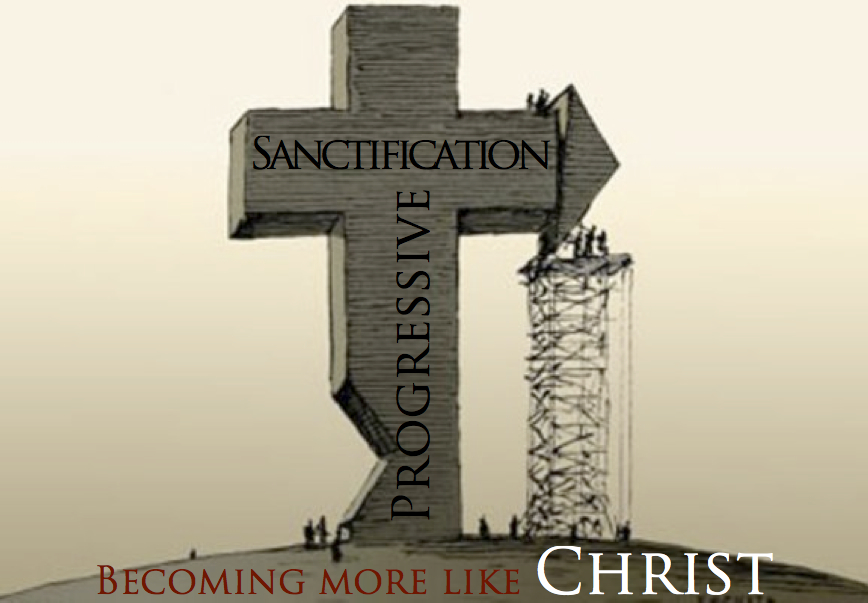
In my last post in this series, I defined sanctification and talked about the objective moment when we are set apart as God’s children. In this post, I want to introduce the concept of Progressive Sanctification.
Progressive Sanctification: A Definition
Progressive Sanctification is defined as the ongoing work of the Holy Spirit in our lives to reveal our sin, in order to remove it, so that we continue to become more and more free from sin and like Christ in our daily lives. It differs from Definitive Sanctification in that it is a continual process, whereas Definitive Sanctification is an objective point in time-space history where we are set apart as Children of God.
A Process that is Never Complete
The process of Progressive Sanctification continues until our death at which time we receive our glorified bodies and finally become like Christ (1 John 3:2). Since Progressive Sanctification is never complete, we will never be without sin before Christ’s return because we live in a sinful body, and our flesh continually wars against our spirit (1 Kings 8:46; Prov. 20:9; Eccl. 7:20; Matt 6:11-12; Rom. 6:12-14; 7:13-25; James 3:2; 1 Jn 1:8).
Instead of reaching a state of perfection, we will continue to grow in Christ’s likeness as the Holy Spirit works in our lives. This does not mean we are to give up, throw our hands up in the air and say, “What is the point of all this then, if we will never be perfectly like Jesus this side of the grave.” Our lack of perfection does not mean we should despair or continue in sin.
We Should Not Despair
In Romans 8:15-16 Paul says,
For you did not receive the spirit of slavery to fall back into fear, but you have received the Spirit of adoption as sons, by whom we cry, “Abba! Father!” The Spirit himself bears witness with our spirit that we are children of God, and if children, then heirs—heirs of God and fellow heirs with Christ, provided we suffer with him in order that we may also be glorified with him.
We should not despair if we do not attain to perfection in this life. The Holy Spirit bears witness to our salvation and adoption as sons. We are not to be racked with guilt over our sin, nor are we to listen to the accusations of Satan that a child of God need be perfect. When we see change occurring in our lives, we can be sure the Holy Spirit is the one working to bring about that change, which proves we are God’s children.
We Should Not Continue To Sin
In Romans 6:1-7 Paul says,
What shall we say then? Are we to continue in sin that grace may abound? By no means! How can we who died to sin still live in it? Do you not know that all of us who have been baptized into Christ Jesus were baptized into his death? We were buried therefore with him by baptism into death, in order that, just as Christ was raised from the dead by the glory of the Father, we too might walk in newness of life.
For if we have been united with him in a death like his, we shall certainly be united with him in a resurrection like his. We know that our old self was crucified with him in order that the body of sin might be brought to nothing, so that we would no longer be enslaved to sin. For one who has died has been set free from sin.
God in His grace saves us from eternal damnation through the death, burial, and resurrection of Jesus Christ. When we believe in Jesus as our Lord and Savior, we are united with Him in His death and resurrection, so that His death and His resurrection become our death and our resurrection.
When we are united with Jesus, we are released from the bondage of sin and are free to worship and glorify God in our bodies. We no longer have to follow our former master Satan. The enslavement we once knew has been broken, and we are not to continue as we lived formerly when we were in bondage to Satan and his rule. In other words, we are not to continue to sin because we have been set free from a life of sin through our relationship with Jesus Christ, as well as we are not to presume upon the grace of God.
Conclusion
So we see the the process of Sanctification is also Progressive, in that it continues throughout our entire lives. As the Holy Spirit works in our life to convict us of sin, we grow more and more like Jesus in our daily lives.
We also saw Progressive Sanctification is a process that is never complete. We will never be perfect in this life because of our sinful bodies. Even so, we are not to despair because the Holy Spirit’s work in our lives testifies to our salvation and adoption as sons of God. In addition, we are not to continue to sin presuming upon God’s grace, nor are we to continue to sin because we have been freed from the bondage of sin to a life that is able to live as our Savior Jesus Christ.
Looking Forward
In my next post in this series, I will talk about how the Holy Spirit works in our lives to bring about change Monergistically (by Himself).
Resources
Jerry Bridges, The Transforming Power of the Gospel, Ch. 8
Wayne Grudem, Systematic Theology, Ch. 38.

 Christianity Matters