Reflections on Scripture

This morning in my reading, I came across Jeremiah 5:20-24. Here is what it says:

Declare this in the house of Jacob;
        proclaim it in Judah:
“Hear this, O foolish and senseless
people,

        who have eyes, but see not,
        who have ears, but hear not.
Do you not fear me? declares the
LORD.

        Do you not tremble before me?
I placed the sand as the boundary
for the sea,

        a perpetual barrier that it can-
not pass;

        though the waves toss, they can-
not prevail;

        though they roar, they cannot
pass over it.

But this people has a stubborn and
rebellious heart;

        they have turned aside and
gone away.

They do not say in their hearts,
   ‘Let us fear the LORD our God,
who gives the rain in its season,
    the autumn rain and the spring
rain,

and keeps for us
    the weeks appointed for the
harvest.’

My Reflection

As I reflected on this passage, I was reminded there are people around us everyday who know that the Lord is our Creator, who know He is the One true God. These same people look out like Judah and see His power. How He controls even the raging sea, so that it does not go pass the boundary He has set for it. How He is the One who gives us rain and causes our crops to grow.

Even so, they choose to ignore the Lord. They do not fear Him. Rather, they turn from Him to worship other gods and to do what seems good in their own eyes. But what happens when the end comes? What will those who do not fear the Lord do when they stand before Him in judgement?

Judah did not repent and worship the One true God, and His wrath was poured out on them. Let Judah’s example serve as a warning to all those who act in the same way, who ignore the Creator of this world, in order to serve other gods and themselves. A day of judgment is coming, and the Lord, who is mighty and powerful, will not be ignored then. To all who do not fear the Lord, repent and worship Him.

Resource

Image

Judge Not is Not a Shield to Hide Behind

It is not uncommon to hear people say:

Aren’t we all sinners? What gives you the right to make moral judgments about someone else? Isn’t that God’s job?” “Do not judge, or you to will be judged.”

A Real Life Example

I posted an article one time on Facebook that questioned homosexuality. One comment I received said, “Aren’t you a Christian? I thought Christians were not supposed to judge others.” After which, my friend, or used to be friend, de-friended me.

Some people who make these claims know where this verse is found, and other do not, but both groups are using this verse out of context. Incase you did not know, the verse is found in Matthew 7:1.

Why is this verse commonly used, or might I say, misused?

People desire to shield their sin. They want to keep others at bay. They desire to have “unrestrained moral freedom, autonomy, and independence” [1]. In short, they don’t want anyone to question their behavior, thoughts, or ideals.

What Does This Verse Really Mean?

Even though people use this verse to dissuade others from judging their behavior, the verse actually does not mean we cannot ever judge another person. Let’s look at this verse in context, and you will see what I mean.

Judge not, that you be not judged. For with the judgment you pronounce you will be judged, and with the measure you use it will be measured to you. Why do you see the speck that is in your brother’s eye, but do not notice the log that is in your own eye? Or how can you say to your brother, ‘Let me take the speck out of your eye,’ when there is the log in your own eye? You hypocrite, first take the log out of your own eye, and then you will see clearly to take the speck out of your brother’s eye.”

After reading this verse in context, it should be apparent that what Jesus is addressing here is not all judgment, but hypocrisy. He was after the Pharisees who judged others without first dealing with their own sin.

In these verses, we see first, Jesus rebukes the Pharisees by telling them to “Judge not.” Then, He tells them “the measuring stick they used to measure the lives of others will be the same measuring stick held up against their lives by God Himself” [2]. After which, we are told that the Pharisees sin is greater than the sin of those they were judging. They had a log in their eye, which is by far greater than a speck.

The key to these set of verses comes in verse 5 when Jesus tells them to remove the log in their eye first before dealing with the speck in their brother’s eye.

Essentially, Jesus is giving them two commandments:

  1. Stop judging others in a hypocritical fashion.
  2. Get the sin out of your own life [3].

So then, Jesus is not telling us that we cannot judge others. Rather, He is telling us that we are not to be hypocritical. We are not to judge others, when there are massive sins in our lives that we are not willing to deal with.

It is like a father chastising his daughter for her suggestive and scandalous dress, then after she leaves, he looks at pornography. His actions are hypocritical. He is not dealing with his own sin before dealing with the sin of his daughter.

Can We Judge?

The answer is yes. In fact, it is our duty to judge others, so that they will grow in their Christian life. We are to spur one another on to growth and godliness, and we are to keep each other accountable. Hebrews 10:24-25 says,

And let us consider how to stir up one another to love and good works, not neglecting to meet together, as is the habit of some, but encouraging one another, and all the more as you see the Day drawing near.

In order to stir one another up and hold them accountable, we have to look into people’s lives and make judgments about how they are living.

However, if we are not humbly submitting our own lives to the Word of God for review, and if we are not willing to allow others to help us in that task, then we are not to judge others. If we are examining our own lives, and we are dealing with our own sins, living a life of genuine repentance, then we can judge others.

So then, we can judge others, but not before we deal with the sin in our own lives.

The Proper Way to Judge

When we judge others, we must do it in a loving way. We are not judging them in order to make ourselves look better. We don’t come at them from a morally superior position. No, we approach them in love, humbly recognizing we are all sinners, we have all fallen short of God’s glory, and we all need Jesus Christ as our Lord and Savior. If we approach people from that position, then we have a right, neigh a duty, to speak into their lives, so that we may wage war on the flesh together.

Conclusion

Jesus did not say these words, in order to keep us from ever making any moral judgments about others. Nor is He giving us this verse so we can shield our own sin from review. Rather, He is attacking the Pharisees, who were hypocrites because they did not deal with the massive amount of sin in their lives (log) before passing judgment on others, whose sin was not as great (speck). So then, when we look at this verse in context, we see that we can judge others, as long as we are first judging ourselves, and as long as we are approaching them in a loving manner.

Resource

[1] Eric Bargerhuff, The Most Misused Verses in the Bible, 26.
[2] Ibid., 27.
[3] Ibid.

Image

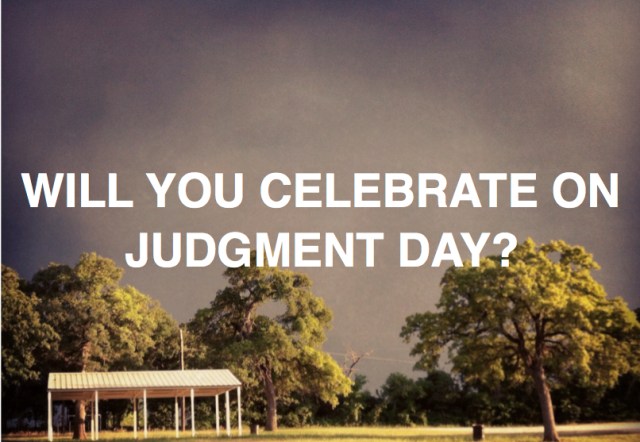
Will You Celebrate on Judgment Day?

Will you celebrate on Judgment day? This is the question I asked my congregation in my last sermon, and the question I want you to think about as well.

Exposition

This last week I preached over 1 John 4:13-21. In that section, John provides his readers with confidence for the Day of Judgment by giving two tests.

These two tests ask the questions:

(1) Do you have the Holy Spirit residing in you?

The way in which you know you have the Holy Spirit residing in you, is by confessing that Jesus is the Son of God (1 John 4:15). The reason our profession provides us with assurance that we are children of God is because without the Holy Spirit, we would not make that confession (1 John 4:2-3).

(2) Do you love your brother?

The reason loving our brother provides us with assurance that we are the children of God is because without God first working His love in us, we would not love others (1 John 4:16-17). God has to first break our hard hearts with the gospel, changing our will and affections, before we will love our brothers in the way that God loves us – self-sacrificially (1 John 4:19). When we love others in the same way that God loves us, then God’s love is said to be perfected with us (1 John 4:17). Perfect love casts out fear for the Day of Judgment (1 Jn 4:18).

So then, if we can answer yes to these two tests, then we can be assured that we will celebrate on the Day of Judgment.

Application

Even though, we who are assured of their salvation will celebrate on Judgment Day, it is clear from the book of Revelation that a Day of Judgment is coming. God will judge the nations and those who are not His children will be destroyed and thrown into the lake of fire. Those who are His children will live for all of eternity with Him in the new heavens and new earth (Revelation 20:11-21:5). Knowing that this judgment is coming, we should seek to evangelize our neighbors, friends, and families.

In addition, knowing that we are going to celebrate on Judgment Day should cause us to look forward to that day because we know at that time we will live for all of eternity with our heavenly Father and His Son, Jesus Christ, who is our Savior, for all of eternity in a new heavens and a new earth free from the bondage of sin, death, persecution, illness, and heartache.

Thinking Out Loud: How is God a Christian’s Judge?

A perplexing question has had me racking my brain for several days now. In what way are we as Christians judged by God? The text that has motivated this question is 1 Peter 1:17, which says

And if you call on him as Father who judges impartially according to each one’s deeds, conduct yourselves with fear throughout the time of your exile,” (1 Pe 1:17).

Context

Verse 17 comes in the midst of Peter telling his readers to place their hope in Christ alone (13), to not be conformed to their former way of life (14), but instead to be holy as God is holy (15-16). So then, the context deals with Christian conduct. More specifically, Peter wants his readers to understand that their profession of Jesus Christ as their Savior should also result in transformed living.

Verses 13, 14, 15-16 provide commands to live a certain way, as well as they provide the motivation for such living. Verse 17 seems to follow suit. It provides a command, “conduct yourselves in fear”. It also provides a motivation, God is both the Father of those who profess Christ to be their Savior and the Judge of all.

How Can God Be The Judge of Christians?

Verse 17 says God judges all impartially according to their works, which should lead to us conducting ourselves in fear during our earthly stay. Commentators and preachers differ in regard to what this judgment on Christians could be.

  • Some hold it is a judgment regarding rewards (Rom 14:12; 2 Cor. 5:10-11).
  • Others skip over the phrase, “who judges impartially according to each one’s deeds,” opting only to deal with the word fear. They then conclude fear means we need to live in reverence to God.
  • While others hold a tension between fear referring to reverence for God, and also a fear of God’s judgment.

What I Think

Based on Peter’s mentioning of God as Father and Judge, the context calling for believers to live a transformed life as a result of their salvation, as well as Romans 2:6-11, 1 Corinthians 9:24-27, and John 3:36, I think Peter is presenting a tension here. A tension both John and Paul present in their writings and one that is evident in the passages above.

The tension I think Peter is presenting is that our faith in Christ should produce good works (Gal. 5:21; 1 Cor. 6:9-11). It is these works that are judged, proving that we are Christians. So then, on the one hand, our fear is to be one of reverence and respect for God. On the other hand, we are to fear God as judge, knowing that if we do not finish the race (1 Cor. 6:9-11), we will not inherit the kingdom of God. Even if at one time we did great works for the kingdom, we must continue to live a righteous life throughout our time here on earth. In other words, we must finish the race. God is not a partial judge, no matter how much good we have done for the kingdom.

I don’t believe our righteous living earns us salvation, but I do believe it proves our salvation since it would not be possible to live righteously without the Holy Spirit residing in us. The Holy Spirit would not reside inside of us, if we did not believe Christ to be our Savior.

Final Questions: I Want Your Thoughts

Those are my thoughts. I want to know what you think. To help facilitate that, here are my final questions:

  • Am I on the right track believing there is a tension between God as Father and Judge, or am I missing something?
  • Do you also see a tension between our faith and works, with our works, or obedience, proving our faith?
  • Do you believe fear in 1 Peter 1:17 is referring to reverence only, or both reverence and judgment?
  • Do you believe Peter is talking about our rewards in heaven? If so, how would those rewards motivate us to live holy lives now?
  • What do you make of verses like 1 John 4:18-21, which tells us those who fear have not been perfected?

Image: digitalart / FreeDigitalPhotos.net