X-Ray Questions: Where do you bank your hopes?

This week we continue our X-Ray Questions series, as we look at where we bank our hopes. You can read the other posts in this series by clicking here.

X-Ray Question:

(4) Where do you bank your hopes? 

The future dimension is prominent in God’s interpretation of human motives. People energetically sacrifice to attain what they hope for. What is it? People in despair have had hopes dashed. What were those shattered hopes?

Understand

When we bank our hopes in something or someone other than Jesus Christ, we will always be disappointed. When we place our hope in something other than Jesus we are really placing our hope in an idol. Idols will never satisfy us, in fact, they will always disappoint us.

If we place our hope in our husbands and wives, finding ultimate meaning in the way they treat us, then we will always be disappointed. Man is sinful, and at some point that sin will cause us to treat others unkindly.

Alternatively, if we place our hope in a raise, promotion, or new job, we can almost always be guaranteed to be disappointed. Oh, we may get the raise, promotion, or new job, but when we do, we will find it did not provide us with the satisfaction or significance that we were hoping it would.

Riches will not satisfy us either. 1 Timothy exhorts us not to place our hope in the riches of our current age because riches are uncertain. One minute they are here, and the next minute they are gone. The bursting of the real estate bubble and subsequent recession a few years back, of which we are still feeling the effects, attests to the uncertainty of riches.

Repent

We should repent by realizing that our only hope lies in Christ. He is the only one who will never disappoint us. His value will never diminish, and we will always be satisfied in Christ. Where people, jobs, and riches fail us, Christ will not.

Scripture

Here are a few passages from God’s word to meditate on this week, as you consider where you place your hope: 1 Peter 1:13; 1 Tim. 6:17

All X-Ray questions taken from David Powlison’s book Seeing with New Eyes.

Celebrate the Savior for He is Risen

Today is Easter. The day that Jesus rose from the grave and defeated the power of death for all who believe in Him as their Savior. Read what the Scripture has to say about the resurrection.

Jesus Has Risen Just As He Said

1 Now after the Sabbath, toward the dawn of the first day of the week, Mary Magdalene and the other Mary went to see the tomb. 2 And behold, there was a great earthquake, for an angel of the Lord descended from heaven and came and rolled back the stone and sat on it. 3 His appearance was like lightning, and his clothing white as snow. 4 And for fear of him the guards trembled and became like dead men. 5 But the angel said to the women, “Do not be afraid, for I know that you seek Jesus who was crucified. 6 He is not here, for he has risen, as he said. Come, see the place where he lay. 7 Then go quickly and tell his disciples that he has risen from the dead, and behold, he is going before you to Galilee; there you will see him. See, I have told you.” 8 So they departed quickly from the tomb with fear and great joy, and ran to tell his disciples. 9 And behold, Jesus met them and said, “Greetings!” And they came up and took hold of his feet and worshiped him.

Matthew 28:1–9 (ESV)

Paul’s Exposition of the Resurrection

Christ died for our sins in accordance with the Scriptures, 4 that he was buried, that he was raised on the third day in accordance with the Scriptures. 14 And if Christ has not been raised, then our preaching is in vain and your faith is in vain. 15 We are even found to be misrepresenting God, because we testified about God that he raised Christ, whom he did not raise if it is true that the dead are not raised. 17 And if Christ has not been raised, your faith is futile and you are still in your sins.

1 Corinthians 15:3b, 4, 14-15, 17 (ESV)

Reflect

20 But in fact Christ has been raised from the dead, the firstfruits of those who have fallen asleep. 21 For as by a man came death, by a man has come also the resurrection of the dead. 22 For as in Adam all die, so also in Christ shall all be made alive.

1 Corinthians 15:20–22 (ESV)

Reflect

54 When the perishable puts on the imperishable, and the mortal puts on immortality, then shall come to pass the saying that is written: “Death is swallowed up in victory.” 55 “O death, where is your victory? O death, where is your sting?” 56 The sting of death is sin, and the power of sin is the law. 57But thanks be to God, who gives us the victory through our Lord Jesus Christ. 58 Therefore, my beloved brothers, be steadfast, immovable, always abounding in the work of the Lord, knowing that in the Lord your labor is not in vain.

1 Corinthians 15:54–58 (ESV)

Response to the Resurrection

Our response to the resurrection should be to worship the risen Savior. A way to worship Christ is to tell others about the death, burial, and resurrection of Jesus and what that accomplishes, namely, a restored relationship with God that will last for all eternity.

Application of the Resurrection

(1) Because Christ was raised from the dead we can be assured that our relationship with God has been mended.

God resurrecting Christ from the dead proves that Jesus’ sacrifice on the cross was sufficient to satisfy His wrath and mend our relationship with God.

(2) We can face death with joy being assured of eternal life.

Jesus was not resurrected in order to die again like Lazarus or Jarius’ daughter; rather, He was resurrected and given a new body, in order that He might live and reign forever.

Because Christ defeated death in the resurrection, we too, if we believe in Jesus as our Savior, will defeat death, be resurrected and given a new body. One that will not grow old, experience pain, disease, or even death.[1] As a result of the resurrection, we can look death in the face knowing that we, those who are in Christ, will experience eternal life.


[1]1 Cor. 15:20-28; 2 Cor. 5:1-10; 1 John 3:1-3


The Crucifixion Story

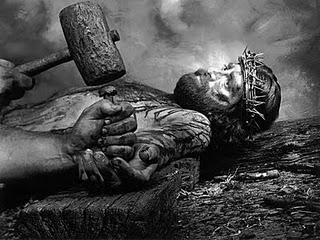
Last night, we had a Maundy Thursday service at our church. During the service, selected scripture was read that led us through the crucifixion of Jesus. Since today is Good Friday, the day Jesus was crucified, I wanted to provide you with an excerpt from our reading last night.

Betrayal and Trial

43 And immediately, while he was still speaking, Judas came, one of the twelve, and with him a crowd with swords and clubs, from the chief priests and the scribes and the elders. 46 And they laid hands on him and seized him. 53 And they led Jesus to the high priest. And all the chief priests and the elders and the scribes came together. 55 Now the chief priests and the whole Council were seeking testimony against Jesus to put him to death, but they found none. 61bAgain the high priest asked him, “Are you the Christ, the Son of the Blessed?” 62 And Jesus said, “I am, and you will see the Son of Man seated at the right hand of Power, and coming with the clouds of heaven.”

Mark 14:43, 46, 53, 55, 61b-62 (ESV)

Reflection

63 And the high priest tore his garments and said, “What further witnesses do we need? 64 You have heard his blasphemy. What is your decision?” And they all condemned him as deserving death. 65 And some began to spit on him and to cover his face and to strike him, saying to him, “Prophesy!” And the guards received him with blows.

Mark 14:63–65 (ESV)

Reflection

1 When morning came, all the chief priests and the elders of the people took counsel against Jesus to put him to death. 2 And they bound him and led him away and delivered him over to Pilate the governor. 15 Now at the feast the governor was accustomed to release for the crowd any one prisoner whom they wanted. 16 And they had then a notorious prisoner called Barabbas. 17 So when they had gathered, Pilate said to them, “Whom do you want me to release for you: Barabbas, or Jesus who is called Christ?” 21 The governor again said to them, “Which of the two do you want me to release for you?” And they said, “Barabbas.” 22 Pilate said to them, “Then what shall I do with Jesus who is called Christ?” They all said, “Let him be crucified!” 23 And he said, “Why, what evil has he done?” But they shouted all the more, “Let him be crucified!”

Matthew 27:1–2, 15-17, 21-23 (ESV)

Reflection

26 Then he released for them Barabbas, and having scourged Jesus, delivered him to be crucified. 27 Then the soldiers of the governor took Jesus into the governor’s headquarters, and they gathered the whole battalion before him. 28 And they stripped him and put a scarlet robe on him, 29 and twisting together a crown of thorns, they put it on his head and put a reed in his right hand. And kneeling before him, they mocked him, saying, “Hail, King of the Jews!” 30 And they spit on him and took the reed and struck him on the head. 31 And when they had mocked him, they stripped him of the robe and put his own clothes on him and led him away to crucify him.

Matthew 27:26–31 (ESV)

The Crucifixion

33 And when they came to a place called Golgotha (which means Place of a Skull), 34 they offered him wine to drink, mixed with gall, but when he tasted it, he would not drink it. 35 And when they had crucified him, they divided his garments among them by casting lots. 36 Then they sat down and kept watch over him there. 37 And over his head they put the charge against him, which read, “This is Jesus, the King of the Jews.” 38 Then two robbers were crucified with him, one on the right and one on the left. 39 And those who passed by derided him, wagging their heads 40 and saying, “You who would destroy the temple and rebuild it in three days, save yourself! If you are the Son of God, come down from the cross.” 41 So also the chief priests, with the scribes and elders, mocked him, saying, 42 “He saved others; he cannot save himself. He is the King of Israel; let him come down now from the cross, and we will believe in him. 43 He trusts in God; let God deliver him now, if he desires him. For he said, ‘I am the Son of God.’ ” 44 And the robbers who were crucified with him also reviled him in the same way.

Matthew 27:33–44 (ESV)

The Death of Jesus

45 Now from the sixth hour there was darkness over all the land until the ninth hour. 46 And about the ninth hour Jesus cried out with a loud voice, saying, “Eli, Eli, lema sabachthani?” that is, “My God, my God, why have you forsaken me?” 47 And some of the bystanders, hearing it, said, “This man is calling Elijah.” 48 And one of them at once ran and took a sponge, filled it with sour wine, and put it on a reed and gave it to him to drink. 49 But the others said, “Wait, let us see whether Elijah will come to save him.” 50 And Jesus cried out again with a loud voice and yielded up his spirit. 51 And behold, the curtain of the temple was torn in two, from top to bottom. And the earth shook, and the rocks were split. 52 The tombs also were opened. And many bodies of the saints who had fallen asleep were raised, 53 and coming out of the tombs after his resurrection they went into the holy city and appeared to many. 54 When the centurion and those who were with him, keeping watch over Jesus, saw the earthquake and what took place, they were filled with awe and said, “Truly this was the Son of God!”

Matthew 27:45–54 (ESV)

Maundy Thursday

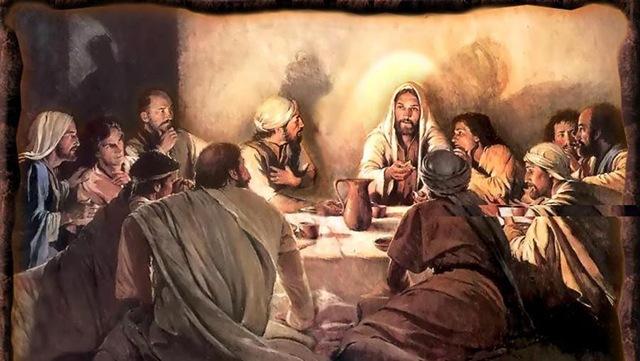
Today is Maundy Thursday. Have you ever wondered what that means? Or what is significant about this day?

What is Maundy Thursday?

Maundy Thursday occurs the Thursday before Easter and commemorates the Last Supper of our Lord. On the day before Jesus’ crucifixion, Jesus and the Disciples met in the upper room to take the Last Supper, which occurred on the day of Unleavened Bread (Luke 22:7). The day when the Passover lamb had to be sacrificed (Luke 22:7).

The Passover

If you remember, the Passover was instituted during the Exodus event (Ex 12:14). Before God brought Israel out of Egypt, a final plague was delivered on the Egyptians. God declared that every firstborn in the land would be killed unless the blood of a lamb was smeared on the doorposts and lintel of their homes. As the Lord passed through the land, He would Passover the houses with the blood, while executing judgment on those who did not have the blood on the doorposts and lintel.

That night, at twilight, a lamb was to be slain and its blood spread on the doorposts and lintels, while its body was roasted to eat. As the Israelites waited, they were to eat the roasted lamb, with bitter herbs and unleavened bread with their belt fastened, sandals on their feet, and their staff in hand. In other words, they were to be ready to leave as they watched and waited on the deliverance of the Lord.

That night, the Lord passed through the land killing the firstborn of all who did not have the blood smeared on their doorposts and lintel. After which, the Exodus of Israel from Egypt occurred. At that time, the Israelites were delivered from the bondage and slavery of Egypt and set free to worship their God.

Jesus Re-institutes the Passover

In order to commemorate the Exodus, the feast of Unleavened Bread was instituted. It was this feast that the disciples and Jesus were celebrating. But something new was happening during the celebration. Jesus takes the wine and says that it represents His blood (Luke 22:20). He takes the bread and says it represents His body (Luke 22:19). At this time, Jesus was re-instituting the Passover Meal around Himself. In other words, He was telling the disciples that He would be the one to deliver His people from the slavery and bondage of sin, through a New Exodus (Eze 20:32-38; 37:15-28; Jer 16:14-15; Isa 40:1-13; 62:10-12). Thus, instituting a new covenant with His blood that would provide all who believed in Him with a new heart (Jer 31:31).

Taking the Lord’s Supper

When we take the Lord’s Supper tonight, in celebration of Maundy Thursday, we should take it in a state of celebration for Jesus’ work on the cross because it is His sacrifice that delivers us from the bondage of sin.

We also should take the Lord’s Supper with the same expectation and hope as the Israelites in Egypt. They were in a state of expectation, waiting and watching for the Lord’s deliverance as they ate their meal. We too, as we take the Supper, must wait in a state of expectation for our Lord’s return. We too must watch and be ready for Him to lead us in a final Exodus.

John Calvin on Prayer

I was recently given a book on prayer at The Gospel Coalition Conference, which is entitled Taking Hold of God: Reformed and Puritan Perspectives on Prayer. The book surveys many of the Reformers and Puritans ideas on prayer. Calvin’s idea of prayer was particularly notable and worth sharing.

Joel Beeke provides us with Calvin’s words:

Prayer is an emotion of the heart within, which is poured out and laid open before God. In prayer we both communicate and commune with our Father in heaven, feeling our transparency in His presence. Like Christ in Gethsemane, we cast our desires, sighs, anxieties, fears, hopes, and joys into the lap of God.

Through prayer, a Christian puts his worries bit by bit on God. We are permitted to pour into God’s bosom the difficulties which torment us, in order that He may loosen the knots which we cannot untie. Prayer is the outpouring of the soul, the deepest root of piety, the bedrock of assurance. Prayer is the most important part of the Christian life; it is the lifeblood of every true believer [1].

I believe Calvin’s words should not go unheeded. Prayer is indeed the lifeblood of every true believer. Christ’s sacrifice on the cross opened the throne room of God, and we should run into it seeking to commune with God (Heb 10:19-23).

Charge

Do not neglect your communion with God. Seek His face daily in prayer. Pour out your heart to Him, casting all your desires, sighs, anxieties, fears, hopes, joys into the lap of God.

Resources

1. Joel Beeke and Brian Najapfour, Taking Hold of God: Reformed and Puritan Perspectives on Prayer, 29.

X-Ray Questions: Evaluating our pursuits

In an effort to help us root the idols out of our lives, I am doing a series entitled X-Ray Questions. You can view the other two posts by clicking here and here. In this post, we will focus on our aims and pursuits.

X-Ray Question

(3) What do you seek, aim for, and pursue? What are your goals and expectations?

This particularly captures that your life is active and moves in a direction. We are purposeful. Human motivation is not passive, as if hardwired needs, instincts, or drives were controlled from outside us by being “unmet,” “frustrated,” or “conditioned.” People are active verbs.

Understand

The things that we seek, aim for, and pursue, as well as the goals and expectations we set for ourselves reveal the true nature of our hearts. As humans, we are not controlled by external conditions or instincts. We are not animals. We have the ability to make decisions. Decisions that reveal the true nature of our heart.

For instance, if our life goal is to acquire a particular job or success in our career, then we will do everything and anything to make it happen. We may neglect our families, compromise our convictions, or defame a co-worker, in order to achieve the level of success we are seeking.

Our desire should be to glorify Christ, not ourselves. In glorifying Christ, we may miss a particular promotion at work, but our families will be better for it because we are able to spend more time teaching them and building them up in the Word of God. Our witness to others about Christ will be greater because our convictions are not compromised. Our relationships with our co-workers will not suffer, resulting in deeper more meaningful relationships that will hopefully allow us to either share the gospel, or build another believer up in the faith.

Repent

We repent by redirecting our pursuits towards Christ. We must value Him and His glory more than our glory. We must see Him as our provider, comforter, and from whom we gain affirmation. We must see His mission, to reach the world with gospel, as more important than our success.

As you reflect on your aims, pursuits, goals, and expectations, remember that climbing the corporate ladder is only one example. You may not struggle with that particular goal or you may be pursuing your career from a godly perspective, but that does not mean you do not struggle with something else. Other idols may include: acceptance, comfort, a new car, a perfect looking spouse, or a finely kept home. Since we cannot cover every idol, my prayer is that you will honestly reflect on your life this week to determine if any of your goals, expectations, or pursuits are taking the place of Christ.

Scripture

Reflect on these Scriptures as you seek to root this idol out of your life: Matt 6:32-33; 2 Tim 2:22

All X-Ray questions taken from David Powlison’s book Seeing with New Eyes.