On Being Guilty but Forgiven Sinners

As guilty but forgiven sinners, what the powers and principalities of this age say to us is true.

But we’ve already been accused; we’ve already been indicted; we’ve been arrested; we’ve been dressed in purple and beaten; we’ve been stapled to a Roman cross; we’ve had the wrath of God poured out upon us; we’ve been left in a tomb as a bloated, abandoned, cursed corpse; and on a Sunday morning in Jerusalem, we were resurrected.

So when the accusations of the Evil One come against us, what he hears in reply is the gospel truth that we can’t be re-executed. What we hear said of us from the Father is,

This is my beloved Son in whom I am well pleased,

because we are in union with Christ, and what is true of him is now, by the grace of God, true of us. And that is precisely why

there is therefore now no condemnation for those who are in Christ Jesus” (Romans 8:1).

Question for Reflection

  1. Do you realize the implications of being buried with Jesus in the likeness of His death and raised with Him to walk in newness of life?

Resources

Russell Moore, Acting the Miracle Together: Corporate Dynamics in Christian Sanctification

Image

How Should Christians Live in the In-Between?

City

A perfect future kingdom awaits those who believe in Jesus as their Lord and Savior. A kingdom with no sickness, death, disease, injustice, war, oppression, etc – a perfect kingdom. Now, however, we live in the already/not yet. The period where we can taste victory, but we can’t fully enjoy it because Jesus’ hasn’t yet returned.

One author captures the tension well when he says,

“The kingdom of God is both the foundation of the church and the goal of the world. Therefore, we have and we hope; we give thanks and we sigh for more.” – Kelly Kapic

So we live in the in-between. As we live in the already/not yet, how should we live our daily lives? Should we pull back to the fringes? Divorce ourselves from society? Or should we do something else?

How Should Christians Live in the In-Between?

We should do what Israel was told to do in Jeremiah 29: Work for the good of the city, for as the city flourishes we flourish (Jer. 29:5-7). As Christians we should lay down roots, conduct business, get married, have children pray for our leaders, and work to make the city a better place.

We can do that in at least three ways.

(1) Politics and Laws

Here is what one theologian says,

“True justice exists only in the society of God, and this will be truly fulfilled only after the Judgment. Nevertheless, while no society on earth can fully express this justice, the one that is more influenced by Christians and Christian teaching will more perfectly reflect a just society. For this reason, Christians have a duty toward government.” – Webber

Sure, politics aren’t going to solve all our problems, but politics and laws have a huge influence on our society.

“Laws express moral beliefs and judgments…They tells citizens what our society ought to value and condemn, what is worthy of our respect and what we should disapprove of.” – Gerson & Wehner

Think about the state of Colorado: Marijuana is now legal. That is a big deal. Not only because people now have access to drugs, but because it is going to influence people’s moral views on Marijuana.

Right now, some citizens may see it as morally wrong, but think about how people will see it in fifty years. As a generation comes and goes the view that it is wrong to use marijuana is going to fade into the background. And that is going to take place because a law was passed. So we can’t neglect the importance of politics and laws. They shape and influence our moral lives.

So when there is an election, we should be aware of the issues and educate our families and friends. We should vote and encourage others to do the same. Some of us should even get into politics.

(2) Truly Living as Disciples of Jesus

I was sitting with a friend at Starbucks the other day talking about how we as Christians can bring about change and work for the good of the city. And he asked this question,

“What if the world saw disciples actually living out their calling?”

I thought that was good a question. Think about it: What if we really lived as true disciples? What kind of impact do you think that would have on our community, city, country? Think about the witness we would be, the change we could bring, the difference we could make by truly living as Jesus did.

Now, you might be thinking, we have already tried that. This nation was founded by Christian men on Christian principles. While that is true, I would argue we haven’t always lived out our calling. Sure some Christians do, but a lot of people who claim to be Christians don’t live as Jesus did.

But what if we all did? I believe if we did, our society would be radically changed.

(3) Preaching the Gospel

I left this one for last because I believe it’s the most important. I believe that because the gospel changes hearts, which is important because our heart isn’t just the organ that pumps our blood, it’s our inner self.

In Psalm 51:10, when David prayed saying,

Create in me a clean heart, O God, and renew a right spirit within me.” (Ps 51:10)

He wasn’t asking God for a literal heart transplant, instead he was asking God to change his will, desires, affections. He was asking God to transform him, so he lived and acted differently. That is what the gospel does. It transforms people, so that they live differently. So if we want to work for the good of our city and see true change in this country, we have to preach the gospel.

Question for Reflection

  1. What else should Christians do in the in-between?

Resources

Post adapted from the sermon: Hope is Not Lost

Image

On Imitating Jesus

This preoccupation with Jesus’ social and economic identity – whether asserting his relative poverty or affluence – misses the point. We are never explicitly called to imitate Jesus’ early life or career. These aspects of Jesus’ example are never directly identified as the framework for the economic life of Christians, though they obviously influence us.

But we are specifically commanded, over and over again, to imitate Jesus’ unselfish giving on the cross.

To be sure, we are not all necessarily obligated to enter into a life of voluntary poverty. But we cannot claim Christ’s cross as the source of our lives without allowing the same cross to shape the whole course of our lives.

Our faithfulness is not to be judged by where we fit into the socioeconomic ladder, but by the degree to which our daily decisions and life story as a whole correspond to Christ’s self-giving example on the cross.

Question for Reflection

  1. Do you agree with Kapic?

Resources

Kelly Kapic, God So Loved, He Gave156.

Image

On Prayer: The Chief Exercise of Faith

Over the years I’ve found much of what I’ve read about prayer to be unhelpful. Here’s why: Prayer is usually considered under the heading of ‘spiritual disciplines’ which makes it the spiritual equivalent of running on a treadmill or flossing your teeth, neither of which are attractive to me. Viewing prayer purely as a discipline drags the whole business back into the world of law, and law can never impart life.

I awakened to this when I discovered a description of prayer that warmed my heart with a fresh desire to pray. Calvin describes prayer as

“the chief exercise of faith by which we daily receive God’s benefits.”

Then he offers this compelling picture:

“We dig up by prayer the treasures that were pointed out by the Lord’s gospel, and which our faith has gazed upon.”

Imagine walking over a field where vast treasure lies buried. To make these riches your own, you need two things: a map and a spade. Scripture is your map, and prayer is your spade.

I find this picture helpful because it delivers prayers from the austere world of law and discipline and brings it into the realm of the gospel and promise, where it belongs. Prayer is more than a duty to be fulfilled; it is a gift to be enjoyed. There is a world of difference between ‘having your quiet time’ as a spiritual discipline and drawing near to God to possess what He promises to you in Christ.

Since prayer is “the chief exercise of faith by which we daily receive God’s benefits,” it follows that the primary gifts you will receive go far beyond ‘answers’ to items or needs on your prayer list. Prayer is the means by which you lay hold of all that God has promised in your own life and in the lives of others for whom you pray.

Question for Reflection

  1. What do you think about prayer?

Resources

Colin Smith, Jonah: Navigating a God-centered Life, 62-63.

Image

Why Are Christians Persecuted?

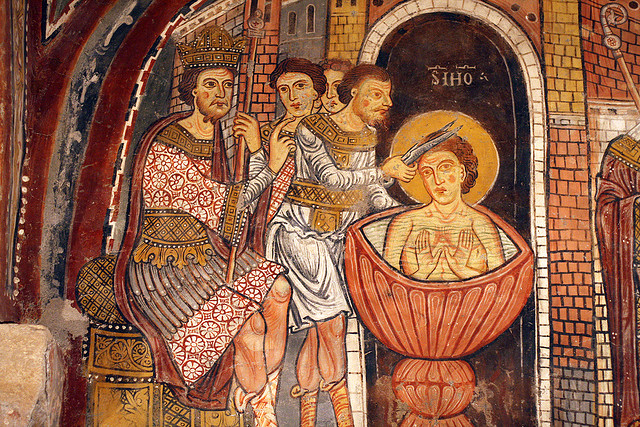
Persecution of St John

For the last several weeks I have been preaching a series on Jesus’ Temple Teachings. While teaching in the Temple, Jesus upset the Religious Leaders in Jerusalem, so much so that the Pharisees and Sadducees attacked Him in an effort to discredit Him with the people.

Attacks on Christians didn’t end with Jesus and His Twelve Disciples. Instead they’ve continued in every age.

Thinking about that this last week, I started wondering why. Why are Christians persecuted? People’s hatred of us don’t match our actions. Christians are usually upstanding citizens. They care for others – they give of their time and resources to help those in need. They are compassionate, gracious, merciful, and forgiving.

According to these attributes, it seems you would want Christians to be apart of your society, your city and your community. That, however, is not always the case. Instead in most areas Christians are hated and attacked.

Why do people attack God and His people?

I believe attacks on God and His people are motivated by self love.

The Sadducees and Pharisees questioned Jesus not as a matter of friendly debate, but because they wanted to get rid of Jesus. They didn’t like Him because Jesus challenged their actions, their beliefs, and their motivations. They wanted Him gone so they did not have to deal with Jesus’ challenge.

You see, the Pharisees loved themselves. They loved themselves more than God or anyone else. Those who love themselves put themselves first. They want what’s best for themselves. They want to do what they want to do. If someone threatens to take that away, they lash out and do everything in their power to destroy them.

How Does This Connect to Christian Persecution?

Christianity teaches we are to deny self. We are to live lives directed toward God and others. People don’t like that. They don’t like being told they aren’t to put themselves first, that they aren’t to always do what is best for them. So they lash out at Christians, persecuting them in an effort to get rid of them, so they aren’t faced with their challenge.

Question for Reflection

  1. Why do you believe Christians are persecuted?

Resources

Post adapted from my sermon: Self Love and the Desire of God

Image

The Hope to Press On

Hope

Christians believe in the resurrection of the dead. They believe there is a world to come.

Revelation 21 and 22 presents a brief glimpse of that world. There we learn death, sickness, disease, corruption, injustice, war, and sin won’t exist. Instead we will be ruled by a perfect King, Jesus Christ, and every moment of everyday will abound with joy and peace.

Hope to Press On

The reason God has revealed our future is to give us hope. Knowing we have something after this life should encourage us to press on, to continue to live for God, even in the face of persecution.

I recently watched 12 Years a Slave – Great movie if you haven’t seen it! There was one scene in the movie, where one of the female slaves comes to Solomon, another slave, in the middle of the night asking him to kill her, to drown her in the nearby pond.

Death to her was the answer. She didn’t believe she would ever be a free person. She saw no end to the beatings and rape to which the plantation owner subjected her. Seeing no way out and having nothing to live she would rather die.

As Christians we might find ourselves in a similar situation one day. While Revelation gives us a picture of the world to come, it also gives a picture of what will happen before Jesus’ return. It tell us there will be mass persecution of those who follow Jesus. When that time comes, if we don’t find our hope in Jesus and believe there is a perfect world to come, we won’t make it through. We will cave and give in to the enemy.

So knowing there is a world to come, should provide the encouragement we need to press on, to continue live for God, even in the midst of persecution.

Question for Reflection

  1. How does knowing a world to come help you press on?

Resources

Post adapted from my sermon Scripture Undermined, Scripture Defended, Repentance Offered

Image