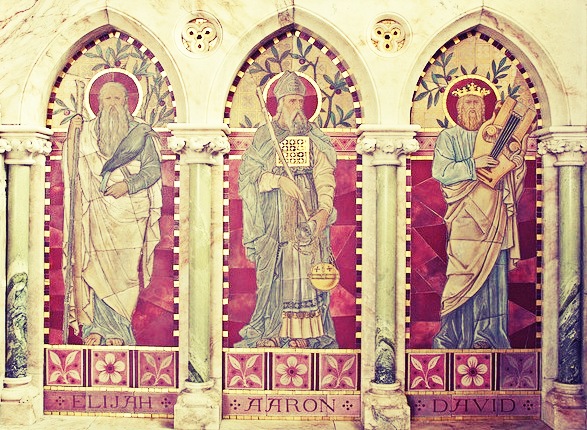
Prophet, Priest, and King

You may have heard that all believers function as a Prophet, Priest, and King, but you may not know how you function in those ways. I have often wondered myself. Yesterday, I came across an article, entitled Movement Dynamics, by Timothy Keller that helped me to understand the biblical reasoning behind these categories, as well as the ways in which we act as a Prophet, Priest, and King. Today, I want to share with you what I learned from that article.

Prophet

A prophet is one who interprets Scripture, judges by Scripture, and witnesses to the truth of their faith. He is also one who admonishes, counsels, nourishes, and encourages other believers from the Scripture.

Joel 2:28-29 predicts those in the New Covenant will act as prophets, and we do. In Matthew 11:9-11, we are told that we are in a greater position and calling than the prophets of old, specifically, John the Baptist who is said to be the greatest prophet.

Then in Colossians 3:16 and Hebrews 3:13 and 10:24-25 our prophetic duties are spelled out, telling us that we are teach and admonish others, exhort others, so that they will not be hardened by sin, and we are to stir one another up to love and good deeds. We are also called by Jesus to take His message to our neighbors and the nations (Matt. 28:18-21).

Priest

A priest is one who has access to God. He is able to enter into His presence and intercede for others.

The veil to the temple was torn in two at Jesus’ crucifixion (Matt. 27:51), resulting in all of us having access as priests in the name of Christ, the great High Priest, to the presence of God (Heb. 4:14-16).

We all are given priestly work (Rev. 5:10). We are to pray for others (James 5:16). We are to offer ourselves as living sacrifices (Rom. 12:1-2). As well as we are to offer sacrifices of deeds and mercy (Heb. 13:16), along with offerings of worship: praising God and acknowledging His name (Heb. 13:15).

King

A king is one who sits on his throne ruling and reigning over those He has been given authority over. He has the power to make decisions and fight off attackers that would threaten his kingdom.

Every believer has these same abilities, having been made a kingdom through the blood of Christ (Rev. 5:9-10) and seated with Him in the heavenly places (Eph. 2:6) we reign now over the powers of Satan. We are able to fight and defeat the world, the flesh, and the devil (1 Tim. 1:18; 6:12). One day, we will reign on this earth alongside our One True King, Jesus Christ (Rev. 1:5-6; 5:9-10). As well as those who are apart of the New Covenant church have the power to make decisions regarding church governance even now.

Jesus is the Ultimate Prophet, Priest, and King

While every believer is a Prophet, Priest, and King, the ultimate Prophet, Priest, and King is Jesus Christ. He is the One that brings us God’s Word (Prophet). Stands as our advocate before the Father (Priest), and orders the life of His people through His Law (King). Without Him and His sacrifice, we would not be able to exercise our offices as Prophet, Priest, and King. So may we not forget that Jesus is the ultimate Prophet, Priest, and King, who makes it possible for us to function in these offices, as well as stands as our perfect example.

Questions for Reflection:

  • How are you doing at exercising your role as Prophet, Priest, and King?
  • Do you exercise your role as a Prophet by speaking the truth in love to others, calling them to repent and believe the gospel, as well as calling those who are Christians to live as Christ?
  • Do you exercise your Priestly role by interceding for others, and offering yourself as a living Sacrifice?
  • Do you fight against evil, the flesh, and the world in your life as a King?

Resources

Post adapted from Timothy Keller, Movement Dynamics, 3-4.

Image

Ungodliness: It is all in how you live?

Note: This is a repost of a series I started last year but did not finish. I am currently teaching this series at my church Sycamore Baptist Church, so I will be reposting the few articles I already wrote along with the new ones that will finish the series.

Last week we began our series on Respectable Sins, you can read the introductory post here. This week, we will deal with the first of many sins we as Christians ignore, that being ungodliness.

Clarification and Definition

When thinking of ungodliness, do not confuse it with unrighteousness. Unrighteousness refers to sinful actions, while ungodliness describes our attitude toward God.

Specifically, ungodliness is defined as “living one’s everyday life with little or no thought of God, or of God’s will, or of God’s glory, or of one’s dependence on God” [1].

With this definition in mind, we can see how someone can be morally good, yet still ungodly. In fact, there are a lot of people who are morally good, yet ungodly. They help others, are courteous, and friendly, but they have no thought of God in their everyday lives. While our society would say that they are good people, God’s Word would say they are ungodly people.

Ungodliness is not just a sin the world commits. There are many in the church who are ungodly as well. They go about their daily lives thinking nothing of the Lord. While we expect those in the world to live as if God does not exist, it is not God’s will for His people to live with no thought of Him. Since this is the case, we must do all we can to rid the sin of ungodliness from our lives. In order to do that, we have to first understand how ungodliness manifests itself.

How Does Ungodliness Manifest Itself?

There are several ways ungodliness can manifest itself in the life of a Christian. The first way ungodliness manifests itself is through our planning. We prove we are ungodly when we do not include God’s will in our plans. Read what James writes,

Come now, you who say, “Today or tomorrow we will go into such and such a town and spend a year there and trade and make a profit”— yet you do not know what tomorrow will bring. What is your life? For you are a mist that appears for a little time and then vanishes. Instead you ought to say, “If the Lord wills, we will live and do this or that.”” (Jas 4:13–15)

The second way ungodliness manifests itself is through our prayer. In his letter to the Colossians, Paul transcribes the way he has been praying for the Colossians. He writes,

And so, from the day we heard, we have not ceased to pray for you, asking that you may be filled with the knowledge of his will in all spiritual wisdom and understanding, so as to walk in a manner worthy of the Lord, fully pleasing to him, bearing fruit in every good work and increasing in the knowledge of God. May you be strengthened with all power, according to his glorious might, for all endurance and patience with joy, giving thanks to the Father, who has qualified you to share in the inheritance of the saints in light.” (Col 1:9–12)

Here we see Paul is concerned for God’s will, glory, and desire for the Colossians lives. He prays they would grow in the knowledge of God’s will and in all spiritual wisdom and understanding. He also gives thanks to the Father for the Colossians’ salvation. When we observe the manner in which Paul prayed and compare it against our own prayers, do we see a similarity? I would argue our prayers are markedly different than Paul’s. Paul’s prayer is God-centered. He is concerned for God’s will and God’s glory. Our prayers are often more of a to-do list that we present to God. They consist of various health and financial needs, which are not necessarily wrong to pray about. Bringing these requests to God actually shows that we depend on Him for our daily sustenance. However, if that is all we pray about, then our prayers are essentially human-centered and we are treating God like a divine genie.

The third way we manifest ungodliness in our lives is through our work. Paul again writing to the Colossians says,

Slaves, obey in everything those who are your earthly masters, not by way of eye-service, as people-pleasers, but with sincerity of heart, fearing the Lord. Whatever you do, work heartily, as for the Lord and not for men, knowing that from the Lord you will receive the inheritance as your reward. You are serving the Lord Christ. For the wrongdoer will be paid back for the wrong he has done, and there is no partiality.” (Col 3:22–25)

Paul tells the Colossians to work heartily for the Lord. This implies they have God in mind when they are working. They think about Him and what He desires in their work. How often do we think about God and representing Him well when we are at work?

The fourth way we manifest ungodliness is through neglecting God in all our actions. In 1 Corinthians Paul says,

So, whether you eat or drink, or whatever you do, do all to the glory of God.” (1 Cor 10:31)

Do we seek to bring glory to God in all our actions, in all our daily tasks, in all our meetings, in every meal? Do we even think about God as we walk through our day? When we do not have God in mind as we move through our daily tasks, we are living ungodly lives.

The final way we manifest ungodliness is through our lack of prayer. Read how the Psalmist viewed his relationship with the Lord:

As a deer pants for flowing streams, so pants my soul for you, O God. My soul thirsts for God, for the living God. When shall I come and appear before God?” (Ps 42:1–2)

The Psalmist’s soul thirsts after God, as a dear pants for a stream when he is thirsty. His desire to appear before the Lord in prayer is great. There are many of us, who do not know what it means to desire to come before the Lord as much as we desire a drink of water or our next meal. There are many men who are in full-time Vocational Ministry, many who teach a Sunday School class, or lead a Small Group Ministry, or work in the Children’s Ministry, who do not desire to commune with the Lord in prayer. Lest I leave anyone out, there are many who sit in the pews each week and never commune with the Lord outside bowing their head when the pastor prays on Sunday. If this is the case, then you are living an ungodly life.

Remedy

We can begin to remove this sin from our lives, by being more aware our lives are lived in the presence of God, and that He is the Sovereign Lord not only over this world, but us as well.

Scripture to Memorize

1 Timothy 4:7-8; 1 Corinthians 10:31; Colossians 1:9-10 and 3:23; Psalms 42:1-2; 63:1; 27:4

Questions for Reflection

  1. Why should we include God in our plans and seek His desire for what He would have us to accomplish?
  2. Are your prayers like Paul’s? Do you pray for God’s will and glory? Do you pray for the spiritual health of others?
  3. How often do you think about God while you are at work? Do you see your time there as an opportunity to glorify Him?
  4. How could you better think about God in all that you do?
  5. Do you desire to meet with the Lord like the Psalmist does? Is your desire to spend time with Him in prayer and Bible reading as strong as your desire for your next meal?

Resources

[1] Jerry Bridges, Respectable Sins, 54.
Structure of post taken from Jerry Bridges, Respectable Sins, 53-61.

Image: Damian Brandon / FreeDigitalPhotos.net

Respectable Sins: Confronting the Sins We Tolerate

Note: This is a repost of a series I started last year but did not finish. I am currently teaching this series at my church Sycamore Baptist Church, so I will be reposting the few articles I already wrote along with the new ones that will finish the series.

There are some sins that are subtle, lurking just beneath the surface, so common in our culture and churches that we are blinded to them and deceived into thinking they are not sins at all. The sins in question are what Jerry Bridges calls Respectable Sins [1]. Respectable sins are sins we overlook and tolerate because they are common subtle sins of believers. Sins like gossip, anger, worry, and frustration, just to name a few, are all respectable sins.

Why Do We Overlook These Sins?

We overlook “Respectable Sins” not only because they are pervasive, but also because they don’t seem as bad as say: Abortion, homosexuality, sex trafficking, and exploiting the poor. Our gossip, worry, and frustrations are insignificant, minor infractions in comparison, so we turn a blind eye and continue to allow them fester.

Another reason Respectable Sins exist is because we don’t realize God has called us all to be holy, to live as saints (1 Corinthians 1:2) and shine as lights in a corrupt world (Matthew 5:16). Since we think sainthood is reserved for the super Christian, we see no reason to try and act like one [2].

What is the Affect of Overlooking these Sins?

When we don’t deal with sin, even respectable sins, they start to metastasis like cancer in our Christian community, harming us and taking root in those around us.

Take for instance gossip, a common respectable sin. As a gossiper, I am not only tearing another down, and sinning against God, but I am teaching others gossip is ok. Before you know it, my sin has metastasized in their heart. They start gossiping, then those they gossip to start gossiping. Before you know it, the whole community is gossiping, and no one is willing to deal with the sin, so we all just keep sinning [3].

How do we Deal with Respectable Sins?

Like any other sin, with the gospel. The gospel teaches us Jesus not only saves us from the wrath of God, but also frees us from sin’s reign over our lives, which allows us for the first time to resist sins dominion over us.

Whereas, before salvation we could not help but sin, after salvation we have the ability to not sin.

In order to keep marching forward against sin, even respectable sins, we must daily preach the gospel to ourselves. Daily reminding ourselves God has already dealt with our sin in Christ should stir in our heart gratitude toward God and a desire to please Him by living as He has called us to live – as saints set apart for His kingdom work [4].

An Invitation

If you are interested in learning more about what sins we deem respectable and how to deal with each in particular, let me invite you to follow along each week as we journey through Jerry Bridges book Respectable Sins. It has been a real source of encouragement in my life, as well as it has opened my eyes to the sins I personally overlook and the sins my church overlooks.

Looking Forward

Over the next couple of weeks, I will be using Jerry Bridges book Respectable Sins to help us see what sins we overlook in the church and our own lives. You will probably be just as surprised as I was of the amount of sins we commit but overlook or do not realize are even sins in our lives.

Resources

[1] Jerry Bridges, Respectable Sins, 9.
[2] Ibid., 11-22.
[3] Ibid., 23-30.
[4] Ibid., 31-38

You can purchase a copy of Respectable Sins on Amazon by clicking here.

Image: Phiseksit / FreeDigitalPhotos.net

Scripture Memory Challenge – Week 2

How did you do with memorizing Scripture last week? If you did not do so well, or you did not know what Scripture to start memorizing, I invite you to take up the Scripture Memory Challenge with me. You can read more about it, and get started with week one’s memory verses, by clicking here.

Memory Verses

This last week, I memorized Isaiah 40:8, Romans 10:13-15, and Psalm 16:11. I challenge you to do the same.

Isaiah 40:8

The grass withers, the flower fades, but the word of our God will stand forever.

Romans 10:13-15

For everyone who calls on the name of the Lord will be saved. How then are they to call on Him in whom they have not believed? And how are they to believe in Him of whom they have not heard? And how are they to hear without someone preaching? And how are they to preach unless they are sent? As it is written, “How beautiful are the feet of those who preach the good news!”

Psalm 16:11

You make known to me the path of life; in your presence there is fullness of joy; at your right hand are pleasures forevermore. 

Resource

Fighter Verses Set 2 weeks 1, 2, 3

Image

Abraham: A Model For World Missions

Have you ever thought about how Abraham, a Jew, serves as a model for the Gentiles mission? I have been doing some reading and thinking in this area lately. Here is what I have discovered.

No Distinction Between Jews and Gentiles

In Galatians 3:27-29, we learn that there is no distinction between Jews and Gentiles. All who put their faith in Christ are offspring of Abraham. They are kingdom citizens who are grafted into Israel, and, as such, are heirs to the promise God has made to Abraham (Rom. 11:11-24; see also Eph. 3:1-6; Rom. 4:13-17).

This means the kingdom of God is a multinational community of faith, which includes Jews and Gentiles alike. That means us, all those who are non-Jews. We are apart of God’s kingdom. We are the offspring of Abraham. As his offspring, we are apart of God’s mission to bring redemption to the world.

Abraham: Our Model

In Genesis 12, Abraham teaches us how we might accomplish our mission. God comes to Abraham and tells him that He will bless him if he would leave his country and go to a land that the Lord would show him. In Genesis 12:4, we are told that Abraham listens to the Lord and leaves. In doing so, he exercises faith and obedience to God (Rom. 4; Gal. 3:6-29; James 2:20-24; Heb. 11:8-19).

If we use Abraham as our model, we learn that to be successful in, and apart of, God’s mission, we too must exercise faith and obedience. This means that Abraham’s faith and obedience to God are not merely models for personal piety and ethics. They are also the essential credentials for effective participation in God’s mission [1].

Christopher Wright says,

“Those whom God calls to participate in his redemptive mission for the nations are those who exercise saving faith like Abraham and demonstrate costly obedience like Abraham” [2].

He continues by saying,

“So then, what God promised Abraham becomes the ultimate agenda for God’s own mission (blessing the nations), and what Abraham did in response to God’s promise becomes the historical model for our mission (faith and obedience)” [3].

Questions for Reflection

  • Why do you think it is true that the faith and obedience of Abraham is a historical model for our mission?
  • Do you believe, like Abraham did, that God will use you as His kingdom agents to bring redemption to the nations?
  • How are you doing with exercising faith that God will use you?
  • How are you doing at being obedient to God’s command?

Resources

[1] Christopher Wright, The Mission of God’s People, 80.
[2] Ibid.
[3] Ibid.

Image

God’s Heart for the Nations

Did God’s plan for Israel fail resulting in Him creating another plan that included the nations? Let me say right off I believe the answer is no.

God’s Plan Has Always Included the Nations

Even though the Old Testament is primarily focused on the nation of Israel, we see a glimpse of God’s desire to save all nations. Resulting in His mission as always being focused on, and including, the nations.

Since God’s mission has always been focused on the nations, we, as God’s ambassadors, are to take up His mission to reach all peoples with the gospel.

With that in mind, let’s look at some key verses that I believe shows God’s heart for the nations.

Key Verses Showing God’s Heart for the Nations

Genesis 12:1-3

Now the LORD said to Abram, “Go from your country and your kindred and your father’s house to the land that I will show you. And I will make of you a great nation, and I will bless you and make your name great, so that you will be a blessing. I will bless those who bless you, and him who dishonors you I will curse, and in you all the families of the earth shall be blessed.

God tells Abraham that all the families of the earth will be blessed in Him. He then is the source of blessing. From him comes the Messianic seed, Jesus, who is the Christ. It is Jesus who will bring redemption to all nations and all peoples (Gen. 22:18; Gal. 3:17; Matt. 1; Acts 3:26).

In Psalm 22:27-28, we are told that the Lord will rule over all nations and all nations will worship Him. Granted some will bow down unwillingly, but many will bow down willingly to God as their Lord and Savior.

All the ends of the earth shall remember
and turn to the LORD,
and all the families of the nations
shall worship before you.
For kingship belongs to the LORD,
and he rules over the nations.

In Psalm 67, the Psalmist prays that God would bless the nation of Israel, so that His blessing on them would cause all the nations to know He is the one true God and worship Him.

May God be gracious to us and bless us
and make his face to shine upon us,
that your way may be known on earth,
your saving power among all nations.
Let the peoples praise you, O God;
let all the peoples praise you!

Let the nations be glad and sing for joy,
for you judge the peoples with equity
and guide the nations upon earth.
Let the peoples praise you, O God;
let all the peoples praise you!

The earth has yielded its increase;
God, our God, shall bless us.
God shall bless us;
let all the ends of the earth fear him!

In Isaiah 56:3,6-7, the foreigner is not kept from joining Himself to the Lord. Rather, he will be brought into God’s holy mountain. His  sacrifices will be accepted, and he will experience the joy of the Lord.

Let not the foreigner who has joined himself to the LORD say,
“The LORD will surely separate me from his people”;
and let not the eunuch say,
“Behold, I am a dry tree.”

And the foreigners who join themselves to the LORD,
to minister to him, to love the name of the LORD,
and to be his servants,
everyone who keeps the Sabbath and does not profane it,
and holds fast my covenant—
these I will bring to my holy mountain,
and make them joyful in my house of prayer;
their burnt offerings and their sacrifices
will be accepted on my altar;
for my house shall be called a house of prayer
for all peoples.”

In Zechariah 2:10-11, we are told that many nations will join themselves to the Lord.

Sing and rejoice, O daughter of Zion, for behold, I come and I will dwell in your midst, declares the LORD. And many nations shall join themselves to the LORD in that day, and shall be my people. And I will dwell in your midst, and you shall know that the LORD of hosts has sent me to you.

So then, after reading the verses above, we are not surprised at what Paul writes in Ephesians 3:1-6

For this reason I, Paul, a prisoner for Christ Jesus on behalf of you Gentiles—assuming that you have heard of the stewardship of God’s grace that was given to me for you, how the mystery was made known to me by revelation, as I have written briefly. When you read this, you can perceive my insight into the mystery of Christ, which was not made known to the sons of men in other generations as it has now been revealed to his holy apostles and prophets by the Spirit. This mystery is that the Gentiles are fellow heirs, members of the same body, and partakers of the promise in Christ Jesus through the gospel.

As well as we are not surprised that in Galatians 3:28-29, Paul tells us that all those who believe in Jesus Christ will be saved, and that all those who believe in Jesus by faith are Abraham’s offspring.

Now before faith came, we were held captive under the law, imprisoned until the coming faith would be revealed. So then, the law was our guardian until Christ came, in order that we might be justified by faith. But now that faith has come, we are no longer under a guardian, for in Christ Jesus you are all sons of God, through faith. For as many of you as were baptized into Christ have put on Christ. There is neither Jew nor Greek, there is neither slave nor free, there is no male and female, for you are all one in Christ Jesus. And if you are Christ’s, then you are Abraham’s offspring, heirs according to promise.

Conclusion

The nations were not an afterthought. The Gentiles were not God’s Plan B. He has always had a concern for the nations. His desire has always been for them to experience salvation.

While Israel is God’s special people, experiencing special privileges, they are not God’s only people. Rather, they were the way in which God deemed right to bring salvation to all peoples. In short, Israel was God’s first ambassadors. They were how God manifested Himself to the nations. They were God’s light to the world.

Through God working in Israel the gospel has been made known to the Gentiles. As well as the gospel has been believed by the Gentiles because they were also foreordained to be God’s people.

So then, God has always had a heart for the nations. It has always been His plan to bring salvation to both Jews and Gentiles alike.

Application

Now that we know God’s mission, we are to take up His mission. We are to be His ambassadors, bringing the message of the gospel to all nations, so that all nations will experience salvation.

Questions for Reflection

  1. How are you doing at being a light for God where you work, live, and play?
  2. If we took our mission seriously, do you believe there would be more people reached with the gospel?
  3. Are you allowing the world’s comforts to stop you from sharing the gospel with others?

Resource

image