Bible Reading Tips

I understand that reading the Bible can be a difficult and intimidating endeavor, so let me give you some tips to help you get started.

(1) Get a Translation You Can Read

I know some of you grew up reading the King James Version and the Early Modern English doesn’t bother you, but I also know that for others, myself included, reading the KJV is difficult. Instead of doubling down and pressing through, I encourage you to get a translation you can read.

Personally, I read the ESV. It’s literal enough to confidently study from and it flows well enough that you can sit down and read it for extended periods of time.

(2) Read Literarily, But Also Read Literally

By “literarily” I mean that we are to read each selection based on its literary genre. Not every book or section of the Bible is written in the same genre, which is what makes the Bible such an interesting yet difficult at the same time. The genre’s in the Bible include:

  • Narrative
  • Poetry
  • History
  • Prophecy
  • Epistles or Letters
  • Gospels
  • and Apocalyptic Literature

In order to grasp the meaning of the Bible, we have to read each book or section according to its literary genre.

Along with reading the Bible literarily, we also have to read it “literally.” Meaning we are to take the Bible at face value. While it is popular in some circles to look behind the text for a hidden Bible code, one doesn’t exist, which means we shouldn’t come to the Bible expecting to find one. Nor should we attempt to spiritualize every passage. Instead, we should read the Bible at face value.

So read literarily, but also read it literally.

(3) Read Large Chunks at a time

It’s tempting to read a verse or two and set the Bible aside. Honestly, at times, that might be all we need or can handle. But we shouldn’t make reading a verse or two our main Bible reading practice.

Think about a novel. You don’t typically read a sentence or two and put the book down. No, you read a chapter or two at a time, if not more. The reason you can do that is so you can follow the story. If you are constantly starting and stopping every sentence or two and days go by between each reading, it going to be hard to understand what’s happening in the novel.

That’s the same with the Bible. It’s a book. It’s a story. If we want to understand its characters, it’s plot, it’s narrative; if we want to make connections within the story, we have to commit to reading it more like a novel than our Twitter feed. We have to read large chunks at a time.

(4) Ask Questions of Observation

Who? What? When? Where? and How? are good questions to ask. They not only help in understanding the characters, time, and place, but they also help keep the context straight so that we know what’s going on around the text we are reading as well.

(5) Read the Bible in Community

Every Friday a group of us from the church get together at IHOP for our weekly Men’s Breakfast. The point of that breakfast is to help one another understand God’s Word. Attending the study week in and week out for the last 4 years+ has been immensely helpful. Not only have my questions been answered, but I’ve been able to bounce ideas off the others to see if what I’m thinking is right. As well as it’s given me the opportunity to talk through Scripture, which helps me process what I’ve been reading.

There’s value in reading the Bible in a community, which is one reason I am encouraging everyone to use the Read Scripture plan this year. I’m hoping it’s going to give us the opportunity to have conversations about God’s Word with one another that we might not otherwise have.

(6) Use the Cross References

While not a part of the original text, they’re useful. They’re there to help us understand the passage better and make connections to other parts of the Bible that we might not have otherwise. So use the cross references.

(7) Ask Application Questions

Questions like:

  • What does this text teach me about God, myself, and the world?
  • How does this text point to Jesus or show me my need for a Savior?

These are simple questions you can ask that will help you get more out of your daily Bible readings.

So those are some quick tips that will hopefully help you as you are reading the Bible this year.

Question for Reflection

  1. What tip(s) would you add?

Resource

Image

Let’s Read the Bible Together

Why should we read the Bible? We read the Bible because we are followers of Jesus and Jesus was obsessed with the Bible.

Jesus’ Obsession with the Bible

The Bible for Jesus is what we refer to as the Old Testament — Genesis through Malachi. Believe it or not, Jesus most likely had the entire thing memorized. I know that sounds unreal, but you have to remember that folks in Jesus’ day didn’t have the distractions of Facebook, Twitter, and TV. Life was simpler and their attention spans greater.

As well as they were primarily an oral society. It was rare for someone to own a book. If you wanted to keep reflecting on and referring back to something, you had to memorize it. I know that sounds hard to us, but this is what they did back then.

So all that to say — Jesus probably had large portions, if not the entire Bible, memorized.

Along with memorizing the Bible, you see Jesus consistently teaching and quoting from the Old Testament. As well as when you examine Jesus’ life, you see that He lived according to the Bible’s plan. It shaped His entire life and informed His worldview.

I think it is safe to say, then, that Jesus was obsessed with the Bible.

We Should Be Obsessed with the Bible

As followers of Jesus, we should be obsessed with the Bible too. In other words, we should have the same relationship with the Bible as Jesus does.

In order for us to have the same relationship with the Bible as Jesus, we have to start by reading it. This last Sunday I challenged the church I pastor to read the Bible together. Today, I want to challenge you, my readers, to read the Bible with me and each other.

The Plan

The Bible Project has put out some really high-quality material over the last year. Their Read Scripture video series, app, and reading plan is one of the best I have seen. I used it at the end of last year to read through most of the New Testament (Acts-Revelation). It was a joy to use, which is why it’s my exclusive Scripture reading plan for this year.

The links to download the Read Scripture app, as well as other information about the Read Scripture program, can be found here. Both Apple and Android devices are supported.

If you don’t do apps, you can download a paper copy of the reading plan here.

Along with the app and reading plan, they also have videos that provide an overview of every book of the Bible. You can access those videos through their website thebibleproject.com or their Youtube channel. There you will find videos for the Old Testament and New Testament, as well as theme videos that match the readings.

Of course, if you download the app, all these videos are baked in, so you don’t have to worry about accessing another website.

So that’s the plan.

My Hope

My hope is that you will join my other readers and myself in reading through the Bible in 2017. Oh, I’ll be sure to post updates throughout the year to keep you motivated.

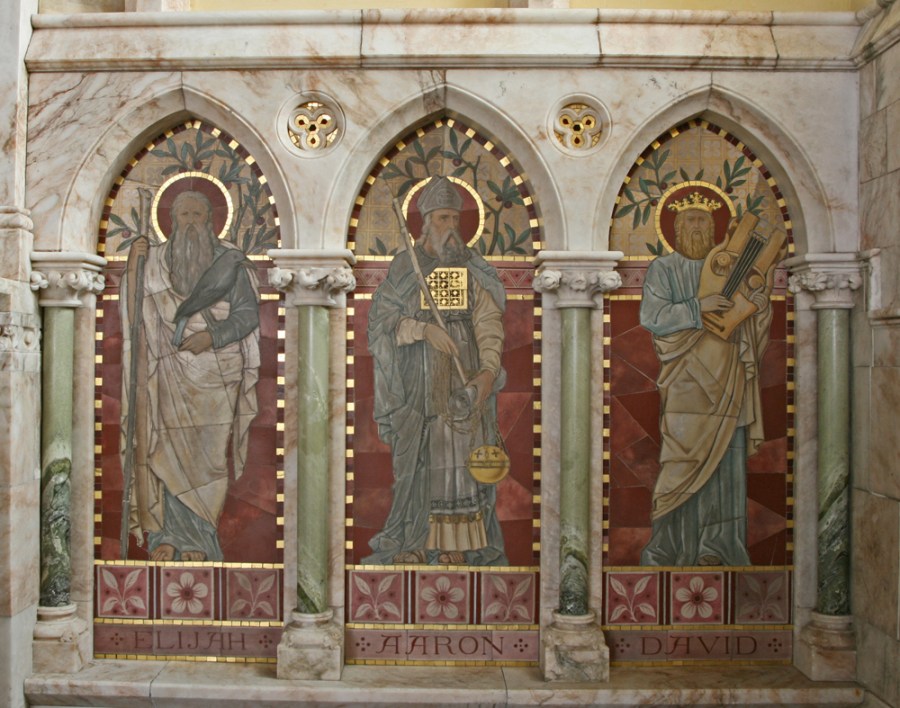
Jesus the True and Better Prophet, Priest, and King

One of my hobbies is photography. While my iPhone does a good job, the Digital SLR I have takes much better pictures. If you aren’t familiar with the lingo, it is one of those cameras that allows you to can change the lens. Being able to change the lens is important because each lens offers a different perspective.

Think about photographing a flower. You could use a macro lens to take a close up of a flower capturing it’s smallest details. Alternatively, you could use a wide-angle lens to capture the flower and the flower bed it’s in all at once, or you could use a telephoto lens to zoom in from far away, and even provide some depth of field to your photographs. It’s these different perspectives that make the picture unique and something we want to look at, and maybe even purchase.

In the same way that different lenses offer different pictures of the same flower, the Bible offers different pictures of Jesus. Three of those pictures are Jesus as Prophet, Priest, and King.

Jesus as Prophet, Priest, and King

When we think about Jesus as Prophet, Priest, and King, we have to understand that He’s not pictured as just any ordinary Prophet, Priest, or King. Instead, He is pictured as the true and better Prophet, Priest, and King, who serves as the culmination of all these roles.

True and Better Prophet

All throughout the Old Testament, the people were looking for a true and better Moses, who would not only proclaim the word of God but also, and more importantly, offer a message of complete forgiveness and reconciliation. But no prophet like Moses ever arose until Jesus came on the scene.

True and Better Priest

Take the Old Testament priests. They served as a mediator between God and man, offering daily sacrifices for the sins of the people so they could exist in relationship with God. But no matter how many priests came, none were able to offer a sacrifice that could reconcile man’s relationship with God forever. That is until Jesus came.

True and Better King

Finally take David. He was the great king of the nation of Israel. God even made a covenant with him. and called him a man after His own heart. But David nor any of the kings after him were able to lead the people to truly follow God, that is until Jesus came.

What this Means for Us

You see, Jesus isn’t just any old Prophet, Priest, or King, He is the true and better Prophet, Priest, and King, who is able to do what those who came before could not. Which tells us that Jesus is:

  • The true and better Prophet, whose message is worth listening to.
  • The true and better Priest, whose salvation is worth believing and hoping in.
  • Finally, the true and better King, whose leadership is worth submitting to and following.

Question for Reflection

  1. Do you believe Jesus is the true and better Prophet, Priest, and King?

Resources

Post adapted from my sermon Jesus as Prophet

Image

The Bible Project

Over the last several weeks I have been on a binge. No, not a Netflix or junk food binge, but The Bible Project binge. I just can’t get enough. Not only is it helping me understand the biblical storyline, but it is doing so in an interesting and engaging way. I want to commend their videos and resources to you. Below is their trailer. It tells you who they are and what they are doing.

After watching the trailer, head over to the app store and download the app: Read Scripture. It’s not only a great way to read through the Bible in a year, but it has The Bible Projects videos baked in. At the beginning of each book, and periodically throughout, there is a video for you to watch that helps you understand the book or theme you are about to read or, in the case of the theme, just read. Give it a try. You won’t be disappointed. The video highlighting the app is below.

A Christian View of Social Justice

Social Justice is a word we hear often. From discussions with our neighbors at our local coffee house, to the nightly news, to the political arena, social justice seems to be a common topic of discussion and debate. But what is meant by the term social justice? Is it biblical? Should Christians participate in acts of social justice?

Two Predominate Views of Social Justice

(1) Unconstrained view – This view is based on everyone getting their fair share. As we are all aware, every society has a finite amount of resources to go around. This view holds that everyone should have their fair share of those resources. It is unjust to allow some to hold onto a greater portion of those resources. We should, then, do all we can to see that those resources are shared equally.

(2) Constrained view – This view is based on the fair treatment of all peoples, and it is not concerned with everyone having their fair share of the total resources in a given society. In this view, it’s not unjust for people to hold onto wealth. People are entitled to what they have earned. Instead of putting energy into the redistribution of wealth, we should put our energy into seeing that everyone is treated fairly.

Which View is Biblical?

Let’s look at a few verses on social justice from the Bible:

  • Exodus 21:1-11 provides laws regarding the fair treatment of slaves.
  • In Deuteronomy 15:1-18, especially 7-11 and 13-15, rules are given concerning meeting the needs of the poor.
  • Psalms 72:12-15 and Psalm 103:6-7 tells of God redeeming the oppressed and persecuted from their oppressors, working righteousness and justice for them.
  • Proverbs 31:8-9 tells us to judge righteously and to defend the rights of the poor and needy.

By far these are not all the verses in the Bible on social justice, but they give us an idea of which view the Bible is upholding. I believe that is the second view, the Constrained View.

God’s Word does not command us to redistribute our wealth to neighbors, so that we all have equal access to the total resources of the society in which they live. Differing classes and a distribution of wealth does not constitute injustice [1].

A biblical view of Social Justice holds that we are not to show partiality, not to steal, not to swindle others, not to take advantage of the weak because they are uninformed or unable to stop us. 

Rather than saying we need to redistribute our resources, so that we are all on equal footing, the Bible tells us that we are to care for the oppressed and seek to stop others from oppressing them. We are to speak up for those who are being persecuted. We are to work for laws that stand for the fair treatment of all peoples regardless of race or nationality.

Christians are to Work for Social Justice

If we believe part of God’s mission is to redeem the oppressed and persecuted, to make sure the poor are cared for and the helpless are not taken advantage, and if we believe we are a part of that mission, then we are to do the same. Christians are to work for social justice in their cities.

Questions for Reflection

  1. Do you agree that the constrained view represents the biblical view of social justice?
  2. How does your church care for the needy, oppressed, and persecuted?

Resources

Gilbert and DeYoung, What is the Mission of the Church?, 176, 180-183.

[1] I do not believe the churches actions in Acts are meant to be prescriptive. Rather, I see their actions as being descriptive of what took place in that city.

Image

Are You Connected to a Biblically Minded Church? – Part 4

Evidence matters. It matters in research papers, in the courtroom, on the news, and in churches. Evidence matters because it reveals what we know, what we’ve done, or who we are. In this series, I am focusing in on that last one – who we are – in an effort to expound on the evidence of a biblically minded church (Read Part 1, Part 2, Part 3).

What is a Biblically Minded Church?

By a biblically minded church, I mean a church that is centered on God’s Word, so much so that God’s Word influences the way it thinks and the things it does.

What is the Evidence of a Biblically Minded Church?

I believe there is, at least, four pieces evidence of a Biblically Minded church in Colossians 1:3-14. The third piece of evidence we come across tells us,

(4) A Biblically Minded Church Seeks to Please God

In verse 10, Paul’s prayer for the Colossians is that they would be

fully pleasing to [God].” (Col. 1:10b)

Paul’s prayer should be our prayer as well. We should pray that we would live lives that are pleasing to God. But before we can pray that we would live lives pleasing to God, we need to know what a life that pleases God looks like.

What does it look like for us to live lives that are pleasing to God?

In verses 10-12, Paul tells us that we please God:

(1) When we live obedient lives

That is what Paul is getting at when he says that we are “to walk in a manner worthy of the Lord.” Just like a parent is pleased when their children obey, God is pleased with us when we obey Him.

(2) When we make it a point to grow in our relationship with Him

Our relationship with God grows, in the same way, it does with a friend, by spending time with Him and learning more about Him. We spend time with and we learn more about God by reading His Word, praying, meeting with others for Bible study, reading books that help us understand His Word better, and coming to worship service. When we do those things, we are actively seeking to grow our relationship with God, and that pleases God.

(3) When we trust in Him

One of the ways you can know if you are trusting in God is by how you respond to trials and tribulations. When faced with a trial, if you find yourself constantly worrying, getting angry or anxious, you are most likely trusting in yourself. On the other hand, if you are able to endure trials with patience and joy, then most likely you are trusting in God. When we trust God, we please Him.

(4) When we give thanks to Him

When we acknowledge and thank God for all He has given us, we please God.

In all these ways we please God. A church that seeks to please God, then, is the fourth and final evidence of a biblically minded church.

Questions for Reflection

  1. Are you a part of a church that is focused on pleasing God?
  2. Are you a part of a biblically minded church?

Resources

Post adapted from my sermon Are We A Biblically Minded Church?

Image

[1] http://catalystconference.com/read/us-churches-no-longer-in-decline/