How Do We Deal with Recurring Sin in Our Lives? – Part 3

Dealing with sin so as to remove it from our life is not easy work. It not only requires us to do the hard work of discovery, but we also must be determined to remove it from our lives. After we have accomplished those two things, we are set to do battle with sin. But how?

How Do We Do Battle With Sin in Our Lives?

Let me just say at the start that the only way we are going to successfully battle sin in our lives is to have had our heart changed by the gospel, which means we must be a believer.

We must be a believer.

If you aren’t a believer, there is no hope of changing. That might sound matter of fact and harsh but it’s true. Non-believers haven’t been set free from the bondage of sin. It has them by the throat, and their only option is to obey. Listen to what Paul says about us before we come to Christ,

“And you were dead in the trespasses and sins in which you once walked, following the course of this world, following the prince of the power of the air, the spirit that is now at work in the sons of disobedience— among whom we all once lived in the passions of our flesh, carrying out the desires of the body and the mind, and were by nature children of wrath, like the rest of mankind.” (Eph 2:1–3)

I think Paul makes it clear that those who aren’t believers are in constant bondage to sin. They are controlled by it and have no choice but to submit to Satan and the passions of their body and mind. In order to deal with sin in our lives, then, we have to first be released from its bondage, which only occurs in Christ.

Jesus is the one who makes us alive, freeing us from Satan and sin’s mastery over us by changing our hearts. Once our hearts are changed our desires are redirected away from sin, Satan, and the world, to the things of God. Without Jesus, then, battling sin is impossible.

Just because we are a believer, however, doesn’t mean our battle with sin is over. In reality, it has just begun. Removing sin from our life is hard work and only happens as we attack sin at the root.

We must attack sin at the root.

The church where I serve as pastor is located in the country. It is surrounded by farmland. While the soil is rich for growing hay, it is also rich for growing stickers. If you were to walk barefoot through the fields surrounding our church, your feet wouldn’t be happy because they would be full of stickers.

Anyone who has ever battled stickers knows the only way to get rid of them is to attack the root. You can cut them down with the mower and it will appear as if there are no stickers for a while. But you can bet they are still there and they will pop right back up in a week or two. Removing stickers, then, requires the hard work of attacking them at the root. Cutting them down at the surface won’t do.

In a similar way, if we want to remove sin from our lives, we can’t just cut it down on the surface, we have to attack it at the root as well. The root of sin is found in our heart.

When the Bible refers to the “heart“, it’s not referring to that organ inside of us that’s pumping blood through our body. Rather, it refers to the inner man where our affections, will, and desires reside. The root of sin is found at the heart level, which is where we must battle sin.

We’ve been given incomplete advice.

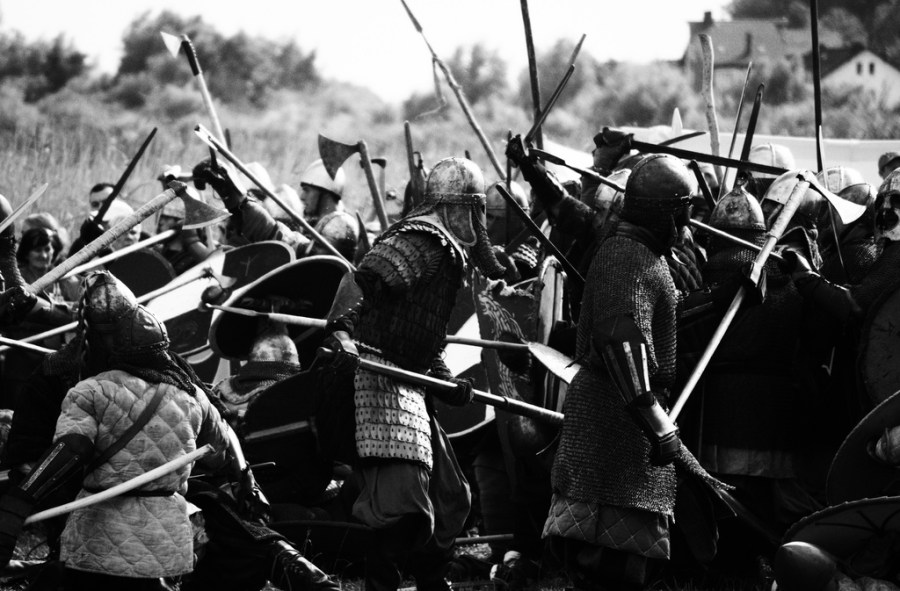
While the battle against sin must take place in the heart, often times we are directed towards another battlefield and given different battle plans. The battlefield to which we are usually directed is the surface. We are told to deal with the externals rather than the internals of the heart.

For instance, we are told if we have trouble with pornography, we should throw our computers out. If we have a drug addiction, we should flush the drugs down the toilet and forget about them. If we are being influenced by the wrong people, we should move.

At one level, this is not bad advice, it is just not complete. Removing these things from our lives may be a good first step since they provide the time we often need to deal with our heart. But that’s all they are — a good first step.

While dealing with externals is a good first step, we often treat it as if it’s the solution. That’s a problem because it means we are only cutting sin down instead of rooting it out. Even worse, it gives us a false sense of victory, believing we have won, we usually head back to camp to celebrate, while our enemy, our sin, regroups for another attack.

Sin that has been cut down and not rooted out will come back.

You know what is going to happen? Eventually, we will buy another computer, see people from our past, or have to have surgery that requires us to take pain pills during our recovery. If we haven’t dealt with our heart, we are going to fall right back into these same sins. Dealing with the externals only buys us time. The sin we thought we defeated will come back, just like the stickers in the field will come back.

Frustration turns to weariness, then to defeat and acceptance.

When we see the sin we thought we defeated come back over and over again, our frustration will grow. After our frustration reaches the boiling point, we may decide to throw in the towel, giving up the fight because we see no use. We may even catch ourselves saying something like, “That’s just the way God made me.”

Keep fighting but on the battlefield of your heart.

But God didn’t make you that way, nor does He want you to give in and continue in sin. Instead, He wants you to continually wage war against sin in your life, and that war must be waged on the battlefield of the heart.

I’ll talk about how we do battle with sin at the heart level in my next post.

Questions for Reflection

  1. Are you a believer?
  2. Are you fighting sin on the battlefield of your heart or on the surface?

Resources

Post adapted from my sermon: How Do We Deal with Recurring Sin in Our Lives?

Image

How Do We Deal with Recurring Sin in Our Lives? – Part 2

In the last post in this series, I provided a few questions from Thomas Watson’s The Godly Man’s Picture that are designed to help you discover your beloved sin. Hopefully, you spent some time with those question, and, hopefully, they either convicted or helped shed light on that which you might have been unaware. Once you have discovered or admitted your beloved sin, the next step is to determine not to hold onto it.

Once you have discovered or admitted your beloved sin, the next step is to determine not to hold onto it.

You Must Determine Not to Hold Onto to Your Beloved Sin

As Christians, we shouldn’t want anything to come between us and God. But that’s exactly what happens when we hold onto sin in our lives. It comes between us and God, stealing our affections away from Him, and hindering our worship and fellowship.

John Owen, another Puritan says,

The unmortified soul [or the one who leaves sin unchecked] cannot say uprightly and truly that God is its portion, having something else that it loves. The soul and its affections, that should be full of God, cannot be full of Him, since it is entangled in worldly pursuits. [1]

As Christians, we can’t hold onto sin. We have to let go of our grip and seek to remove it from our lives.

But how? How do we remove sin from our lives? We have to do battle with it. How do we do that? We answer that question in the next post in this series.

Question for Reflection

  1. Are you determined to remove sin from your life no matter the cost or effort?

Resources

Post adapted from my sermon: How Do We Deal with Recurring Sin in Our Lives?

Image

[1]  John Owen, The Mortification of Sin, 23.

How Do We Deal with Recurring Sin in Our Lives? – Part 1

My calendar is full of reoccurring events. Every Friday at 6:30 am I meet with some guys at IHOP for our Men’s Breakfast, every Saturday is supposed to be Family Fun Day, and the first Tuesday of every month I attend a pastors network luncheon. Those are just a few of the reoccurring events on my calendar each month.

Just like me, I know you have things you do regularly. I am sure a lot of those are good things. But I know there are things in your life, just as there are in mine, that occur regularly that aren’t good. What I have in mind is that one sin that keeps coming back. The one you just can’t seem to shake. What do we do with that sin?  How do we deal with reoccurring sin in our lives?

Over the next five posts (Post 2, Post 3, Post 4), I intend to answer that question, while also providing encouragement for the battle ahead.

We Have to Discover Our Sin

In order to deal with our beloved sin — the one that occurs over and over again, we must know what it is. We can’t do battle with something that’s unknown, or we aren’t willing to admit.

How do we discover our beloved sin?

Thomas Watson, in his book, The Godly Man’s Picture, provides a few questions we can use to discover our beloved or recurring sin. I encourage you to spend some time with the following questions today. They not only serve to convict the soul, but they will also shed light on that which might be hidden.

(1) What is the one sin you don’t want others to point out? That one sore spot that if touched causes you to recoil or snap back in anger?

(2) What is the one sin that runs through your mind the most? The one you think about day in and day out?

(3) What is the one sin that has the most power over you? The one you can’t resist?

(4) What is the one sin that you defend often? The one you advocate and dispute for? The one whose arguments you have waiting in the wing for the moment when someone tries to call you out?

(5) What is the one sin that troubles your conscience the most? When you are distressed, hurting, sick, what sin comes to mind? What sin makes you most ashamed? [1]

What is the one sin you can’t seem to give up? What is your beloved sin? We all have one. It may change from time to time, but we all have one. If we are going to rid it from our lives, we not only have to know it but we have to admit it.

Question for Reflection

  1. What is that one sin that continues to play like a broken record in your life?

Resources

Post adapted from my sermon: How Do We Deal with Recurring Sin in Our Lives?

Image

[1]  Thomas Watson, The Godly Man’s Picture, 148-50.

How do we explain the stricter punishments of the nation of Israel?

If we are honest with ourselves, some of the punishments that took place in the nation of Israel give us pause. Not only were people regularly called out for their sin, often times death was the punishment. When we look at the church today, we don’t see folks being killed by the congregation for their sins. So why the change? How do we explain the stricter punishments in the nation of Israel?

Adultery Then and Now

For instance, in Deuteronomy 22 we read,

“Then they shall bring out the young woman to the door of her father’s house, and the men of her city shall stone her to death with stones, because she has done an outrageous thing in Israel by whoring in her father’s house. So you shall purge the evil from your midst. “If a man is found lying with the wife of another man, both of them shall die, the man who lay with the woman, and the woman. So you shall purge the evil from Israel.” (Dt 22:21–22)

The punishment for adultery in Old Testament Israel was stoning, but in the New Testament the punishment is different. Consider 1 Corinthians 5:1-2

“It is actually reported that there is sexual immorality among you, and of a kind that is not tolerated even among pagans, for a man has his father’s wife. And you are arrogant! Ought you not rather to mourn? Let him who has done this be removed from among you.” (1 Co 5:1–2)

While the sin was the same, the punishment was different. Instead of death, they were excommunicated. The differences, however, don’t stop there. Not only were their lives spared, but it was hoped that they would repent and enter back into the community.

Why the Change?

I believe the change can be explained in several ways.

(1) We no longer live in a Theocracy

We have to remember that Old Testament Israel lived with God as their ruler. He set the laws for the nation. God acting as the governing authority of a nation is generally referred to as a Theocracy. 

Now we live as the church in many different countries ruled by Kings, Governments, Dictators, etc. The rules of each country dictate how we are to live and what the punishment for certain sins will be, or if they will be punished.

(2) Our camp no longer has to be purged of evil

When the nation of Israel began, God tabernacled among the people. His presence was in the Holy of Holies, which is the innermost part of the Tabernacle. In order for God, who is holy, to live in the same camp with an unholy people, sacrifices had to be performed daily and yearly. As well as the evil unrighteous person had to be removed from the camp. One way they were removed was through death.

Death not only removed the unrighteous sinner from the camp, it also reminded the people that a holy God lived in their midst, and that He required them to be holy in order to continue to have a relationship with them.

In the church age, however, God no longer tabernacles in the holy of holies. His presence isn’t present in our churches like it was in the Tabernacle. Instead, God tabernacles among us, as He lives in our hearts. Each and every believer is indwelt with the Holy Spirit. We are, then, the Temple of God.

God is able to dwell in us because of Jesus’ death on the cross. When Jesus died on the cross the Temple and the sacrificial system associated with it, was made obsolete. His death served as the ultimate sacrifice for our sins. His blood now covers us making us righteous and holy, which allows us to have a relationship with a holy God.

Since we are the Temple and the ultimate sacrifice for our sins has been paid, we no longer have to purge the evil from us in order for God to remain in our lives. The evil has already been purged during Jesus’ death on the cross.

(3) Jesus has taken the punishment for sin

The punishment for willful sin in the Old Testament was death. In the New Testament, however, the punishment for sin, specifically unrepentant sin is excommunication from the church with the ability to repent and return to be a part of the community.

While our punishment for sin has changed, the ultimate punishment for sin has not changed. It is still death. Jesus has taken that punishment for us when He died on the cross.

So while there has been a change in practice – we are no longer killed for sin in the church age – the severity of sin is still the same. Sin equals death.

Return to the Question

To return to our question: How do we explain the stricter punishments of the nations of Israel? We explain it by saying that

  • The punishment wasn’t necessarily stricter. It was the same. Sin has always and will always equal death. We don’t experience that death now because Jesus has taken the punishment of sin for us.
  • As well as we don’t live in a Theocracy. We are governed by the state, who sets the laws and punishments.
  • Furthermore, God no longer tabernacles in the holy of holies in the midst of a camp, but in the hearts of individual believers, who have been made righteous by the blood of Jesus.

Question for Reflection

  1. Do you agree with the argument above? I would love your feedback.

Resources

Image

Knowing God Can Do the Impossible Should Affect the Way We Live

In Genesis 18 God confronts Abraham by the Oak’s of Mamre, telling him that he will have a son within the year even though Sarah is beyond childbearing age. When Sarah doubts, God reminds them that nothing is too hard for Him (see my last post for more on this). If He wants to give Sarah a baby in her old age, He will. Nothing will stop the Creator, Sustainer, Healer, and Savior of the universe from doing what He claims. His promise to Abraham will be fulfilled. Indeed, as you work through the text, you see God’s promise realized (Gen. 21). Within the year Sarah gives Abraham his promised son.

Knowing God Can Do the Impossible Should Affect the Way We Live

Knowing God can do the impossible, that nothing is too hard for Him, should affect the way we live. I can’t talk about all the ways it should affect our lives, so let me give you three areas it should affect.

(1) Our prayer life

Probably most of you know someone or have read a story of someone who was diagnosed with a disease or cancer. Upon finding out the news their church began to pray for them. Then some time later, when they went to the doctor for a checkup, the tumor or disease was gone. The doctors couldn’t explain it. It just disappeared.

If we are honest with ourselves, if I am honest with myself, our first thought, when we hear something like that is that the initial tests had to be wrong. They really didn’t have that disease, or cancer, to begin with.

But why do we think that? Why do we think that has to be the case? Why can’t we believe and celebrate the fact that God answered prayer and healed that person? I believe it is because we put limits on God. We think God has to operate in the same way we operate; that He is governed and limited by this world, just like we are.

When we place limits on God, our prayer life suffers. We either don’t pray for big things, like someone to be healed or if we pray for them, we doubt it is going to happen.

But knowing who our God is should give us the confidence to ask without doubting (Jas. 1:5-8). If He wants to heal someone from cancer or a debilitating disease, nothing can stop Him, so we shouldn’t be afraid to pray for things we might consider out of the ordinary, big things. Nothing is too hard for the Lord and knowing that should affect our prayer life.

(2) Our evangelism

At the Together for the Gospel conference I attended back in 2014, one of the speakers preached a sermon entitled: Can your Gospel Save a Terrorist? His answer was yes. God can and does save terrorists. Think about Paul, he was one of the greatest persecutors of the church, but on the road to Damascus God broke into his life, revealed the truth about Jesus, and changed his heart, so that he believed.

Knowing that God can save even those we deem too far gone, should affect our evangelism. It should give us confidence and boldness. It should keep us from judging a person’s likelihood to become a Christian based on their background or their current practices. If God can save Paul, a terrorist, He can save drug dealers, rapists, serial killers, gangsters, hoodlums and the like. He can save us because we are no different. We are all sinners who need Jesus. Our God is a powerful God. Nothing is too hard for Him.

(3) Our giving

Recently, I came across an article with a shocking and revealing statistic. Church members on average only give 2.5% of their income [1]. I don’t quote that statistic to guilt you into giving more to the church. I bring it up because it reveals something about our heart. Either we are lured and enticed by the possessions of this world so that we spend our money on them. Or we squirrel everything back believing that money provides security.

Certainly, there is wisdom in saving, and there is nothing wrong with having things, but we can’t allow the possessions of this world or our fear of the future to get in the way of our giving. We must believe God truly satisfies and that He has the ability to provide. When we believe those things, we will be freed to give radically; to invest in the kingdom in a way that we haven’t been able to do before.

Question for Reflection

  1. How else should God’s power affect the way we live?

Resources

Image

Posted adapted from my sermon: Is There Anything that is Too Hard for God?which you can listen to here.

[1] http://www.relevantmagazine.com/god/church/what-would-happen-if-church-tithed

Is Anything Too Hard For God?

In Genesis 18 God meets with Abraham and tells him that he will have a son within a year, even though Sarah is beyond childbearing age. Hearing God’s promise Sarah laughs in doubt. But God doesn’t think this is a laughing matter. He is serious about finally providing them with their promised child. In a remarkable exchange with Abraham regarding Sarah’s unbelief, God asks Abraham.

Is anything too hard for the Lord? ”” (Ge 18:14a)

The answer to God’s question is important not only for Abraham but us as well. God’s ability to fulfill His promise to Abraham either confirms or denies His power and abilities. Power and abilities we place our hope in today. For if God can’t provide a child to a childless woman beyond childbearing age, how could He ever raise us from the grave, provide us with a glorified body, and return the world to an Edenic state?

How do we know nothing is too hard for God?

Think about who our God is for a moment.

He is our Creator

Genesis 1 tells us that God created everything that you see, including you and me. The way God creates is much different than how we create. God doesn’t need raw materials or tools. He doesn’t have to set up a factory or an assembly line. Instead, God is able to create something from nothing just by speaking.

Imagine being able to say I want a new car, and there is one in the garage. Or I would like my dream home, and there it is. Or I want the next, next iPhone, and it is right there in your pocket. Imagine being able to create something from nothing, just by speaking, like God does.

In case you are wondering, we know this is how God creates because we have Genesis chapter 1. As you work through that chapter, you see the constant refrain, “And God said,”; “And God said”. Over and over again, we read those words before we read of something else He created. As we do, we are reminded of just how powerful our God is.

He is our Sustainer

Jesus, who is God, does the impossible task of holding everything together. Paul in Colossians 1:17 confirms this when he says,

And he is before all things [speaking of Jesus], and in him all things hold together.” (Col 1:17)

You see, the reason the universe functions as it does. The reason everything doesn’t spin out of control. The reason we don’t cease to exist is because God is sustaining it all. Every atom, every particle is sustained by God.

He is our Healer

Lepers, blind men, those who are lame and deaf, those who are dying or dead, Jesus healed them all. Doing what is impossible just by a touch or word.

He is our Savior 

The way that God saves is contrary to how we might imagine someone saving us. God doesn’t use political or military might. He doesn’t use money or technology. Instead, He uses a dying Messiah. Something that, if we are honest with ourselves, doesn’t make much sense.

But with God, that which seems foolish is actually wise. Consider what Paul says in 1 Corinthians 1:22-25 about God’s wisdom in using a crucified Messiah,

“For Jews demand signs and Greeks seek wisdom, but we preach Christ crucified, a stumbling block to Jews and folly to Gentiles, but to those who are called, both Jews and Greeks, Christ the power of God and the wisdom of God. For the foolishness of God is wiser than men, and the weakness of God is stronger than men.” (1 Co 1:22–25)

So our God not only creates, sustains, and heals, but He also saves. He does so in a way that reveals His wisdom and might.

Nothing is Impossible with God

When you consider all these things, I think it is safe to say that nothing is impossible for God. If God wants Sarah to have a baby, even if it is physiologically impossible for her to have one, then she is going to have one. Likewise, if God wants to heal us of a disease, extend our life a few more years, provide us with a job, spouse, or child, then it’s going to happen.

We shouldn’t doubt His abilities. Instead, we should trust God to do the impossible in our lives, in our families, in our community, and in our nation. Nothing is too hard for God!

Questions for Reflection

  1. Do you believe God can do the impossible?
  2. How should our knowledge that God can do the impossible affect the way we live?

Resources

Image

Posted adapted from my sermon: Is There Anything that is Too Hard for God? which you can listen to here.