All Things to All People to Win Some

What does it look like for us to be all things to all people? Paul models that for us in 1 Corinthians 9. He says when he was with the Jews, he became like a Jew; when with the Gentiles, he became like a Gentile; when with the weak, he became like the weak (1 Cor. 9:21-22).

What, however, does it look like in practice for us to be all things to all people? I believe it works out differently for each of us because we all run in different circles. Let me, however, give you some general principles to operate under.

(1) We must present the gospel in a way people can understand.

Presenting the gospel in a way people can understand doesn’t mean we water down the gospel. Paul sure didn’t. Even though he knew the cross was a stumbling block to the Jews and folly to the Gentiles, he boldly preached the cross. We must do the same.

Knowing we can’t eliminate the offense of the cross doesn’t mean we can’t present the gospel in a way that makes sense to those we are trying to win to Christ.

In the mid 1800’s Hudson Taylor went to China as a Christian missionary. While he was there he also founded the China Inland Mission.

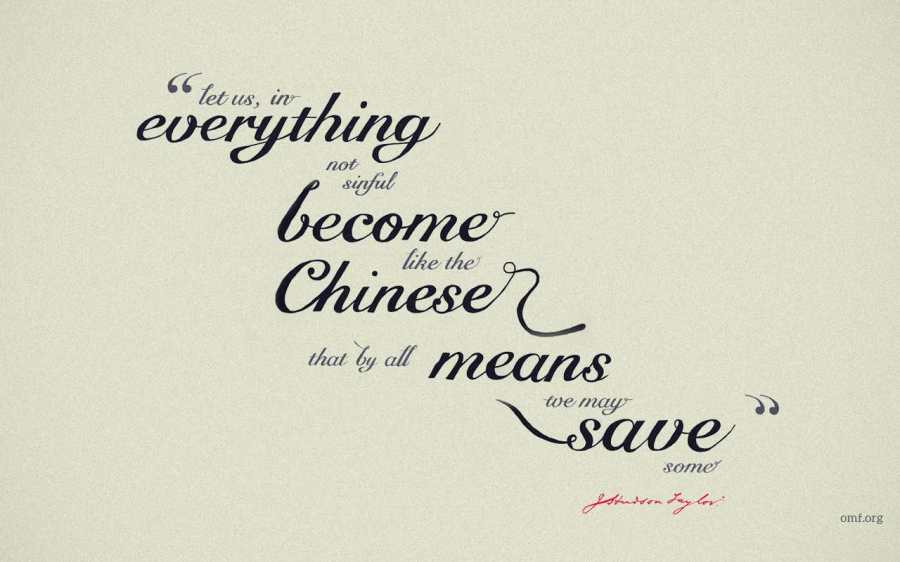
Taylor argued, from the example of the Apostle Paul, “Let us in everything not sinful become like the Chinese, that by all means we may save some [1].

In saying that Taylor was taking a different line than most of the missionaries at the time. Instead of expecting the Chinese to adopt western christendom, he adopted Chinese culture. He grew his hair out, ate Chinese food, wore traditional Chinese clothing, and learned their language and stories.

Taylor recognized forcing his culture on the Chinese wouldn’t work, so he became like the Chinese as much as he could without sinning, just like Paul became like the Gentiles as much as he could without sinning. Taylor’s unusual move allowed him to do something different than those who had come before him. He was able to use language, stories, and metaphors that resonated with the Chinese people.

That is what we have to do. We have to work to understand the culture of those we are trying to reach, so that we can present the gospel in an understandable way.

Not only do cultural difference exist abroad, but in the States as well.

City and Country

I experienced this personally when I moved to Decatur, TX. While Decatur is not too far from the Dallas Fort Worth Metroplex, it is still a rural town. I didn’t grow up in the country. I grew up in the city, and I have always lived in the city.

When I moved to Decatur, I had to start working, and I still am working, to understand the culture, so I can present the gospel in an understandable way to those who live here.

Generational Differences

Cultural divides, however, don’t just exist between the country and city. There are also cultural differences between generations.

There are certain stories, metaphors, and environments that resonate with the older generation that just doesn’t resonate with the younger. If you are in the older generation and you want to reach those in the younger generation — say you grandkids or even your kids — you have to learn their culture. Vice versa for those who are younger.

Now parents this doesn’t mean that you have to start dressing in skinny jeans and cool graphic tee’s. That is probably taking it a little too far. Just understand where they are coming from.

Church and Unchurched

There is also a cultural divide between the churched and unchurched. I believe those of us who were raised in the church either forget this or don’t know it exists. I say that because we often expect those outside the church to understand our churchy language, stories, and metaphors.

We don’t give second thought to using phrases and terms like:

  • Jesus lives in my heart.
  • That was a God thing.
  • That is what sanctification is for.
  • Jesus has justified you.

While there is nothing theologically wrong with those phrases and terms, to those outside the church, they often don’t make any sense. Since they don’t make sense, they don’t get what we are trying to say.

Which means when we are talking with the unchurched we have to use language, stories, and metaphors that resonate with them, as well as we have to define our terms, in order to help them understand the good news of the gospel better.

Again that doesn’t mean we water down the gospel, it just means we speak in a way that makes the most sense to those who haven’t had the opportunity to grow up in the church like most of us.

(2) We must be a living incarnation of gospel values.

Paul was a living incarnation of the gospel. We must be the same. We must incarnate or live as an example of the gospel. People should be able to look at our lives and say,

If I were to become a Christian, that is what my life would look like.

The way we give them that picture is by living out the gospel’s values of grace, mercy, love, justice, compassion, and mission, just to name a few.

Our neighbors should be able to see the gospel’s values worked out in a:

  • A stay at home mom as she cares for her children, husband, and house.
  • A business man as he deals with his clients, employees, and finances.
  • A farmer as he cares for his animals, his workers, and business.
  • A teacher as she interacts with the kids, the parents, and the administration.

The examples could go on and on, but I think you get the idea. The gospel should permeate our lives so that we are a living incarnation of gospel values.

It is one thing to preach the gospel, it is another to live it.

Living out the gospel’s values, along with preaching, has to happen. If we don’t, the message we preach will fall on deaf ears.

(3) We must discipline ourselves to live as Christ has called us to live

We all know Tiger Woods is a great golfer. You can’t deny it. The man has won 105 tournaments, 4 Masters, and 4 PGA Championships. He has won 132 billion dollars in total prizes [2].

While he has real talent, he doesn’t just walk out on the course the day of the tournament and win. He trains almost everyday for 12 hours a day – working out, playing golf, and eating well [3].

Tiger’s talent takes him a long way, but what makes him a great golfer is his discipline and self-control.

Like Tiger, Paul tells us we must exercise self-control, we must be disciplined, if we want to be all things to all people, while remaining faithful to the gospel.

In chapter 9 of 1 Corinthians he uses an athletic metaphor derived from those who participated in the games held in Corinth — the Isthmian games. He says,

Do you not know that in a race all the runners run, but only one receives the prize? So run that you may obtain it.

Then he starts to tell us how we are to run:

Every athlete exercises self-control in all things. They do it, Paul tells us, to receive a perishable wreath, but look what we are striving for – an imperishable wreath; an eternal reward. Because our reward is so great Paul says,

So I do not run aimlessly; I do not box as one beating the air. But I discipline my body and keep it under control, lest after preaching to others I myself should be disqualified. (1 Cor. 9:25-27)

With that Paul gives us the secret to remaining faithful to the life God has called us to live; the secret to being all things to all people is self-discipline, self-control.

Those are needed in order for us to be all things to all people, because we have to have walk a fine line between giving up our rights and adhering to Christ’s law.

As Christians we have rights, but we have to be willing to give those up at times. As Christians we have freedom to live as others do, but we can’t take that too far.

The only way for us to find the sweet spot, so that we can be all things to all people, while remaining faithful to the Law of Christ is to be disciplined, is to exercise self-control.

Question for Reflection

  1. How has God used you as you have been all things to all people?

Resources

Post adapted from my sermon All Things to All People to Win Some, which you can listen to by clicking here.

Image

[1] James Hudson Taylor’s reflection on 1 Corinthians 9v19-23
[2] http://www.tigerwoods.com/about-tiger#biography
[3] http://www.youmotivation.com/motivational-articles/tiger-woods-daily-schedule-12-hour-routine-7129

How and Why Should We Prepare to Take the Lord’s Supper?

The Lord’s Supper is one of the two ordinances of the church. It is something we do regularly, but how and why should we prepare to take the Supper?

How Should We Prepare to Take the Lord’s Supper?

Paul tells us in 1 Corinthians 11 that before we take the Supper we must examine and judge ourselves.

Let a person examine himself, then, and so eat of the bread and drink of the cup.” (1 Cor. 11:28)

Skipping down to verse 31 Paul says,

But if we judged ourselves truly, we would not be judged” (1 Cor. 11:31)

Then in verse 33 Paul says,

So then, my brothers, when you come together to eat, wait for one another — if anyone is hungry, let him eat at home — so that when you come together it will not be for judgment.” (1 Cor. 11:33-34)

So before we come to the table we must examine ourselves to:

  • (1) Make sure that we are a believer, that we believe Jesus to be our Lord and Savior, that we have committed to following Him.

Going even further, we not only need to make sure we are believers, but we also need to:

  • (2) Make sure there is no known unrepentant sin in our lives.

After examining ourselves, if we find sin in our hearts we have been unwilling to repent of, we must repent before partaking of the Supper.

Lastly, we must:

  • (3) Make sure we are united with others.

Recently, I was watching a show, and in it one of the main characters reluctantly goes home for a Christmas meal. While around the table with her family, they break out into a huge argument. The scene ends with her telling her father she regrets coming, then storming out.

Now, I think it is safe to say unity didn’t exist before that meal began — that is why she was reluctant to go home in the first place. Since there was no unity, when they all sat around the table together it ended in a fight.

That, however, should not be so in the church. We are supposed to come to the table together united with one another as brothers and sisters in Christ. We can’t do that if we are at odds with another in the body. So we must examine and repair our relationships before we take the Supper.

What Happens if We Don’t Examine Ourselves and Take the Supper Anyways?

We could be eating and drinking judgment on ourselves. In verse 27 Paul says,

Whoever, therefore, eats the bread or drinks the cup of the Lord in an unworthy manner will be guilty concerning the body and blood of the Lord.” (1 Cor. 11:27)

When Paul tells us that we are guilty of the body and blood of the Lord, he means that we are liable and will face the same punishment as those who crucified Jesus. In other words, we are treated as unbelievers because we show we don’t understand the point of the Supper.

We show we don’t believe what the Supper proclaims — that Jesus died in our place for our sins so that we might have a relationship with the Father and experience eternal life. For if we did, we would show reverence and honor for the Supper being observed.

Also, starting in verse 28, Paul says,

Let a person examine himself, then, and so eat of the bread and drink of the cup. For anyone who eats and drinks without discerning the body eats and drink judgment on himself. That is why many of you are weak and ill, and some have died. But if we judge ourselves truly, we would not be judged.” (1 Cor. 11:28-31)

Apparently, there were some in the Corinthian church who were weak, ill, and some who have even died. Paul tells the Corinthians this happened and is happening because they do not observe the Supper rightly.

The same will happen today. If we take the Supper in an unworthy manner. If we misuse it and treat others poorly at it, we too will face the same fate. We too will be treated as an unbelievers. We too will grow weak, ill, and some of us may even die.

So if we don’t examine ourselves and take the Supper anyways, we could be eating and drinking judgment on ourselves.

Conclusion

So before we take the Supper we need to examine ourselves: make sure we are believers, repent of the sins we are holding onto, and repair any relationship that needs to be repaired. If we do those things, we will not only avoid the Lord’s judgment, but the Supper will be what Jesus designed it to be:

A time for Jesus’ family to come together in unity to celebrate and proclaim to each other and the world what He has done and will do for us.

Question for Reflection

  1. Do you prepare for the taking of the Lord’s Supper?

Resources

Post developed from the sermon: The Lord’s Supper: A Family Meal of Unity, Celebration, and Proclamation which you can listen to in its entirety by clicking here.

Image

The Lord’s Supper: A Family Meal of Remembrance, Proclamation, and Unity

The Lord’s Supper is one of the two ordinances of the church. It is something we do regularly, but what does it represent? Is it just a time for us to sit quietly and receive a pez size unleavened wafer along with a shot of grape juice or wine? Or is there something more to it?

What Does the Lord’s Supper Represent?

(1) The Lord’s Supper is a Meal of Remembrance

It is a time for us to remember what Jesus has done for us and will do for us. Because of that it is a time of celebration, a time of joy.

What do the elements of the supper tell us that Jesus did for us?

About the bread, Paul quotes Jesus as saying,

This is my body which is for you.” (1 Cor 11:24)

By this, we know that Jesus physically died in our place. His body was broken for our sins, as He took the punishment on Himself that we deserve.

Then about the cup, Paul quotes Jesus as saying,

This cup is the new covenant in my blood” (1 Cor. 11:25)

By this, we know that Jesus’ blood was spilt for us. It was spilt to cover our sins. Just like the blood in the Old Testament sacrifices, although imperfect, covered the sins of the Israelites, making them holy, Jesus’ blood covers us, making us holy and righteous, which allows us a relationship with the Father.

As Jesus suffered the pain of the cross and the weight of the Father’s wrath, He did so gladly, knowing that His sacrifice provides us with a way of escape and the ability to once again experience a relationship with the Father.

What do the elements of the supper tell us that Jesus will do for us?

They remind us a time is coming when we will once again sit around the table with Jesus.

In 1 Corinthians 11:26 Paul writes,

For as often as you eat this bread and drink the cup, you proclaim the Lord’s death until he comes.” (1 Cor. 11:26)

In Savannah, there are a lot really good restaurants. For our birthdays’, my Dad would take my sister and I to the restaurant of our choice. One year, my sister decided she wanted to go Elizabeth’s on 37th street, which is a five star restaurant. Definitely, not a place we went often, but a place that lived up to the hype.

While the meal was small — I had to go to McDonald’s afterwards to get full — it was amazing. It was so good I still remember it 15 years later.

As good as our meal was that night, it doesn’t hold a candle to the meal we will have with Jesus one day in the recreated garden as we celebrate His second coming, His defeat of our enemies, and the ushering in of the New Heavens and New Earth, which is exactly what the Lord’s Supper points toward. The time after Jesus’ return when we will sit around the table with Him once again in the New Heavens and New Earth.

(2) The Lord’s Supper is a Meal of Proclamation

Have you ever noticed when watching the Olympics after a runner wins the race he takes it upon himself to do one more lap with his countries flag in hand? We call what he does a victory lap.

In some sense that is what we are doing as Christians when we take the Lord’s Supper. We are taking a victory lap to proclaim our Savior’s victory.

Paul in 1 Corinthians 11:26 says,

…as often as you eat this bread and drink this cup, you proclaim the Lord’s death until he comes.” (1 Cor. 11:26)

By partaking of the Lord’s Supper, Christians proclaim Jesus’ victory.

  • We proclaim that we believe Jesus’ death on the cross was sufficient to pay the price for our sins and bring about a New Covenant with God.
  • We proclaim that Jesus will return and defeat our enemy Satan, rid sin from the world, and bring in a New Heavens and New Earth.

Every time we take the Lord’s Supper we not only proclaim these truths to each other, but we also proclaim them to the watching world. We take a victory lap for our Savior.

(3) The Lord’s Supper is a Meal of Unity

On the idea of meal time as unity, one commentator says,

“Mealtimes [in the 1st century] were far more than occasions for individuals to consume nourishment. Being welcomed at a table for the purpose of eating food with another person had become a ceremony richly symbolic of friendship, intimacy, and unity.” [1]

As Jesus gathered around the table with His disciples, they were unified. They were a family. They were brothers and sisters in Christ.

Likewise, when we take the Supper, we are to be unified, because we too are all brothers and sisters in the Lord united with one another through one head — Jesus Christ (Col. 1:18).

When we come to the table, there shouldn’t be any bad blood, disputes, or conflict between us. We all should be in one accord, united with one another. We should be one happy family.

Question for Reflection

  1. Is this how you think of the Lord’s Supper?

Resources

[1]  A Meal with Jesus, 19

Post developed from the sermon: The Lord’s Supper: A Family Meal of Unity, Celebration, and Proclamation which you can listen to in its entirety by clicking here.

Image

Let Love Lead You

Knowledge is power, and it helps us excel in life. Even so, it can be a hindrance, especially in our church community.

How can knowledge be a hindrance?

Knowledge is a hindrance when we allow it alone to guide us. We see an example of this in 1 Corinthians. There were some in the church who had come to believe that:

an idol has no real existence,” and that “there is no God but one.” For although there may be so-called gods in heaven or on earth—as indeed there are many “gods” and many “lords”— yet for us there is one God, the Father, from whom are all things and for whom we exist, and one Lord, Jesus Christ, through whom are all things and through whom we exist.” (1 Co 8:4b–6)

For their understanding, we would praise God because what they believe is correct.

Where they went wrong, however, is in how they applied their knowledge. Since gods and idols are nothing, they concluded it was ok to attend meals thrown in pagan temples by their pagan friends, and even to eat the meat sacrificed to idols.

While their belief may be true, others in the church weren’t there yet. When they saw other brothers and sisters in the church participating in these activities, they were led to believe it was ok to combine these practices with their Christian faith, which resulted in their faith being destroyed (1 Cor. 8:11).

How should we use our knowledge?

(1) Love must lead us

As Paul begins chapter 8, at the end of verse 1 he says,

This knowledge puffs up, but love builds up.” (1 Cor. 8:1b).

Paul’s statement tells us love must lead us. Love should lead us because it has others best interest in mind. Unlike Knowledge, which often serve to puff us up, love is willing to sacrifice for another. Love is willing to give of our rights, desires, and freedom for the sake of another.

When we think about it, giving up our rights, desires, and freedoms is not our natural tendency. Naturally, we hold those things close because we are selfish. The only way we are going to love in a way that allows us to joyfully give up our rights, freedom, and desires at times for another is if we have experienced love like that ourselves.

I believe we experience that type of love in the gospel. The Father loved us so much that He gave of His only Son, Jesus. The Son, Jesus, loved us so much that He was willing to give of His life for us. He hung on a cross dying in our place, while the Father poured the wrath we deserve out on Him. Hanging there, receiving God’s wrath, Jesus gave up His rights, desires, freedom, and life for us. He gave of Himself to repair our relationship with the Father, so that we might have eternal life.

Experiencing the love and benefit of Christ’s sacrifice should motivate us to sacrifice for another. As Christians’, God’s love then should channel through us to others.

Love, true love, not the love pictured in movies or shows, should be what leads us. Love should lead us alongside our knowledge because love focuses on others, while knowledge by itself often focuses on us and our rights.

(2) At times, our rights must be sacrificed

While Paul agrees with the Corinthians that eating food offered to an idol is a matter of indifference, he also tells us that we are to use our “rights” in a way that does not cause another to stumble.

But take care that this right of yours does not somehow become a stumbling block to the weak.” (1 Cor. 8:9)

It might be our freedom to do something, but if our actions are harming another person’s faith instead of building them up, we must be willing to give that thing up. That’s what love does.

Whereas, knowledge looks at a situation and says: I have the freedom and right to do that. Love looks at a situation and asks: will my right harm another? Where we determine our actions could harm another’s faith; where it would tear them down instead of build them up, we don’t do it.

For instance, we live in a technologically savvy world. Facebook has become a normal part of our lives. One of the great things about Facebook, and social media in general, is the connections we can make with others.

Whereas in the past, we might have only been able to connect with and keep up with a small group of people in our own community, through Facebook we can connect with people halfway around the world and keep up with friends from our past.

With those connections comes influence. Influence like we have never had before. Through my posts I can influence the way people think not only in my immediate community, but also in my global community.

With influence comes responsibility.

As a member of Facebook, I have the freedom and right, to post almost anything, but as a Christian, that doesn’t mean I should. Instead, my first thought before posting something should be: How will this be perceived by another?

  • Will it be positive and build them up in their faith?
  • Will it tear them down in their faith?
  • Will it lead them to think or act in a way that is contrary to God’s Word?
  • Will it lead them into excess?

After answering those questions, we may conclude that our post is not beneficial. At that point, we have a decision to make. Will we give up our right to post what we were going to for the sake of another? Or will we go through with it because it is our right to do so? Paul tells us at times we must be willing to give up our rights for the sake of another.

(3) There is a difference between leading others into sin and leading others into the truth

I don’t want you to get the impression that we should never challenge another person. We should challenge other people to think and act differently, especially when we are challenging them to think and act in a more biblical way.

There is a distinction between leading others into sin and leading others into the truth. If we have knowledge that someone else doesn’t have, we may temper our actions, some of the things we post, or say in a public forum, if we know our actions would hinder their faith. That, however, doesn’t mean we don’t teach them what God’s Word says in another setting.

While our actions could lead another into sin. Dialoguing with them and teaching on a particular subject, where we can explain ourselves and expose them to Scripture can lead them into the truth.

Teaching, challenging, and dialoguing is something we should do. It is an area in which we shouldn’t hold back because our desire isn’t to make good, neat legalists, but gospel-centered followers of Jesus.

So there is a difference between leading others into sin and leading them into the truth. One we should do and one we shouldn’t do.

Conclusion

Love then should lead us. It should lead us because love will do what is best for others, whereas knowledge will more often do what is best for us.

Question for Reflection

  1. What are you allowing to lead you: Knowledge? Or love alongside your knowledge?

Resources

Post adapted from the sermon: Let Love Lead Youwhich you can listen to here. Image

The Christian and the Same Sex Marriage Decision

While I had a feeling the courts would rule for same sex marriage, I was still shocked when I read the headlines. I guess I had hoped they would consider how polarizing Roe vs. Wade has been and do something different. Something like put the decision to a vote by the people, instead of deciding for us. But that is not what happened. Instead nine justices decided for the American people that same sex marriage should be a reality in all 50 States.

If many of you are like me, you were probably shocked as well. I am sure other emotions may have been and still are running through your veins. Emotions like: Anger, dismay, hopelessness, sadness, even fear — fear of what is to come. Fear for our children and the world in which they will grow up.

As I have talked to many of my friends, read my Facebook and Twitter feeds, and thought and prayed myself, one question has consistently come up: How should Christians Respond?

As I have thought, prayed, and searched Scripture, the Lord has given me several ways we should respond.

(1) We Must Respond In Love, Not with Anger, Hate, or Violence

Searching Scripture, the Lord led me to 1 John 3. There John says in verse 11 and 15,

For this is the message that you have heard from the beginning, that we should love one another…Whoever does not love abides in death. Everyone who hates his brother is a murderer, and you know that no murderer has eternal life abiding in him.” (1 Jn 3:11–15)

As Christians we must heed these words and respond in love. We aren’t to hate. We aren’t to turn to anger or even violence. We as Christians are to love. We are to show care, compassion, grace, and mercy to the gay community and those who support them.

That doesn’t mean we condone their activity, back down, or roll over and let others do what they want to us. We must stand our ground. We must fight for our rights. We must reject the decision handed down, but we have to do it in love.

(2) We Must Respond by Trusting in the Lord

While the Supreme Court decision didn’t go the way we wanted. While our country is slipping further and further from the original intent of our founding fathers — that we be “One Nation Under God.” Even though our Religious Freedom may be slipping away. We must still trust in the Lord.

We must trust in Him because He is sovereign. Psalms 47:8 says,

God reigns over the nations; God sits on His holy throne.” (Ps 47:8)

God is the one reigning. He is the one ruling. That was true 1,000 years ago, 100 years ago, last month, last week, 1 day ago, today, and for all eternity, God is reigning and ruling. There is no authority greater than Him.

Consider what Paul says starting in Colossians 1:16 about Christ,

For by him all things were created, in heaven and on earth, visible and invisible, whether thrones or dominions or rulers or authorities — all things were created through him and for him. And he is before all things, and in him all things hold together.” (Col 1:16-17)

Did you catch that? All things were created by Jesus. Thrones, dominions, rulers, authorities were all created by Him. He is the authority above all authorities. There is no greater authority than Him.

Along with there being no greater authority, we know that every authority is ruling because the Lord appointed them.

Romans 13:1 says,

Let every person be subject to the governing authorities. For there is no authority except from God, and those that exist have been instituted by God.” (Rom. 13:1).

So what happened this last week was no mystery to God. It didn’t slip through the cracks. The Lord allowed those nine justices to sit on the Supreme Court, knowing that this last Friday, five of them would publish the majority opinion in favor of Same-Sex marriage.

Since the Lord is Sovereign, knows all things, He is who He is — all powerful, just, merciful, gracious, loving, kind, etc. — we must continue to place our trust in Him.

We may not always understand the way the Lord works. Why He allows certain things to happen, but one thing we do know is that the Lord is sovereign, His plan is perfect, so we must continue to place our trust in Him.

(3) We Must Respond By Preaching the Gospel

As the Supreme Court decision was handed down, those for Same-Sex marriage were exuberant. You could hear their cheers in videos, their excitement was evident in the media, and on social media. They were excited because they believe this win will satisfy them and give them something they long for — peace. But that is not true. Nothing in the world can give us peace. This world is ruled by the domain darkness, and it provides no lasting hope, satisfaction, or peace. Only Jesus provides peace.

In Colossians 1:19 and 20, Paul writes,

For in him [speaking of Jesus] the fullness of God was pleased to dwell, and through him to reconcile to himself all things, whether on earth on in heaven, making peace by the blood of his cross.” (Col 1:19-20)

Only through Jesus can we find true peace. That’s because the peace our heart longs for is not the peace of social or civic justice, but the peace between man and God. Deep down inside we know we are sinners, who will answer to God one day. Try as we might to rid ourselves of that reality, it is still there. That is why we fight for peace on this earth. It is the natural longing of every human. In our effort, we may experience temporary peace, but we will never experience peace with God unless we trust in Jesus as our Lord and Savior.

Unless we see ourselves as sinners who have sinned against a perfect and holy God, rejecting Him as our Creator and Ruler for our own rule. Unless we realize that, and turn to Jesus as our Savior, believing He paid the penalty for our sins on the cross, we will never experience the peace for which we long.

So as Christians, one way we can respond in love is by preaching the gospel, sharing it with the lost world, because it is only through the gospel that they will experience peace.

(4) We Must Respond By Preparing for Persecution

In his gospel, John, quoting Jesus, says in chapter 15, starting in verse 20,

Remember the word that I said to you: ‘A servant is not greater than his master.’ If they persecuted me, they will also persecute you. If they kept my word, they will also keep yours. But all these things they will do to you on account of my name, because they do not know him who sent me.” (John 15:20-21)

According to Jesus, His disciples must prepare for persecution. We must prepare as well because as we shine the light of the gospel into the world, the world will respond in one of two ways: They will either accept it, or they will reject it.

Those who reject the gospel may not just reject its message, but they may seek to silence us through persecution. This is going to be especially true as Christians take a stand on God’s Word.

Same-sex marriage is a polarizing topic in our country because you are either for it or against it. As we take a stand on the truth of God’s Word, we will be called things like bigot or hater. We will probably be excluded from certain activities and benefits. Our businesses or jobs may even be in jeopardy. The culture will try to silence us. (We have already seen those things happen in certain parts of this country.) Our freedom to exercise our religion will continue to be strangled. So as a church, we must prepare for persecution.

We must prepare by:

  • Banding together as a community of believers who are committed to praying for, encouraging and strengthening one another. If there is ever a time we need to reconcile with one another and live in true biblical community, now is the time.
  • Reading God’s Word to strengthen our knowledge of and trust in God.
  • Continuing political action to fight for our right to exercise our religion.
  • Supporting those who are fighting for our rights already. People like Russell Moore who is the President of the ERLC of the Southern Baptist Convention.

So as a church, we must prepare for persecution.

(5) We Must Respond By Praying for Our Leaders

Scathing rebukes in the media, violence, and hatred will not change the hearts of those leading this country. The only thing that will change their heart is God and His gospel. As Christians we must pray for them.

Paul in 1 Timothy 2, starting in verse 1 says,

First of all, then, I urge that supplications, prayers, intercessions, and thanksgivings be made for all people, for kings and all who are in high positions, that we may lead a peaceful and quiet life, godly and dignified in every way. This is good, and it is pleasing in the sight of God our Savior, who desires all people to be saved and to come to the knowledge of the truth. For there is one God, and there is one mediator between God and men, the man Christ Jesus, who gave himself as a ransom for all, which is the testimony given at the proper time.” (1 Tim. 2:1-6)

So we must pray. We must pray because the Lord commands us to pray. We must pray because prayer is the only thing that will change things. We must pray because the Lord desires all people to be saved and the only way they will be saved is through Jesus.

I have been dialoguing with a guy recently who is all about Christians being political. He is all about it because he believes it is how things will change.

I am not against political action, certainly Christians need a voice in politics. However, I also know that nothing is going to happen politically if people’s hearts stay the way they are — dark and without the gospel.

So we must pray because the only way anything will change in our country, is if people’s hearts are changed.

Question for Reflection

  1. How else should the Christian respond to the same-sex marriage decision?

Resources

Post developed from my sermon: The Christian and the Same Sex Marriage Decision. Listen to the full audio here.

Image

6 Practical Ways Fathers Can Man Up

An epidemic of epic proportions is occurring right before our eyes. An epidemic we have the power to do something about.

What’s happening?

Fathers are not only abandoning their families – 17.4 million children grow up in fatherless homes – they are also abandoning their God-given responsibility as the spiritual leader in their homes. As a result, millions of boys are growing up unprepared to lead their families.

What we need, then, is for fathers to man up and lead their families. But how? How can we lead our families.

6 Practical Ways Fathers Can Man Up

(1) When at home, be at home

After a long days work, it is easy to retire to the work bench, study, den, or lose yourself in social media or the TV, but we have to resist that temptation. We have to engage our children in some meaningful way when we are home. We have to actually be at home, when we are home.

(2) Eat dinner together

When I say eat dinner together, I don’t mean for us to sit in the living room watching TV together with dinner plates in hand. When we do that, we might be eating dinner at the same time and in the same room, but we aren’t eating together.

No, what I am talking about is actually turning off the TV, setting our phones aside, and sitting around the dinner table together talking with one another.

For those of you with teenagers, this might be the only time you have their undivided attention. It might be the only time you have to build into them. Don’t waste that opportunity because your favorite TV show is on.

Watching TV together does not have the same impact as talking together.

(3) Read the Bible together

I know what you are thinking, we don’t have the time for that. How am I ever going to get everyone in my family together at the same time? If that is you, you might need to cut some activities out of your schedule, so you will have the time. What’s more important: That your child participate in yet another extra-curricular activity, or you read God’s Word together?

In all reality, you may not even need to cut your schedule because I am not talking about an extensive hour long devotional every night. I am instead talking about devoting 5-10 minutes to reading the Word and praying together.

5-10 minutes is not a lot of time, and it is something we can all do. Just take the time you spend scrolling through your Facebook feed and watching cat videos, and devote it to your family.

While 5-10 minutes is not a lot of time, it does take discipline. It does take a little planning and motivation. It does take putting down the remote, turning off the game, and setting your phone or tablet aside for a few minutes.

If you want to know the secret to accomplishing a family devotional each day, make it apart of your routine. It has worked for our family. Reading God’s Word as a family happens every night after we brush our son’s teeth and before we put him to bed. Since it is apart of our routine, we do it. If we don’t do it, it feels like something is missing.

Surely, there is some place you can add a 5 minute devotional to your daily routine.

(4) Play together

Carving out fun time is important because it’s one way to build a relationship with your kids. Relationships are key if we are going to lead our children.

Don’t think play time is all fun and games. Even during play time, questions and opportunities to talk about God come up. It may only be for a minute or two while resting, but those couple of minutes over the years add up. Who knows, maybe that conversation will be replayed over and over in your child’s mind for the next couple of days.

(5) Memorize Scripture together

Not too long ago my Sunday School teacher challenged the class to memorize Scripture together as a family. What a novel idea!

Memorizing Scripture together not only motivates the parents to hide God’s Word in their heart, but it also motivates the child to do the same. As well as it’s another way to stimulate conversation around God’s Word.

(6) Don’t quit ministering

That’s true even after your kids have left home. Things are going to look different, but keep at it. Share with them what you are learning in God’s Word. Send them a blog post or sermon you liked. Give them a book. Tell them you are praying for them. Encourage them to train their kids. Whatever it may be, keep at it. Don’t stop ministering!

Challenge

I can’t stress how important it is for our society and churches that fathers lead their families in a biblical way. If we want to turn our country around, fathers have to train their children. If we want to raise up another generation of leaders in the church, fathers have to train their children. If we want to kill the current epidemic happening in our country, fathers have to train their children.

Fathers, it’s time we man up! It’s time we take God’s Word seriously. It’s time we be involved in our kids lives, training them, instructing them, and teaching them to be future spiritual leaders.

Question for Reflection

  1. Fathers, are you manning up?

Resources

Post developed from the sermon: Fathers, Man Up!

Image